

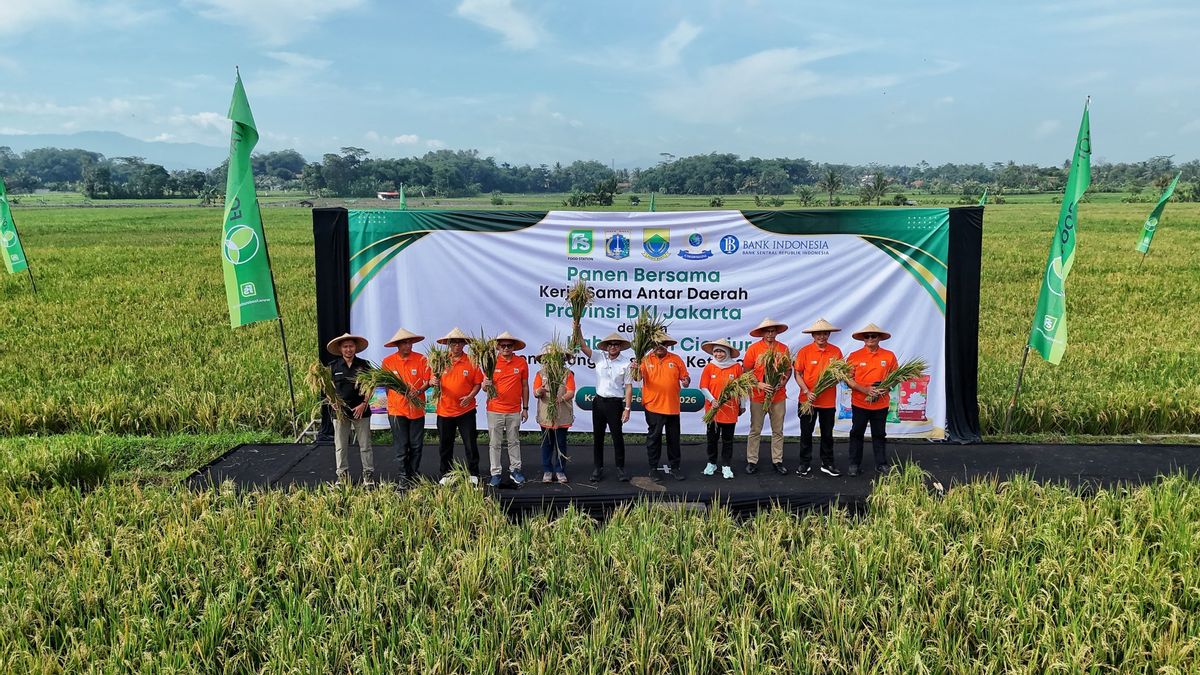


CIANJUR - Deputy Governor of DKI Jakarta Rano Karno attended a joint harvest in Sindang Jaya Village, Ciranjang District, Cianjur Regency, West Java. This activity is part of the inter-regional cooperation between the DKI Jakarta Provincial Government and the Cianjur Regency Government to maintain food supply while reducing the rate of inflation.
Rano emphasized that the cooperation was not just a ceremony, but a concrete step to maintain the stability of supply ahead of the religious holiday.
"This cooperation is born from a simple awareness that food security is not built with discourse, but with the courage to cooperate. We want the supply to be maintained and the price to remain reasonable, farmers to smile, and Jakarta residents to feel calm welcoming Ramadan, Chinese New Year, and other major days with sufficient food stocks," said Rano at Sindang Jaya Village, Cianjur, West Java, Thursday, February 12.
This cooperation refers to the Minister of Home Affairs Decree Number 22 of 2020 and has been initiated by the preparation of a joint agreement. Its implementation is carried out technically by the relevant regional devices.
Rano explained that the scheme used was a business to business (B2B) between the DKI BUMD, PT Food Station Tjipinang Jaya, and business partners in Cianjur. The scheme was strengthened by a government to government cooperation between the two regional governments.
"The follow-up to this cooperation is carried out through a business to business (B2B) scheme, namely between the DKI Jakarta Provincial BUMD, in this case PT Food Station Tjipinang Jaya, with business partners in Cianjur Regency. This scheme is also strengthened through government to government cooperation between the DKI Jakarta Provincial Government and the Cianjur Regency Government," he said.
In the initial phase, cooperation is focused on rice and rice commodities, including the use of agricultural laboratories for quality testing and breeding. This step is expected to ensure the quality of commodities before being marketed to Jakarta.
Rano explained the amount of food needs for the capital city every day. Jakarta needs about 2,700-3,000 tons of rice per day, 120 tons of chili, 65 tons of beef, and 750-800 tons of chicken meat per day.
According to him, Cianjur with its vast and fertile agricultural land has a strategic position to support these needs.
"I hope this cooperation will be a sustainable start. As long as I am in Jakarta and Bang Ramsi in Cianjur, let's use these four years to strengthen good relations. Jakarta may not have land, but has a large fiscal capacity. This large budget must be used to build a mutually beneficial collaboration," he said.
"We hope that this five-year agreement will become a solid basis for regional devices to gather and develop various cooperation potentials. With sustainable synergy, the needs of both parties can be optimally met and provide real benefits for the community," continued Rano.
Food Station President Director Tjipinang Jaya Dodot Tri Widodo said that this harvest was a follow-up to the cooperation with PT Tunas Bumi Emas Lestari since 2025. Of the total 150 hectares of land, about 100 hectares are planted with IR64 and Inpari 32 varieties, while the other 50 hectares are pandan fragrant.
Dodot quoted data from the Central Statistics Agency (BPS) which stated that Cianjur rice production reached around 630 thousand tons per year or equivalent to 315 thousand tons of rice, so that the area was in a surplus condition.
"Based on the data we read from the Central Statistics Agency (BPS), the production of rice in Cianjur reaches around 630 thousand tons per year or equivalent to 315 thousand tons of rice. This means that Cianjur Regency is in a surplus production condition. This surplus is expected to supply the needs of DKI Jakarta, considering the rice needs in the capital city are very large," explained Dodot.
However, he admitted that there were challenges in the dynamics of grain prices at the farmer level, which tended to increase, while the highest retail price (HET) remained.
"The government's purchase price for rice is at Rp. 6,500 per kilogram, while in the field it can reach around Rp. 6,800 per kilogram at the rice field level. If you add the transportation cost, the price can reach around Rp. 7,000 per kilogram. This is a challenge for us to maintain stability," he concluded.
The English, Chinese, Japanese, Arabic, and French versions are automatically generated by the AI. So there may still be inaccuracies in translating, please always see Indonesian as our main language. (system supported by DigitalSiber.id)


