
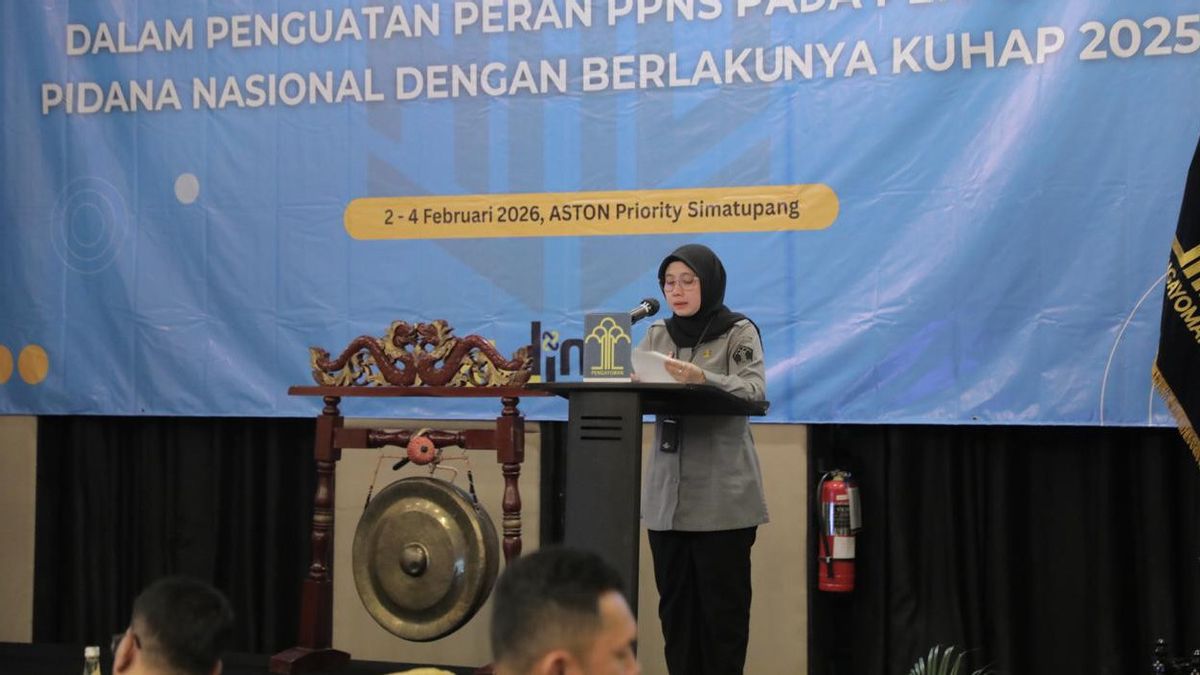


JAKARTA - The Directorate General of General Legal Administration (Ditjen AHU) of the Ministry of Law held a Regulation Drafting Activity in Strengthening the Role of Civil Servants Investigators (PPNS) in National Criminal Courts.
The activities on February 2-4 at the Aston Priority Simatupang Hotel, Jakarta, were held in response to the enactment of Law Number 20 of 2025 concerning the Code of Criminal Procedure (KUHAP 2025), which brought a number of new clarifications regarding the structure and mechanisms of investigations in the national criminal justice system.
In substance, this activity discusses the strengthening of the role and work system of the PPNS after the 2025 KUHAP, including the legal and technical implications of sectoral authority, coordination of investigations, and standard procedures for handling criminal cases.
The Secretary of the Directorate General of General Legal Administration (SesDitjen AHU) Andi Yulia Hertaty said the 2025 KUHAP provides a clearer normative legitimacy for the existence of PPNS as investigators who obtain direct authority from sectoral laws.
"KUHAP 2025 emphasizes that PPNS is not merely an addition or ad hoc, but a legitimate part of the national criminal justice system," said Yulia.
According to him, the confirmation of the National Police as the main investigator is also a binding norm to encourage cross-institutional coordination with uniform and accountable procedure standards.
Yulia emphasized that the strengthening of the PPNS in the future must be done systematically, not only through strengthening authority, but also reforming institutional governance and work systems.
"What is being built is an ecosystem that encourages effective coordination, consistency of procedures, and administrative order," he said.
He also highlighted the importance of improving the professionalism of PPNS through education, training, certification, and the updating of accurate and sustainable PPNS data.
Meanwhile, the Director of Criminal Affairs of the AHU, Romi Yudianto, explained that the 2025 Criminal Procedure Code divided investigators into three categories, namely the Police Investigator, PPNS, and the Designated Investigator, with the Police being designated as the main investigator for all criminal offenses.
"This provision closes the room for interpretation of the dualism of authority between the National Police and the PPNS. PPNS coordination with the National Police is now a legal obligation," said Romi.
He emphasized that the PPNS must coordinate from the beginning of the investigation until the submission of the case file to the Public Prosecutor, in order to ensure uniformity of due process in the criminal justice system.
"In practice, the BAP PPNS without coordination with the National Police is at risk of formal defects. Therefore, all PPNS actions must follow the 2025 KUHAP procedures," he continued.
Romi also conveyed that the Criminal Directorate of the Directorate General of AHU would discuss the revision of Government Regulation Number 58 of 2010 as a derivative rule of the Criminal Procedure Code which regulates the PPNS.
Through this activity, the Directorate General of AHU of the Ministry of Law and Human Rights targets the preparation of a study report as the basis for the preparation of the urgency draft and draft amendments to PP 58 of 2010, in order to realize a more professional, coordinated, and credible PPNS in supporting the national criminal justice system.
The English, Chinese, Japanese, Arabic, and French versions are automatically generated by the AI. So there may still be inaccuracies in translating, please always see Indonesian as our main language. (system supported by DigitalSiber.id)


