

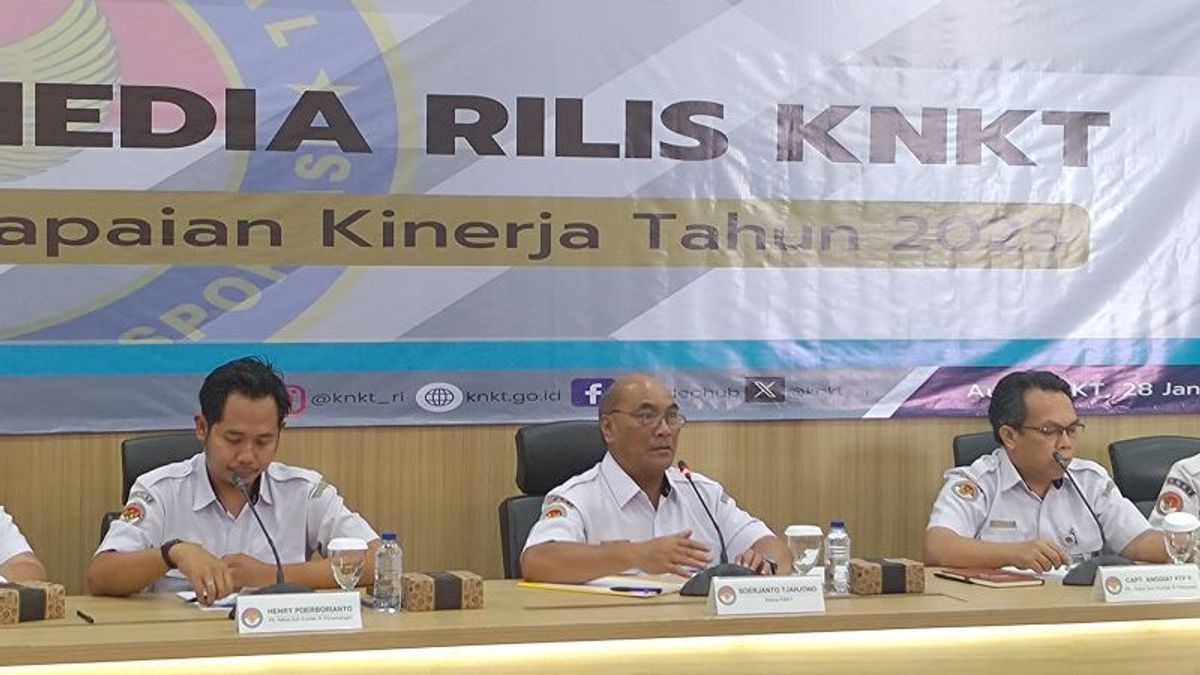


JAKARTA - The National Transportation Safety Committee (KNKT) notes that human factors are still the dominant cause of cross-mode transportation accidents investigated throughout 2025.
The findings are considered consistent in road accidents, shipping, and aviation, although the risk characteristics in each mode are different.
KNKT Chairman Soerjanto Tjahjono said that in many cases the biggest contribution to accidents still comes from human aspects, such as fatigue, negligence, and non-compliance with safety procedures.
"In many cases, human factors still make the biggest contribution, both related to fatigue, negligence, and non-compliance with safety procedures," Soerjanto said at the Media Release of the KNKT Performance Achievement 2025 in Jakarta, Antara, Wednesday, January 28.
In the road traffic and transportation mode, KNKT investigated nine accidents throughout 2025 with a total of 69 injured victims. In the results of the investigation, the failure of the braking system or widely known as the blong brake is still a recurring pattern in accidents of public transport vehicles and freight transport.
KNKT also assessed that supervision of vehicle conditions and fulfillment of safety administration had not been optimal, including the implementation of periodic vehicle suitability tests.
KNKT Road Traffic and Transportation Investigator Dwi Bakti Permana revealed that many accidents involve vehicles that are technically not roadworthy.
"We found vehicles that did not meet the periodic test, there were even test approval documents whose authenticity was questionable," said Dwi.
In the shipping sector, KNKT recorded eight accident investigations throughout 2025. The majority of these incidents fall into the category of serious accidents, such as sinking ships and burning ships. Another recurring finding is overdraft or overdraft and weak passenger registration in ship manifests.
Acting Head of the KNKT Marine Accident Investigation Subcommittee, Capt. Anggiat PTP Pandiangan, said that this condition significantly increases the risk of accidents, especially when the ship faces bad weather.
"When the load exceeds the safe limit and the stability of the ship is disturbed, the risk of accidents will increase sharply," he said.
Meanwhile, on the flight mode, KNKT recorded 19 investigations throughout 2025 consisting of nine accidents and 10 serious incidents. The most common type of incident is aircraft leaving the runway or runway excursion, which is a condition when the aircraft is unable to stop on the runway.
KNKT also identified crew fatigue and the non-optimal implementation of operational procedures as safety issues that still need serious attention.
Overall, throughout the period 2015-2025, KNKT has issued at least 1,481 cross-mode safety recommendations. These recommendations are dominated by control and supervision aspects, with the main goal of preventing similar accidents from recurring, not to find the fault of certain parties.
KNKT appeals to all transportation stakeholders, from operators, regulators, to local governments, to follow up on safety recommendations consistently.
"The KNKT investigation is oriented towards learning and prevention, so that the national transportation system is safer," said Soerjanto.
The English, Chinese, Japanese, Arabic, and French versions are automatically generated by the AI. So there may still be inaccuracies in translating, please always see Indonesian as our main language. (system supported by DigitalSiber.id)
Most Popular Tags
#Prabowo Subianto #donald trump #2026 World Cup #Febrie Adriansyah #8791Popular


