

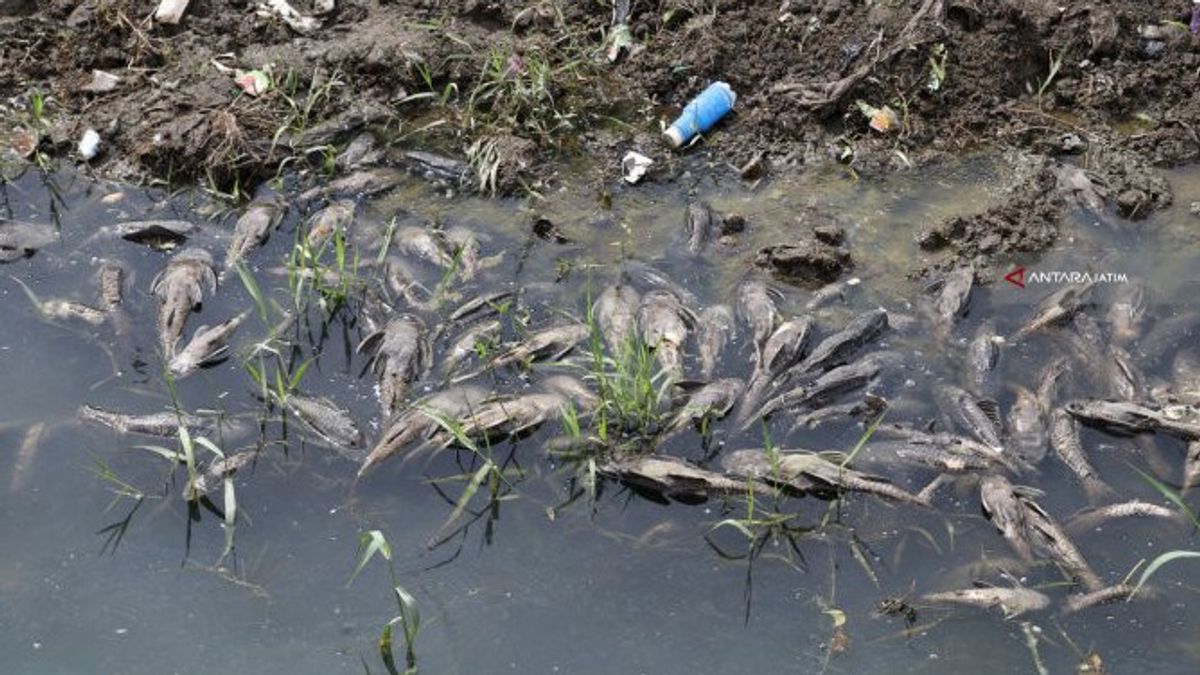


JAKARTA - The appearance of the mop fish in the Ciliwung River stream has again become a public concern. A number of residents were seen catching the fish to eat, even though the condition of the waters in the Jakarta area was known to be polluted.
Head of the DKI Jakarta Food, Marine, and Agriculture Agency (KPKP) Has Sidabalok emphasized that the fish caught in polluted rivers are not suitable for consumption because they are harmful to health.
"Wild catch fish such as sapu-sapu fish in polluted rivers usually do not go through a quality control and security system so that wild catch fish cannot be ensured to be safe to consume and do not meet food safety and quality standards," said Hasudungan in his statement, Tuesday, January 27.
He explained that most rivers in Jakarta are polluted with waste, including industrial waste. This condition makes wild fish that live in the waters have the potential to carry various dangerous substances.
Hasudungan refers to a number of studies that show fish from polluted rivers, such as the Ciliwung, can contain dangerous heavy metals.
"Based on existing research, it shows that fish from polluted rivers (e.g. Ciliwung) can contain various heavy metals such as arsenic (As), cadmium (Cd), lead (Pb), mercury (Hg), and others," said Hasudungan.
He added that heavy metals are cumulative in the body of fish and are at risk of causing health disorders if consumed regularly.
In addition to chemical contamination, fish that live in polluted waters also have the potential to carry biological contamination. Pathogenic bacteria and parasites can stick to fish and trigger digestive disorders to infections.
"On the contaminated occasion, the risk of contamination with dangerous heavy metal contaminants is very high and other contaminants such as E coli are dangerous if consumed," said Hasudungan.
Hasudungan also reminded of the potential for other contaminants such as pesticide residues, microplastics, and waste chemicals that can be absorbed by fish from polluted environments.
He emphasized that biologically, sapu-sapu fish can actually be consumed if they come from controlled and closely supervised cultivation. However, fish from contaminated open waters do not fall into this category.
"Sapu-sapu fish can be consumed biologically if it comes from controlled cultivation, not in polluted rivers or reservoirs. Even in this condition, it must still be accompanied by laboratory tests," he said.
In Indonesia, the safety of fish for consumption refers to the Indonesian national standard (SNI) which sets the maximum limit of heavy metal contaminants in fish meat. According to Hasudungan, wild fish from polluted rivers are difficult to ensure meet these standards.
Therefore, the DKI Jakarta Provincial Government appeals to the public not to consume fish caught from polluted rivers or waters, and to choose fish from supervised aquaculture sources to reduce health risks.
"The difference between wild catch fish and fish in cultivation in terms of aspects of water quality control, usually wild catch fish are not controlled, exposure to pollutants is higher, there is no food guarantee and there is a risk of bacteria/parasites because the implementation is not in accordance with the standard of good fish cultivation," he concluded.
The English, Chinese, Japanese, Arabic, and French versions are automatically generated by the AI. So there may still be inaccuracies in translating, please always see Indonesian as our main language. (system supported by DigitalSiber.id)
Most Popular Tags
#Prabowo Subianto #donald trump #2026 World Cup #venezuela #konflik timur tengahPopular


