
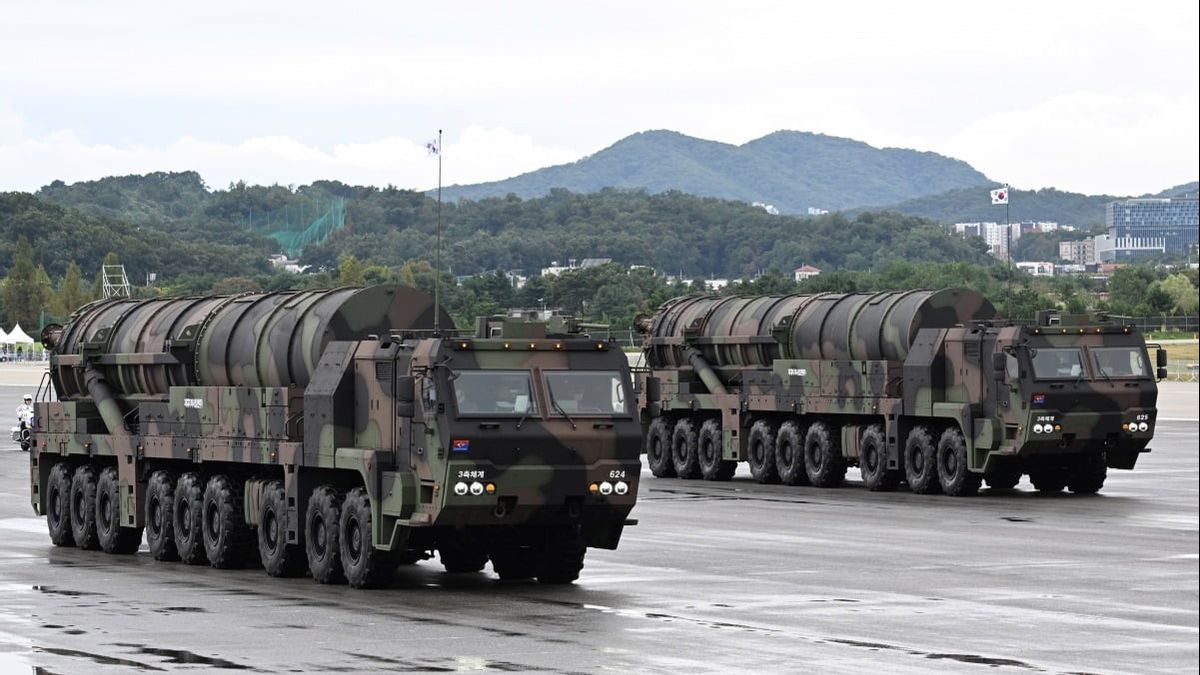


South Korea (South Korea) has begun moving a conventional ballistic missile dubbed the "monster" kara hulu with a large warhead, Hyunmoo-V, to a front-line unit, military officials said Sunday, a move that underscores efforts to strengthen deterrence against North Korea (North Korea).
The ground-to-ground missiles, which are capable of carrying a warhead of up to eight tons, began entering front-line units late last year and are expected to complete full operational deployment before the current administration ends in 2030, according to military officials. The missile, considered the Ginseng State's most powerful weapon to date, is designed to target deep underground facilities, including command bunkers believed to be used by North Korea's leadership and strategic forces.
Hyunmoo-V was unveiled publicly during South Korea's Armed Forces Day events in 2024 and 2025, drawing attention for its size and its potential for destruction amid rising regional security tensions.
Although the missile is very powerful, analysts warn against overestimating its ability to neutralize North Korea's most formidable underground sites.
Korea Defense Network Director Lee Il-woo said the Hyunmoo-V represents the most strategically significant missile ever deployed in South Korea's Hyunmoo series, but faces physical limitations.
"Hyunmoo-V carries a conventional warhead with very high explosive power, and by reducing its payload, its range can theoretically be extended to about 3,000 kilometers, some even compare it to an intercontinental class missile," Lee said, quoted by The Korea Times (19/1).
"In terms of power and strategic signals, this is the most powerful missile South Korea has ever deployed," he continued.
From North Korea's perspective, Lee said the missile poses a serious threat, especially because Pyongyang's missile interception capabilities are still limited.
"The possibility that North Korea has successfully intercepted Hyunmoo-5 seems very low," he said, citing the varied real-world performance of the Russian-made S-300 and S-400 air defense systems, which are similar to those operated by North Korea.
However, Lee said the effectiveness of the missile against the North Korean facility buried in must be viewed more carefully.
Many of Pyongyang's main underground installations are located more than 100 meters underground, often under the granite bedrock common on the Korean Peninsula.
"Even the most advanced conventional bunker-busting weapons have difficulty in granite terrain," Lee said.
He then pointed to the use of GBU-57 by the US, which is estimated to be able to penetrate about 60 meters in soft rocks such as sandstone, but still failed to completely neutralize underground facilities in Iran.
"North Korean facilities are deeper - often 100 to 150 meters - and built under much harsher geological conditions," he explained.
"As a result, it is unrealistic to say that conventional weapons alone, including the Hyunmoo-5, can completely destroy these facilities. Without nuclear weapons, total penetration is impossible," Lee added.
The South Korean military has promoted the Hyunmoo-5 as a central element of the Korean Massive Punishment and Retribution doctrine, or KMPR - one of the three pillars of the country's deterrence strategy against North Korea, along with the Kill Chain preemptive strike concept and the Korean Air and Missile Defense system.
Defense officials said the missile was intended not only for physical destruction but also for deterrence, by demonstrating South Korea's ability to inflict severe damage on strategic targets if attacked.
Seoul is also known to be developing next-generation high-powered missile systems, informally known as Hyunmoo-VI and Hyunmoo-VII, which are believed to have a longer range or better penetration capabilities.
The English, Chinese, Japanese, Arabic, and French versions are automatically generated by the AI. So there may still be inaccuracies in translating, please always see Indonesian as our main language. (system supported by DigitalSiber.id)
Most Popular Tags
#Prabowo Subianto #donald trump #2026 World Cup #venezuela #konflik timur tengahPopular


