
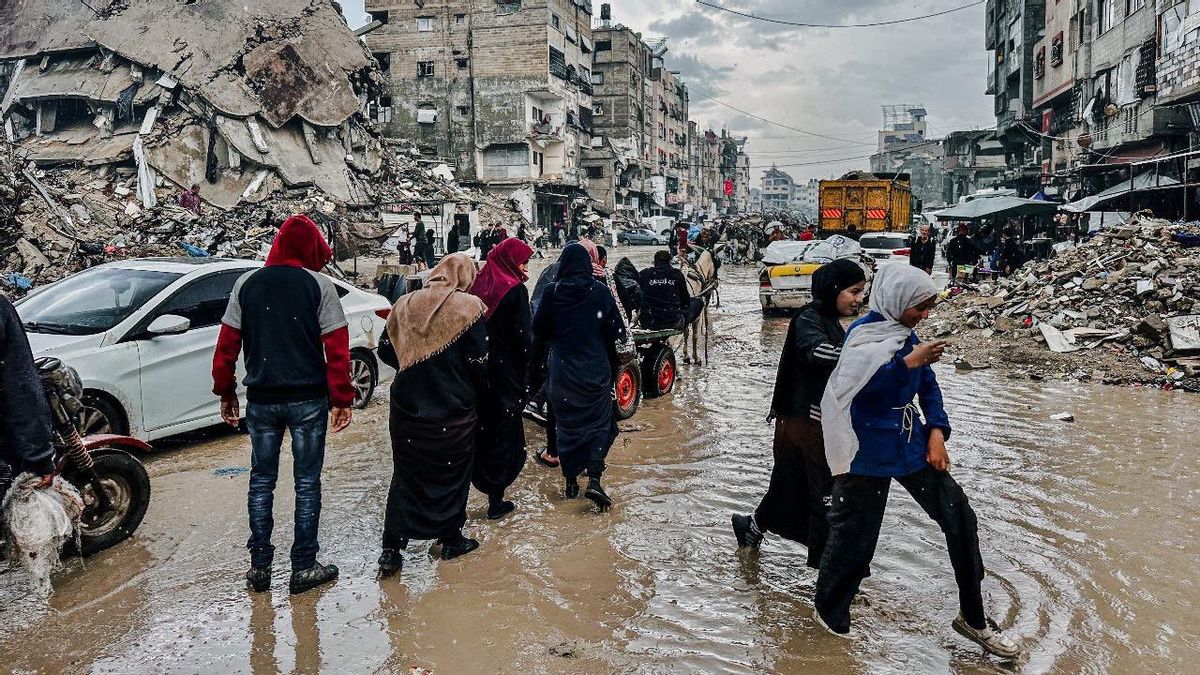


JAKARTA - The United Nations on Wednesday stressed that significant challenges still remain in the Gaza Strip even though Special Envoy of the President of the United States Donald Trump announced the start of the second phase of the ceasefire plan.
Asked about Steve Witkoff's recent announcement, UN spokesman Stephane Dujarric told a news conference, "we continue to urge all parties to abide by the commitments they made under the agreement."
"We see that in the last month, we have been able to do as much as we can to provide much-needed humanitarian assistance," he said, launching Anadolu (15/1).
Underlining the challenges despite the ceasefire, Dujarric said: "There are still many obstacles, as we talk about every day in the humanitarian field. And the humanitarian needs continue to be great."
He also urged all parties to "seize" the "opportunity" and "establish a credible political track, leading to a two-state solution."
Responding to Anadolu's question about Witkoff's post saying "phase one, a historic humanitarian relief has been provided," Dujarric said: "The United Nations is able to provide humanitarian assistance in large quantities, but it is not enough."
"I think we have addressed all the ongoing obstacles and challenges," he said, stressing that the UN cannot "give as much as we want, but I think we have given as much as we can, given all the challenges that still exist."
Separately, the Palestinian media WAFA reported Wednesday, the death toll from Israeli aggression in October 2023 has reached 71,439 people, while the number of injured reached 171,324 people.
Medical sources said that since the October 10 ceasefire agreement, Palestinian casualties have reached 449, 1,246 people have been injured and 710 bodies have been found. Israel is known to continue to attack Gaza during the ceasefire, claiming to target Palestinian militant groups.
Israel also refused to reopen the Gaza crossings despite a UN Security Council resolution adopted in November 2025 calling for a permanent and comprehensive ceasefire in the region, the unhindered delivery of humanitarian aid and the reconstruction of the region.
Citing the Office for the Coordination of Humanitarian Affairs (OCHA), Dujarric warned that "the insecurity in Gaza, and that includes aerial attacks, shootings, and armed clashes, is increasing, causing civilian casualties."
"Last week saw the highest number of incidents resulting in casualties since the ceasefire was implemented, with more than 300 incidents reported," he said.
Dujarric reiterated that under international humanitarian law, civilians and civilian infrastructure must be protected "at all times."
He added that UN partners on the ground "continue to provide shelter assistance to people in need" throughout the region.
The English, Chinese, Japanese, Arabic, and French versions are automatically generated by the AI. So there may still be inaccuracies in translating, please always see Indonesian as our main language. (system supported by DigitalSiber.id)
Most Popular Tags
#Prabowo Subianto #donald trump #Febrie Adriansyah #8791 #giias 2026Popular


