

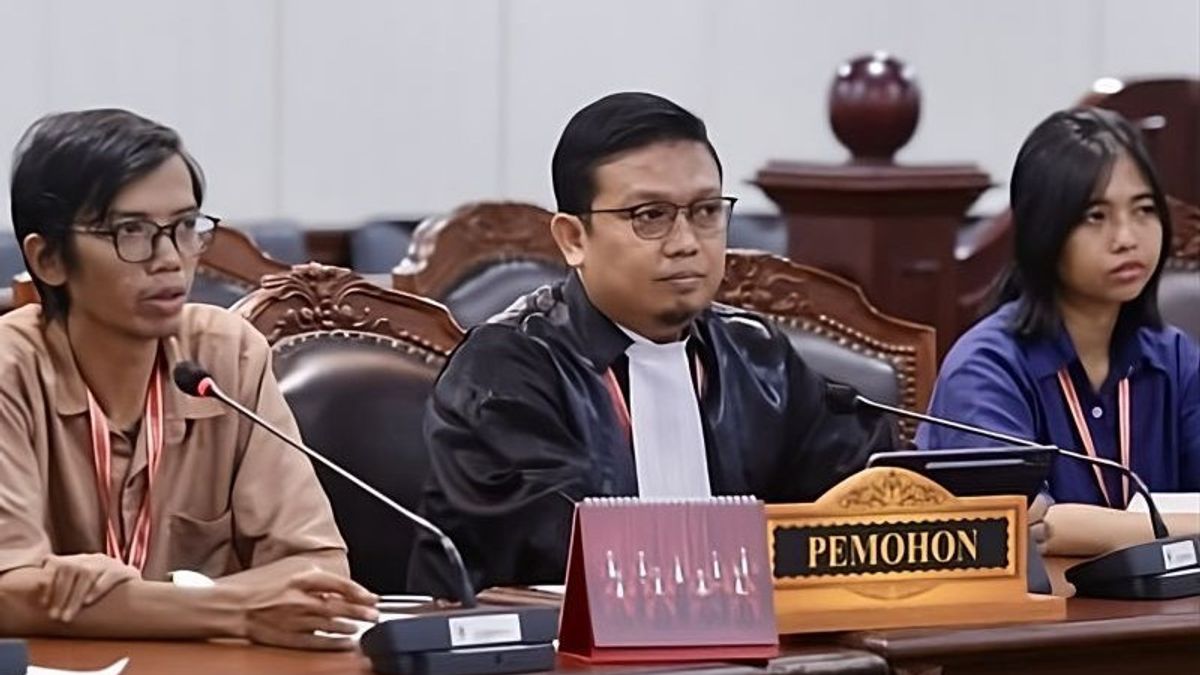


JAKARTA - Online motorcycle taxi (ojol) driver Didi Supandi and online culinary trader Wahyu Triana Sari are testing Law Number 6 of 2023 concerning Cipta Kerja to the Constitutional Court (MK) because they feel disadvantaged due to the internet quota being burned before it is used up.
Both of them are testing Article 71 paragraph 2 of the Job Creation Law which is a change to Article 28 of Law Number 36 of 1999 concerning Telecommunications. This article regulates the rates for the provision of telecommunications.
"The provisions of the norm of Article 71 paragraph 2 of the Job Creation Law have given operators a blank check to establish a burnt quota scheme without any accumulation obligation to consumers," said Didi in the first hearing in Jakarta, Tuesday, January 13, reported by ANTARA.
In front of the panel session chaired by Deputy Chairman of the Constitutional Court Saldi Isra, Didi said he suffered actual losses due to the policy of unilaterally removing quotas from telecommunications network providers.
In fact, said Didi, the internet quota is his main production tool as an online motorcycle taxi driver, equivalent to vehicle fuel. Without quotas, the motorcycle taxi application cannot function so that he loses access to work.
"I often experience a large quota left because the work area has fluctuating signals or when it is quiet (orders) so that I often have to experience the quota being burned before it is used up," he said.
Didi said that this condition forced him to seek money loans to buy internet quotas if the order was quiet or was forced not to work because the internet quota had been burned and not accumulated.
"So if I want to extend the active period of the quota with the limitations of the money I have with the small quota, it makes me not enough to use the online application for work," he said.
Article 71 paragraph 2 of the Manpower Creation Law contains two points, the first: The amount of the tariff for the implementation of telecommunications networks and/or the provision of telecommunications services is determined by the telecommunications network operator and/or telecommunications service provider based on the formula set by the central government.
Then, the second point: The central government can set upper limit tariffs and/or lower limit tariffs for the provision of telecommunications, taking into account the interests of the public and healthy business competition.
The applicant's lawyer, Viktor Santoso Tandiasa, said that the article contains a multi-interpretable norm and has no limiting parameters, thus giving operators absolute freedom to mix between service rates and ownership duration.
"This creates legal uncertainty for telecommunications service users as consumers because they never know for sure why data commodities that have been paid for can be lost just because of the unilaterally determined variable time," said Viktor.
Article 71 paragraph 2 of the Employment Creation Law is also considered to create injustice. The applicants reasoned that the article allows operators as telecommunications service providers to receive full payment in advance, but the rights of users or consumers can be forcibly terminated.
On this basis, the applicants asked the Constitutional Court to declare Article 71 paragraph 2 of the Employment Creation Law to be in conflict with the constitution and not to have binding legal force as long as it is not interpreted as:
"The determination of tariffs and schemes for the provision of telecommunications services must provide guarantees for the accumulation of data quota (datarollover) that has been paid by consumers".
During the judge's advice session, Constitutional Justice Arsul Sani said the applicants could compare telecommunications regulations in various countries in the world.
"This is important so that the Court can also get an overview of how to regulate expired pulses that have not been used, especially for prepaid users," he said.
The application of Didi and Wahyu Triana Sari is recorded with case number 273/PUU-XXIII/2025. After the first hearing on Tuesday, the panel of judges gave the two 14 days to complete the application.
The English, Chinese, Japanese, Arabic, and French versions are automatically generated by the AI. So there may still be inaccuracies in translating, please always see Indonesian as our main language. (system supported by DigitalSiber.id)
Most Popular Tags
#Prabowo Subianto #donald trump #firearm #8791 #giias 2026Popular


