

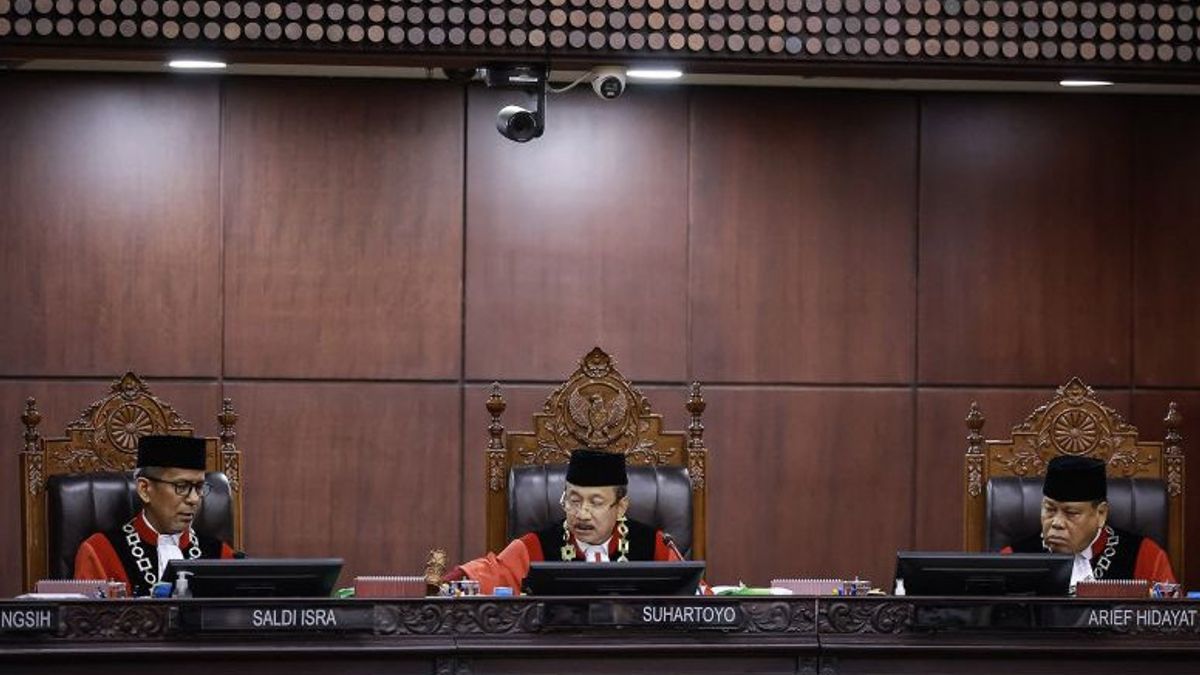


JAKARTA - The Constitutional Court (MK) is asked to provide clear limits regarding the right to grant amnesty and abolition by the President as regulated in Article 1 of the Emergency Law Number 11 of 1954 concerning Amnesty and Abolition.
The application was submitted by students of the Faculty of Law at Muhammadiyah University of Bima, namely Sahdan, Abdul Majid, Moh. Abied, and Rizcy Pratama, through the case of testing law number 262/PUU-XXIII/2025.
"The applicants believe that this article is contrary to Article 1 paragraph (3), Article 28D paragraph (1), and Article 27 paragraph (1) of the Constitution of the Republic of Indonesia in 1945," quoted from the official MK website as reported by ANTARA, Friday, January 9.
Article 1 of the Amnesty and Abolishment Law states, "The President in the interest of the state may grant amnesty and abolition to persons who have committed a criminal act. The President grants this amnesty and abolition after receiving a written advice from the Supreme Court which conveys the advice at the request of the Minister of Justice."
The applicants acknowledge that the granting of amnesty, abolition, rehabilitation, and clemency by the President is the constitutional prerogative of the head of state, as stipulated in Article 14 of the 1945 Constitution.
However, according to them, the pardon or restoration of these rights raises problems in the form of actions that have the potential to expand the meaning of the norms of Article 1 of the Amnesty and Abolition Law.
Therefore, the applicants believe that the President must consider the opinion of the House of Representatives (DPR) in issuing the pardon. This is a form of check and balances so that there is no practice of arbitrariness.
In addition, the applicants also want a limit on amnesty and abolition can only be given for cases whose decisions have been inkrah. They want this regulation to be written clearly in the article norm.
Therefore, in the main request, the applicants asked the Court to interpret Article 1 of the Amnesty and Abolishment Law as follows:
"The President in the interest of the country can grant amnesty and abolition to people who have committed a criminal act whose verdict has become final and binding (inkracht van gewijsde). The President granting amnesty and abolition must really take into account the considerations of the Supreme Court and the DPR."
The applicants' petition has been rolling at the Constitutional Court after the first hearing was held on Thursday (8/1). During the trial, the panel of judges gave 14 days for the applicants to complete their petition files.
The English, Chinese, Japanese, Arabic, and French versions are automatically generated by the AI. So there may still be inaccuracies in translating, please always see Indonesian as our main language. (system supported by DigitalSiber.id)
Popular


