

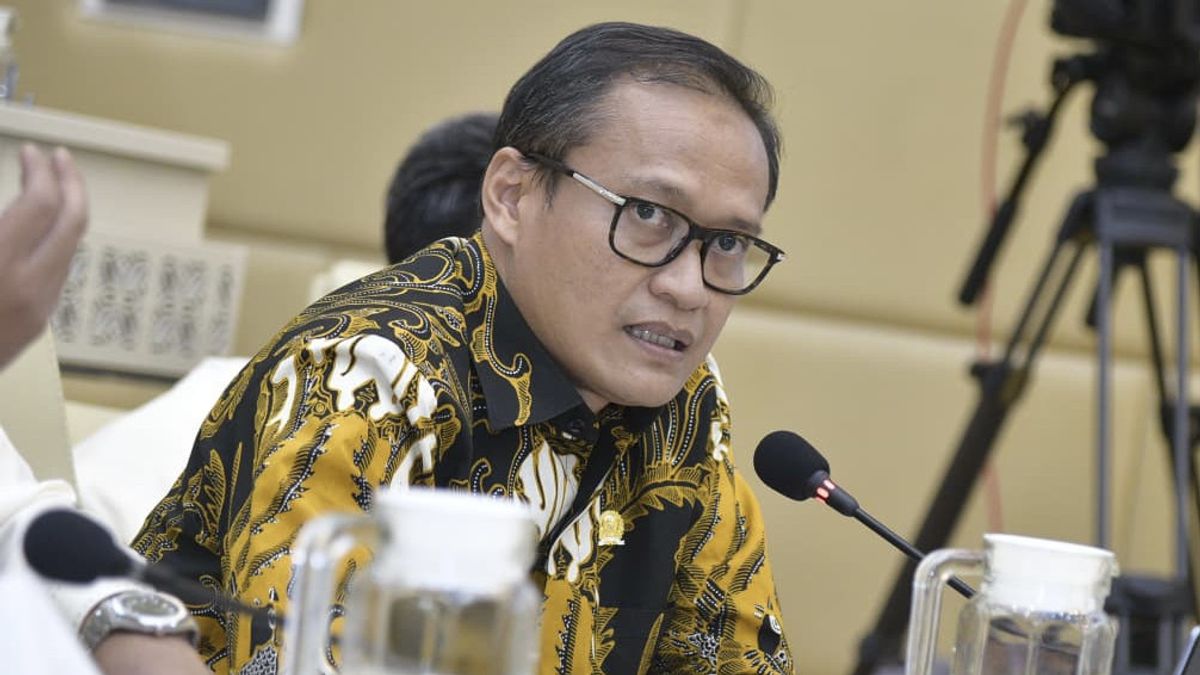


Member of Commission II of the DPR Azis Subekti responded to the debate regarding the mechanism for the election of regional heads that has resurfaced. According to him, the Pilkada discourse through the DPRD needs to be considered, because it is not only questioning the problem of democracy regression but the courage to correct the system.
"This discourse is often simplified as a tug-of-war between democracy and political regression, but the real issue is not in the romance of the form of democracy, but in the courage to read reality and correct the system so that it continues to work for the people," said Azis in his statement, Wednesday, December 31.
Azis said that the Indonesian constitution from the beginning was not designed as a rigid text. The 1945 Constitution provides room for interpretation for democratic practices that develop according to community needs.
"Therefore, implementing the constitution does not mean maintaining one model dogmatically, but ensuring that its values of people's sovereignty, justice, and public welfare are maintained in actual practice," he said.
Azis revealed that the direct Pilkada has been an important breakthrough to bring the people closer to their leaders. However, two decades have passed, there are structural problems that cannot be ignored.
"The very high cost of politics has encouraged competition based on capital, not ideas. In many areas, candidates for regional heads must spend far beyond their official income capacity," he said.
"The consequences are clear: transactional practices before and after the election, policies that are full of interests, to regional heads who face legal problems," continued the Gerindra Legislator from the Central Java VI District.
Azis assessed that democracy in this condition risks losing its substantive meaning. According to him, people's participation is indeed present in the voting booth, but political decisions are often determined by the power of money and power networks.
"The dispute over the results of the local elections, horizontal conflicts at the local level, and social polarization are recurring phenomena that drain the energy of the community without always being followed by improvements in the quality of public services," he said.
Therefore, Azis said, democracy needs to be interpreted more progressively. Democracy is not merely a voting procedure, but an instrument to produce leadership that is integral and capable of working.
"When a mechanism actually produces systemic bad incentives, evaluation is not a form of denial of democracy, but an effort to save it," he said.
"A nation that wants to grow quickly and firmly must dare to reflect. Indonesian political history shows that system correction is not a taboo. We have changed the presidential election mechanism, revised the design of regional autonomy, and rearranged various state institutions for effectiveness and accountability. Rethinking direct elections should be placed in the same framework: improve, not regress," continued Azis.
The member of the commission which deals with domestic governance said the election of regional heads through the DPRD is one of the constitutional options that should be considered rationally. He emphasized that the DPRD is a representative institution that was born from the mandate of the people and works in a relatively more supervised political space.
"With a transparent design, open public testing, measurable delivery of vision-mission, track record of candidates that can be tested, and media supervision, this mechanism has the potential to reduce political costs and move the competition from the arena of mobilizing money to the arena of ideas and leadership capacity," he said.
For example, said Azis, candidates for regional heads are no longer required to finance expensive mass campaigns, but must convince representatives of the people and the public with concrete programs.
"How to improve health services, manage regional budgets, or create jobs. If it deviates, the DPRD and the public have a clearer political basis to demand accountability," he said.
"Of course, no system is completely sterile from transaction risks. But democracy is not about eliminating risks absolutely, but rather choosing the most rational and most controllable design. Concentrated transactions are easier to control than widespread and difficult to track transactional practices," he continued.
In the end, continued Azis, what must be guarded is the substance of democracy itself, namely to present a stable, responsible, and pro-people regional leadership.
"The debate on the regional election should not be trapped in polarization, but should be directed at one fundamental question: which system is most likely to work honestly and effectively in today's Indonesian context. If the question is answered with a cool head and political courage, democracy will actually grow more mature," he concluded.
The English, Chinese, Japanese, Arabic, and French versions are automatically generated by the AI. So there may still be inaccuracies in translating, please always see Indonesian as our main language. (system supported by DigitalSiber.id)
Most Popular Tags
#Prabowo Subianto #donald trump #2026 World Cup #venezuela #konflik timur tengahPopular


