
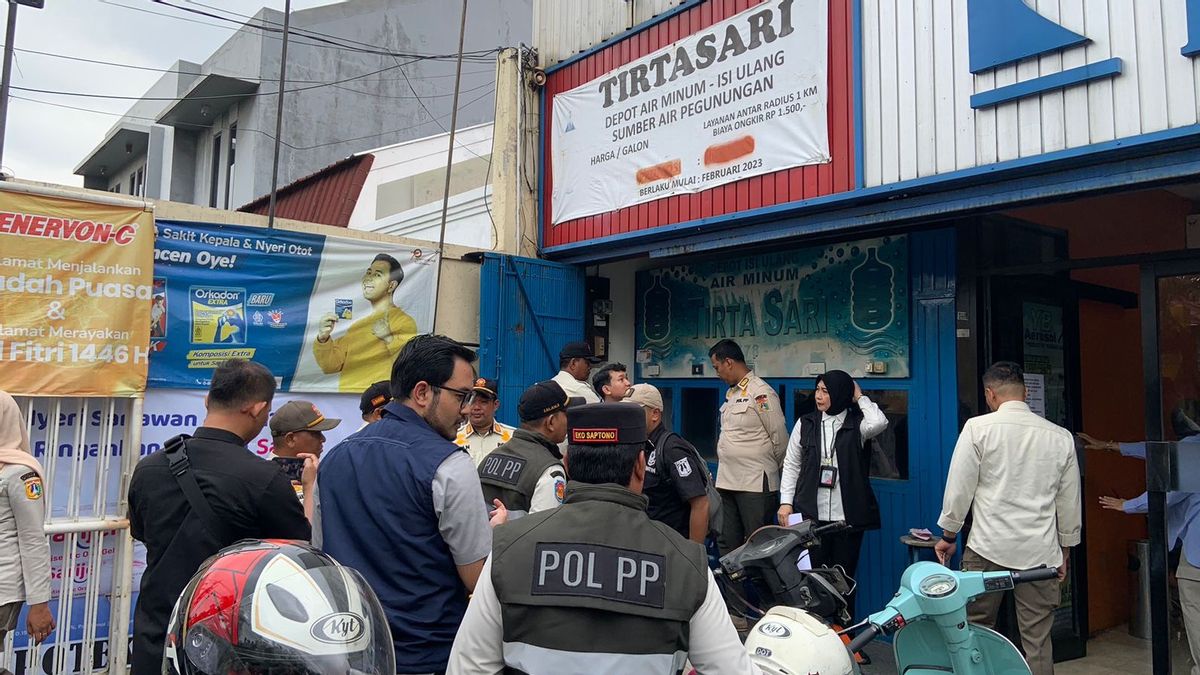


JAKARTA - Following up on public complaints and the results of integrated supervision across agencies, the DKI Jakarta Provincial Police Unit (Satpol PP) closed and sealed a number of drinking water refill depots (DAMIU) in Central Jakarta and East Jakarta on December 23-24, 2025. This crackdown is part of efforts to protect public health and enforce health-based business rules, especially towards the end of the year.
The closure was carried out after the joint team found that the drinking water depots that were inspected did not meet the licensing provisions and drinking water quality standards. Based on the results of the study and inspection of the DKI Jakarta Provincial Regional Health Laboratory (Labkesda), the water produced by DAMIU was detected to contain Escherichia coli (E. coli) bacteria and total coliform above the safe threshold.
Deputy Head of the DKI Jakarta Provincial Satpol PP, Drs. Moh. Rizki Adhari Jusal, S.H., M.Si., explained that the action was taken after considering public health aspects.
"Today is the closure and sealing of the water depot for refillable drinking water that does not meet the requirements, because based on the study of the Health Service team, the water still contains E. coli bacteria and the level of hygiene is low. So there needs to be a temporary closure until the requirements are met," he said.
In addition to water quality issues, licensing violations were also the main findings in the operation. Rizki revealed that a number of DAMIU did not have the basic legality required by regulations.
"Several refillable drinking water depots were found that did not have a Business Registration Number, did not have a Certificate of Public Hygiene and Sanitation, and did not have a food hygiene and sanitation training certificate. DAMIU-DAMIU, which consists of six points, must be taken action based on applicable regional regulations," he said.
Previously, the Head of the Supervision and Control of Business Places of the Satpol PP of the DKI Jakarta Province, Eko Saptono, also emphasized that this enforcement operation was a direct response to reports and public unrest.
"Today's apple is to answer complaints from the community regarding permits and also water depots that do not meet health standards," he said at the opening of the activity.
Structural Problems in the DAMIU SectorThe enforcement in Central Jakarta and East Jakarta reflects the wider problem in the bottled drinking water depot sector. Data from the DKI Jakarta Health Office shows that of the thousands of DAMIU operating in the capital, only a small number have obtained the Certificate of Hygiene and Sanitation (SLHS), although the certificate is a key requirement for water providers.
A similar situation also occurs nationally. Until April 2024, of the 78,378 drinking water depots registered in Indonesia, only 1,755 depots or about 2.2 percent have had SLHS. This low level of compliance indicates that the implementation of basic health standards in the bottled water sector is still weak.
In terms of water quality, the findings are in line with various studies. The 2023 Household Drinking Water Quality Survey (SKAMRT) of the Ministry of Health noted that about 45 percent of bottled drinking water in Indonesia was detected to contain E. coli bacteria, which is a major indicator of fecal contamination and health risks.
Branded Galon and Deviated Business PracticesIn addition to water quality and licensing, field supervision also often finds the practice of using branded gallons by DAMIU. This practice is not in accordance with the Decree of the Minister of Industry and Trade Number 651/MPP/Kep/10/2004, which stipulates that the depot of drinking water for refill is only allowed to use plain gallons without a brand.
The use of branded gallons has the potential to mislead consumers because it gives the impression that the water sold comes from the official producer of bottled drinking water. In the field, DAMIU is still found to exchange or lend branded gallons to consumers, as well as store ready-to-sell water stocks in branded gallons, which is contrary to technical provisions and consumer protection principles.
Legal Basis of ClosureThe action to close DAMIU by the DKI Jakarta Provincial Satpol PP was based on a number of regulations, including the DKI Jakarta Provincial Regulation Number 4 of 2009 concerning the Regional Health System, Regional Regulation Number 8 of 2007 concerning Public Order, and the Decree of the Minister of Industry and Trade Number 651/MPP/Kep/10/2004 concerning the Technical Requirements of Drinking Water Depots and Trade. These regulations emphasize that every DAMIU must have an Entrepreneur Identification Number (NIB), SLHS, and ensure that the quality of the water produced meets the quality standards of health.
Consumer Protection and Public AwarenessThis regulation is emphasized not as a form of business restriction, but as a step to protect consumers from health risks. UNICEF notes that diarrhea is still among the top three causes of death in toddlers, and poor drinking water quality is one of the risk factors.
Satpol PP DKI Jakarta Province appeals to DAMIU business actors to immediately complete licensing, conduct periodic water quality tests, and implement standards for the cleanliness of equipment and operator personal hygiene. Meanwhile, the public is expected to be more careful in choosing drinking water sources by ensuring that the depot has a clear permit and routinely conducts laboratory tests.
Consistent enforcement of rules, supported by critical public participation, is key to ensuring public access to safe, decent, and health-responsible drinking water.
The English, Chinese, Japanese, Arabic, and French versions are automatically generated by the AI. So there may still be inaccuracies in translating, please always see Indonesian as our main language. (system supported by DigitalSiber.id)


