

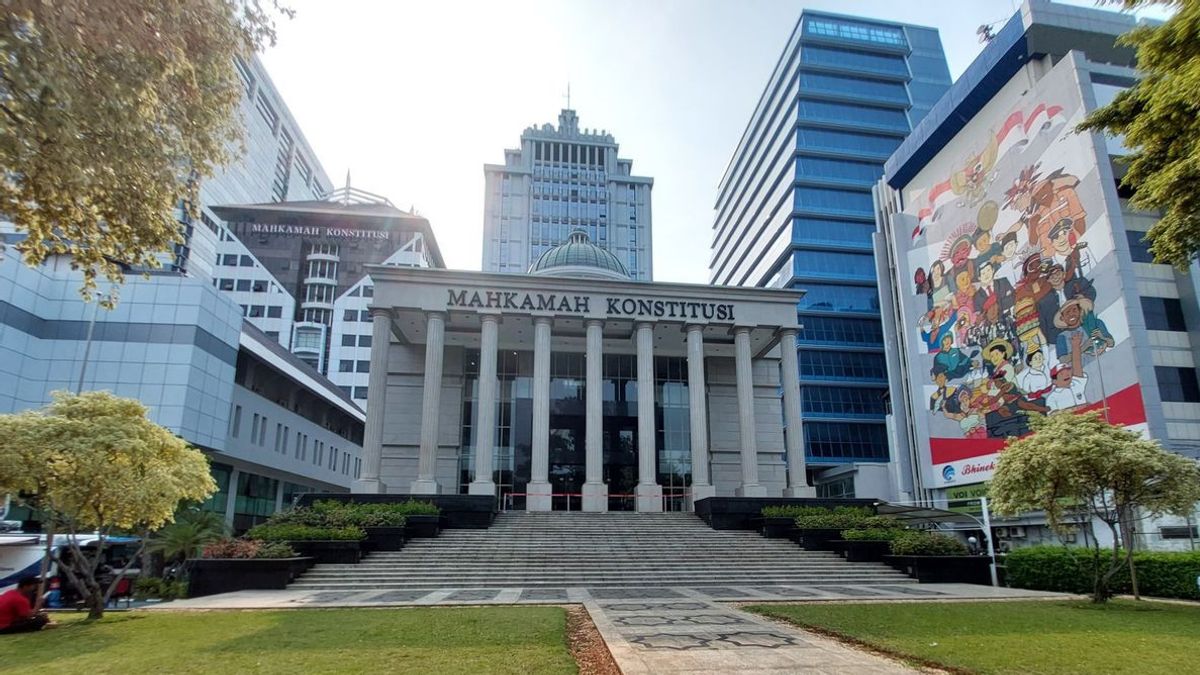


JAKARTA - The Constitutional Court (MK) has confirmed that royalties in a commercial performance must be paid by the organizer of the performance, instead of the singer or performer.
The Constitutional Court in this case granted the request of musician Tubagus Arman Maulana (Armand Maulana), Nazril Irham (Ariel NOAH), and 27 other musicians and singers in the trial of the material of Law Number 28 of 2014 concerning Copyright.
The Chairman of the Constitutional Court, Suhartoyo, while reading the verdict on Case No. 28/PUU-XXIII/2025, stated that the phrase "every person" in the norm of Article 23 paragraph (5) of the Copyright Law must be interpreted as "including commercial performance organizers".
"Declaring the phrase 'every person' in the norm of Article 23 paragraph (5) of Law 28/2014 is contrary to the Constitution of the Republic of Indonesia in 1945 and does not have binding legal force conditionally as long as it is not interpreted as 'including commercial performance organizers'," he said. reported by ANTARA, Wednesday, December 17.
The article previously read, "Everyone can use the creation commercially in a performance without asking the creator for permission in advance by paying the creator a reward through the Collective Management Agency (LMK)."
The court stated that the issue so far is who should pay royalties to the creator or copyright holder through LMK when a work of authorship is used in a commercial performance.
In response to this, Constitutional Justice Enny Nurbaningsih, while reading the legal considerations, said that a performance could at least be held with the existence of the organizer and the performer.
He explained that the organizer of the show is the party who designs, manages, and carries out the show from the beginning to the end, while the performer of the show is a person or group of people who use a creation in a show in front of the audience.
According to the Constitutional Court, if associated with a literal understanding, the phrase "every person" in Article 23 paragraph (5) of the Copyright Law could refer to anyone who makes a performance possible.
With this understanding, said Enny, the phrase has the potential to cause multi-interpretations and legal uncertainty regarding the party who is obliged to pay royalties to the creator or copyright holder through LMK.
The value of the profit of a performance that is held commercially is determined by the number of ticket sales for the performance. The MK assesses that the party who knows in detail the number of ticket sales in a performance is the organizer of the performance itself.
"Therefore, according to the Court, the party who should pay royalties to the creator or copyright holder through the LMK when the creation is used in a commercial performance is the party who organizes the performance," said Enny.
The English, Chinese, Japanese, Arabic, and French versions are automatically generated by the AI. So there may still be inaccuracies in translating, please always see Indonesian as our main language. (system supported by DigitalSiber.id)
Most Popular Tags
#Prabowo Subianto #donald trump #Febrie Adriansyah #8791 #giias 2026Popular


