
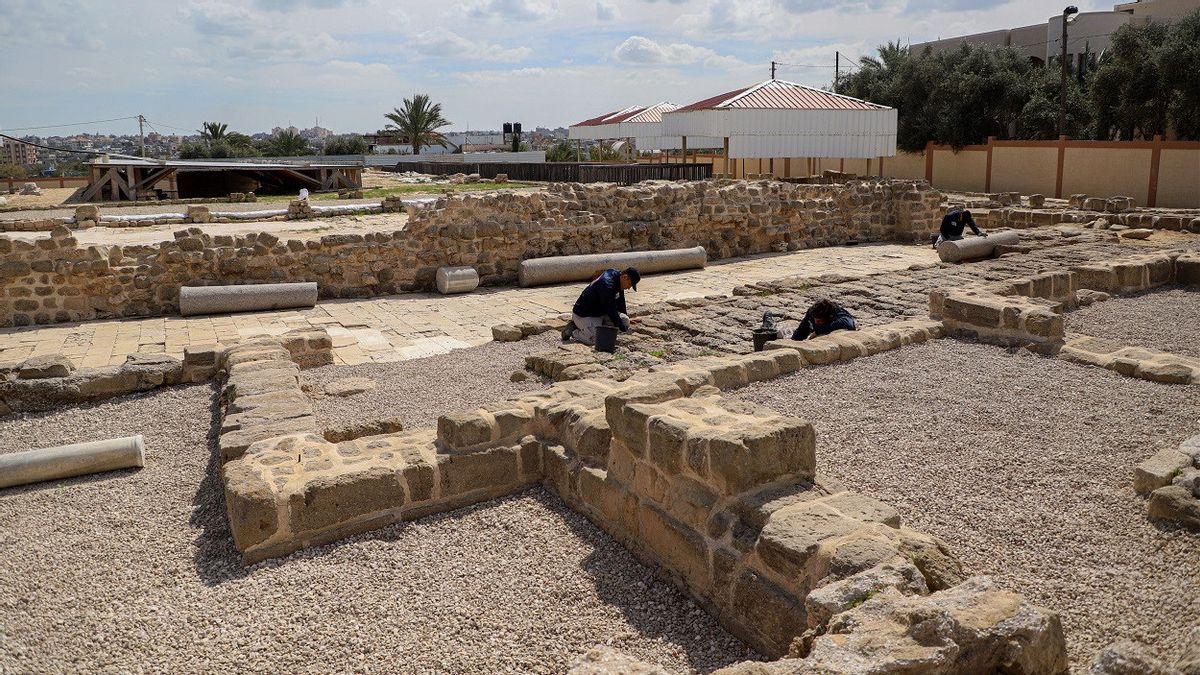


JAKARTA - Gaza's historical and cultural heritage did not escape Israeli airstrikes, with more than 20,000 rare artifacts, from prehistoric to Ottoman, lost and looted eras.
"The Israeli army has systematically and extensively destroyed Gaza's archaeological sites as part of a policy aimed at removing Palestinian identities," Ismail al-Thawabteh, head of the Gaza Government Media Office, told Anadolu Agency, as quoted December 1.
Official data shows that Israeli forces have partially destroyed or throughout more than 316 archaeological sites and buildings in the Gaza Strip, mostly from the Mamluk and Ottoman eras, while others date back to the early centuries of Islam and the Byzantine period.
Qasr al-Basha, the Mamluk-era palace built on the UNESCO heritage site dating back to 800 BC, did not escape Israel's systematic attacks on Gaza's history.
Located in the Al-Daraj neighborhood of the Old Town of Gaza, 70 percent of the Qasr al-Basha Palace was damaged by Israeli attacks, according to Hamouda al-Dahdar, a cultural heritage expert at the Center for Cultural Heritage Preservation in Bethlehem, the occupied West Bank.
The technicians and workers continue to search for artifacts strewn under the rubble, using simple equipment to restore and preserve the remains of Gaza's historical identity.
"What happened to Gaza's legacy is not just destruction; it was organized looting, a practice criminalized under international law and considered an attack on global cultural heritage," al-Thawabteh said.
He added that more than 20,000 rare artifacts from prehistoric to Ottoman periods stored in the museum had been lost during Israel's war.
Dahadar also confirmed the disappearance of thousands of rare and diverse artifacts after Israeli forces stormed and destroyed the site.
"Each part of this artifact has significant historical value and represents a chapter in the history of Palestinian civilization," said Dahdar, calling the looting a "serious cultural crime affecting national identity and human heritage."
Dahadar noted that the site had previously suffered severe damage during Israel's previous military operations prior to its 1994 withdrawal.
SEE ALSO:
-
 | BERITA
Indonesia Bersama Negara Arab-Islam Kritik Pembukaan Satu Arah Penyeberangan Rafah
06 Desember 2025, 13:37 -
 | BERITA
Hamas Tidak Ingin Memerintah Gaza, Setujui Pembentukan Badan Teknokratis
06 Desember 2025, 05:00 -
 | BERITA
Kantor HAM PBB Desak Tekanan Internasional Terhadap Israel untuk Akhiri Serangan di Gaza
06 Desember 2025, 04:00 -
 | BERITA
Kedutaan Besar Palestina di London Dirusak Demonstran Bertopeng Pro-Israel
05 Desember 2025, 21:30 -
 | BERITA
Abstain di Voting Resolusi Pemulangan Anak-anak Ukraina, Indonesia Soroti Sejumlah Hal
05 Desember 2025, 20:00
After Israel's withdrawal, the Palestinian Authority restored the palace and turned it into a museum showing off its valuable historical collection.
Israel occupied the Gaza Strip in 1967 and withdrew in 1994 under the 1993 Oslo Agreement with the umbrella of the Palestine Liberation Organization (PLO). In 2005, Israel dismantled its settlements in Gaza based on its unilateral "release Plan".
Most recently, during the last war which began in October 2023, the palace suffered destruction and looting of its archaeological objects.
The English, Chinese, Japanese, Arabic, and French versions are automatically generated by the AI. So there may still be inaccuracies in translating, please always see Indonesian as our main language. (system supported by DigitalSiber.id)
Most Popular Tags
#Prabowo Subianto #donald trump #2026 World Cup #Febrie Adriansyah #8791Popular


