

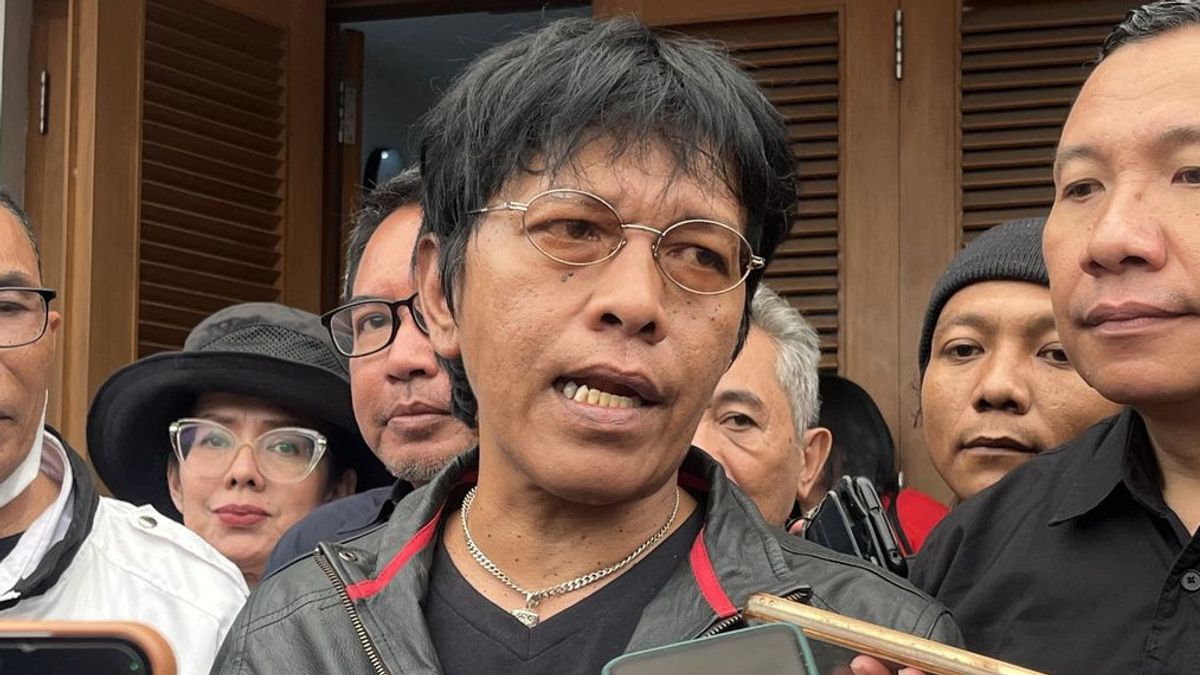


JAKARTA - Deputy Chairman of the House of Representatives' Public Aspirations Agency from the PDIP faction, Adian Napitupulu, revealed data comparing imports of thrifting goods and imports of Chinese products. He also wanted to invite Minister of Finance Purbaya Yudhi Sadewa to discuss thrifting, which the Ministry of Finance and the Ministry of Trade are attempting to crack down on because it is considered illegal and detrimental to MSMEs.
Adian presented the data and invitation during a hearing (RDP) with thrifting traders in the DPR BAM room, Nusantara II Building, Parliament Complex, Senayan, Jakarta, on Wednesday, November 19.
Adian first explained why thrifting is popular among millennials and Gen Z. According to him, this is simply because they care about the environment, where a single thrifted product can save thousands of tons of clean water.
"Likely, on November 12th, I WhatsApped Mr. Purbaya and invited him to discuss thrifting. Why? Global research shows that 67 percent of millennials and Gen Z like thrifting. The survey then explained why millennials and Gen Z like thrifting: Because it's cheap? No. Because it's good? Yes. And the most dominant reason is a shift in perspective that may not have existed in previous generations. That when they buy thrifted clothes, are they making an effort to conserve clean water? This is our data," said Adian at the House of Representatives Building on Wednesday, November 19th.
Adian explained the clean water needs of the textile industry. He said that one pair of jeans requires 3,781 liters, one cotton t-shirt requires 2,700 liters, or the equivalent of 2.5 years of drinking water for one person, and one laborer's shirt requires 2,700 liters.
"So, if the research shows that 67 percent of millennials like thrifting, this is one of the reasons. This means that thrifting cannot be viewed as simply as Mr. Purbaya suggests," he said.
Adian then revealed that thrifting imports aren't unique to Indonesia. In 2021, the United States imported thrifting worth IDR 2.19 trillion. "Come on, Mr. Purbaya, we need to discuss this with our friends in America who shop for thrifting," he said.
"The Netherlands imported IDR 2.76 trillion in thrifting from other countries. Russia imported IDR 2.184 trillion in thrifting from other countries. This data is clear. So it's not just us who import; global trade does too. That's what I understand," he added.
Adian also invited Finance Minister Purbaya to first understand the problems, for example, those related to the environment. He mentioned that the textile industry contributes 20 percent to air pollution.
"Let's look at the data again, the textile industry produces 1.2 billion tons of gas emissions. It produces 282 billion carbon dioxide, producing 20 percent of the world's industrial waste. It contributes 20 percent to industrial waste. This is the data, and this is why millennials and Gen Z are interested in the thrifting industry. Perhaps their mindset is like, 'If I can't make clean water, I won't waste clean water. If I buy used jeans, it means I'm saving 2,700 liters of clean water.' That's roughly how the current generation views it. So we must understand, we and the government as regulators, with a comprehensive understanding, we make decisions that represent justice in society," he explained.
"If it's a tax, just tax it. Do you guys mind? If I calculate it, the tax on one container is 20 percent, which is only 200 million rupiah, but without tax, they're charged more. This means that if thrifting isn't legalized, it's tantamount to allowing illegal levies to continue. How can we prevent these levies from continuing? The state takes over in the form of taxes," continued the PDIP legislator from the West Java electoral district.
According to him, thrifting sales have a different market share than MSMEs. "Thrifting is a segmented market. It's a very small market. Why? People who like different styles, don't want to buy goods from many places, are more affordable, and are environmentally conscious. This segment isn't easily replaced," he said.
According to Adian, as a first step, thrifting should be legalized, but with a quota. In fact, thrifting only accounts for 0.5 percent of textile imports from China.
"Okay, let's do the math. Well, this is the same as illegal imports. Here's the container data from the garment association. Assuming the weight of 28,000 containers equals 784,000 tons. This is illegal textile imports from China. Then let's see: Illegal thrifting imports, according to the Ministry of MSMEs, are 3,600 tons. So what is the contribution of illegal thrifting? In comparison, thrifting imports only account for 0.5 percent of illegal textile imports from China. So, does the Ministry of Finance have this data? Could it be that the minister has good intentions but has heard the wrong data?" he said.
Adian also encouraged the BAM members, who comprise various commissions, particularly Commission XI of the House of Representatives (DPR), to question the calculations with the ministers of finance and customs. "Well, I think we need to discuss this data. 784,000 tons of illegal containers contain textiles. Our problem is we don't know what the textiles are. "Whether it's pants, shirts, or t-shirts, that data doesn't exist," he said.
"But let's assume, Chairman, that 784,000 tons are all shirts. So, I calculate the total number of shirts, in quotation marks, illegally entering Indonesia at 3 billion, 136 million. 784,000 tons is equivalent to 784 million kilos. One kilo of shirts contains between 3-4 shirts. So, 784 million kilos multiplied by 4 equals 3 billion, 136 million illegal shirts entering Indonesia every year," he continued.
Adian also wondered why thrifting traders were considered "killers" of MSMEs. He said, however, that Chinese imports are the ones that have the potential to shut down companies and MSMEs.
"Then they say (thrifting) kills MSMEs. Let's do the math. How do we calculate that? 3 billion, 136 million shirts, let's assume, is how many? "We assume one company sews 1 million shirts. If 3 billion shirts enter Indonesia, that means 3,000 companies in Indonesia will close," he said.
According to Adian, this problem can only be addressed by the state for the benefit of the people, not the interests of a select few or individuals. Of course, he said, based on accurate figures and data.
"This is what I wanted to talk to Mr. Purbaya about yesterday, and he replied, 'We'll schedule a time, sir. I want to talk about this data, I don't want to hear what artists sing about, 'Little thieves are beaten, big thieves are protected,'" he said.
"Well, this is what I think, so we don't make mistakes. I'm aware of Mr. Purbaya's good intentions, and the Minister of Trade's good intentions. I'm fully aware of them, but good intentions without good data can be detrimental. As a member of the House of Representatives, I'm trying to open communication. Let's talk about it first. If I'm wrong, I'll say so. If I'm right, what can we do?" he concluded.
The English, Chinese, Japanese, Arabic, and French versions are automatically generated by the AI. So there may still be inaccuracies in translating, please always see Indonesian as our main language. (system supported by DigitalSiber.id)


