
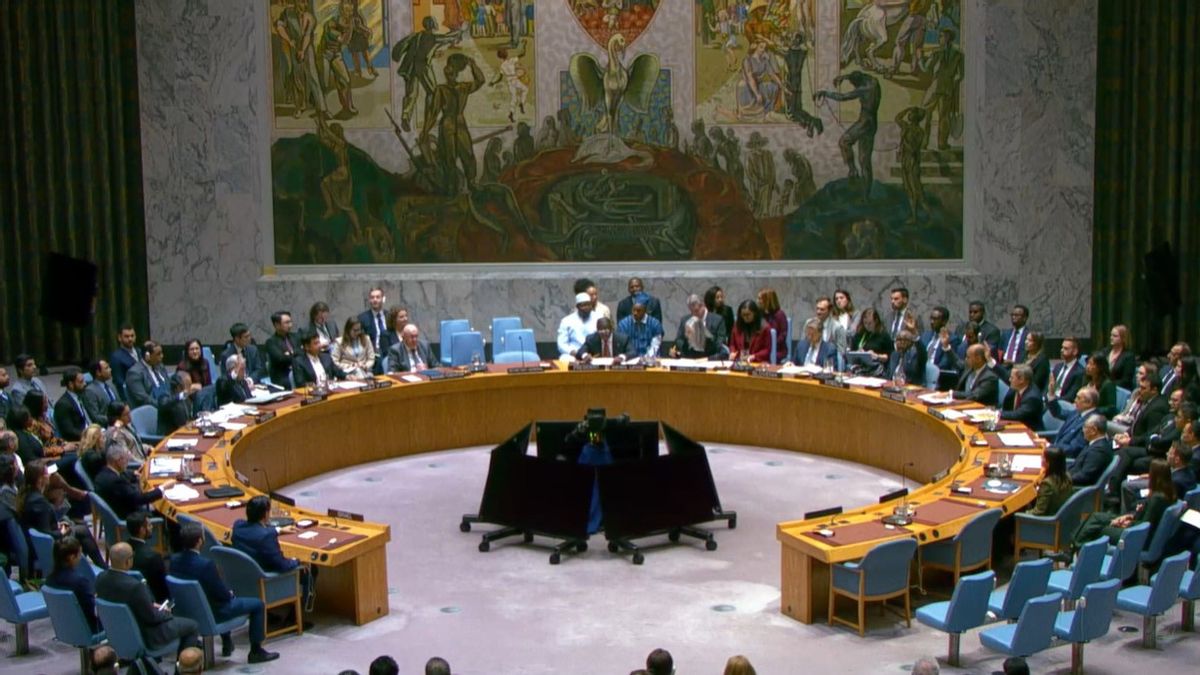


JAKARTA - China and Russia have stated abstention in the vote on the United Nations Security Council's draft resolution on the Gaza Strip, highlighting the Two-State Solutions and mandates to the International Stabilization Forces (ISFs) to be deployed to the Palestinian enclave.
The 2025 UN Security Council's 2803 resolution received 13 votes support from council members. France, Britain, the United States, Algeria, Denmark, Greece, Guyana, Pakistan, Panama, South Korea, Sierra Leone, Slovenia, and Somalia support. Meanwhile, China and Russia voted abstain, without any members refusing, quoted from UN News Nov. 18.
The resolution welcomes the Comprehensive Plan announced by President Trump on September 29. The first phase of the 20-point plan resulted in a ceasefire between Hamas and Israel a few days later.
The resolution also welcomes the establishment of the Peace Council (BoP) "as a transitional government" in Gaza which will coordinate reconstruction efforts.
"Thank you for joining us in mapping out new directions in the Middle East for Israelis and Palestinians as well as all the people in the region," said US Ambassador Mike Waltz after the vote.
"Today's resolution is another important step towards a stable and prosperous Gaza, as well as an environment that allows Israel to live safely," he added.
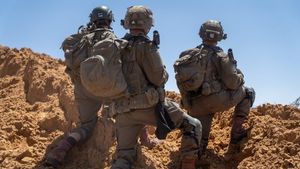
Next, this resolution authorized the BoP to form a temporary International Stabilization Force (ISF) in Gaza "to be deployed under an integrated command that could be accepted by the BoP".
Countries will contribute personnel to the force "in consultation and close cooperation" with Egypt and Israel.
Waltz said the ISF "will stabilize the security environment, support Gaza's demilitarization, dismantle terrorist infrastructure, disable weapons, and maintain the safety of Palestinian civilians."
Meanwhile, Algerian Ambassador Amar Bendjama acknowledged the efforts made by President Trump in advancing peace around the world. However, he stressed that true peace in the Middle East cannot be achieved "without justice for Palestinians who have waited decades for the founding of their independent State."
He noted the manuscript had received support from Arab and Muslim countries, and that "Palestinian authorities at the highest level have publicly welcomed the initiative."
Meanwhile, in his explanation of Russia's abstention options, Ambassador Vasily Nebenzya said the Council basically "provided its blessing to US initiatives based on Washington's promises," and "given full control over the Gaza Strip to the Peace Council and the ISF, whose modalities we don't know so far."
He said the Russian Federation stated it could not support the draft because it failed to enforce the principles of "two countries, two nations" and inappropriately authorized the enforcement of peace to the International Stabilization Forces that could make it a party to the conflict.
He noted that none of the prospective contributors to the troops agreed to the mandate. He also warned that the resolution risks becoming a cover for the "experiment" of the United States and Israel in the occupied Palestinian Territory, given the initiatives driven by the United States in the past that have resulted in the opposite of the stated goals.
SEE ALSO:
-
 | BERITA
94 Tahanan Palestina Tewas di Penjara Israel Selama Dua Tahun Terakhir
18 November 2025, 10:00 -
 | BERITA
RI-Jepang Bahas Pembangunan Pasar Ikan Natuna hingga Hibah Kapal Patroli dalam Pertemuan 2+2
18 November 2025, 08:10
Meanwhile, Chinese Ambassador Fu Cong said the Council must secure a lasting ceasefire, address the humanitarian crisis in Gaza, and begin reconstruction.
However, he expressed "deep concern" that the resolution was unclear about the structure and mandate of the Peace Council and the International Stabilization Forces.
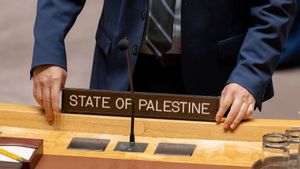
He also criticized the resolution text for not paying attention to Palestine and failing to assert Palestinian sovereignty as well as a two-state solution, highlighting the hasty and non-conultative processes as well as the UN's limited role as expected.
The English, Chinese, Japanese, Arabic, and French versions are automatically generated by the AI. So there may still be inaccuracies in translating, please always see Indonesian as our main language. (system supported by DigitalSiber.id)
Popular


