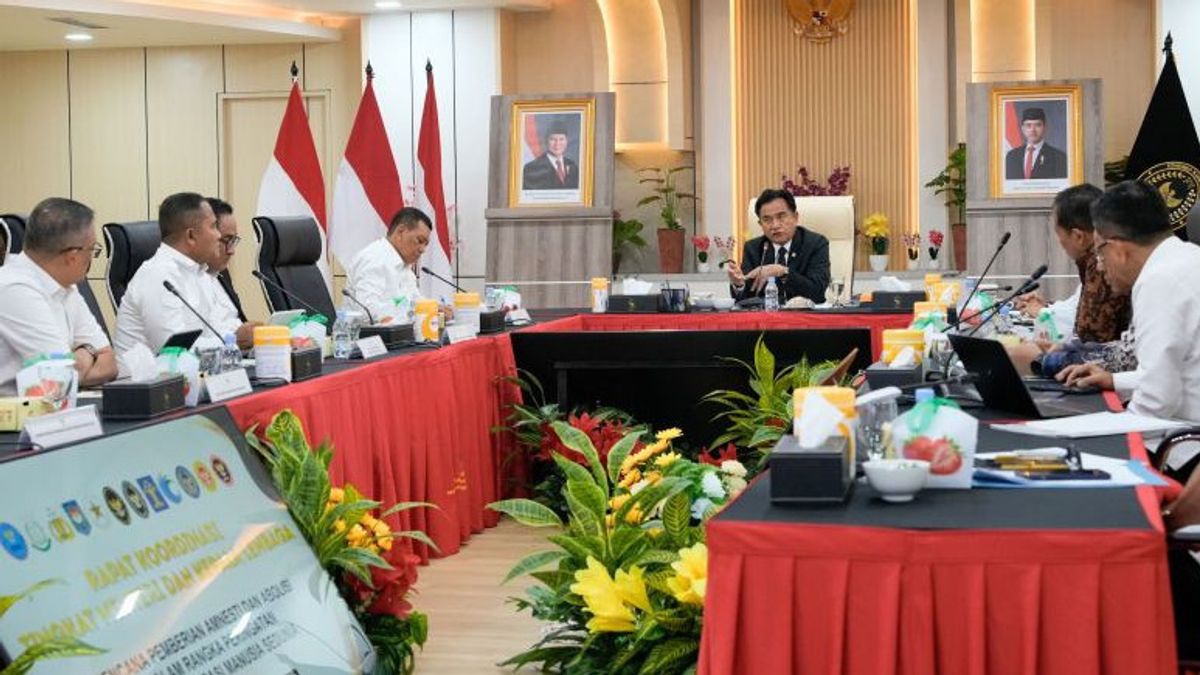


JAKARTA - Coordinating Minister for Law, Human Rights, Immigration, and Correction Yusril Ihza Mahendra said President Prabowo Subianto would again grant amnesty, rehabilitation, and abolition to prisoners.
After granting amnesty to 1,178 people and abolition to one person some time ago, Yusril explained, there are still a number of people waiting to be granted amnesty and abolition.
"Amnesty and abolition will be given to everyone, both in the process of investigation, prosecution, as well as criminal implementation, as well as those who have finished serving the sentence to be given rehabilitation," said Yusril in a press conference after the Ministerial Meeting on the Plan to Provide Amnesty, Abolition, and Rehabilitation in Jakarta, Thursday, November 13, reported by ANTARA.
Yusril said the government had discussed plans to grant amnesty, abolition, and rehabilitation for a number of parties who met the humanitarian, justice and national reconciliation considerations in the ministerial-level meeting he leads.
The meeting was attended by representatives across ministries and institutions, including the Coordinating Ministry for Political and Security Affairs, the Attorney General's Office, the Indonesian National Police (Polri), the National Counterterrorism Agency (BNPT), the National Narcotics Agency, the Ministry of Law, the Ministry of Home Affairs, as well as the Ministry of Immigration and Corrections.
According to Yusril, the government must be careful in determining who deserves the state's pardon because amnesty and abolition are individuals, not institutions.
He also highlighted the importance of legal certainty, especially for those who have been suspects for a long time without further processing.
During the meeting, the Ministry of Law and Human Rights proposed four categories of recipients of amnesty, namely narcotics users, perpetrators of unarmed treason, as well as violators of the Electronic Information and Transaction Law or the ITE Law (insulting the president or head of state).
SEE ALSO:
-
 | BERITA
Meksiko Tutup 13 Kasino Ladang Cuci Uang Jutaan Dolar, Konglomerat Grupo Salinas Murka
13 November 2025, 17:03 -
 | BERITA
Truk Tabrak Pejalan Kaki di Pasar Korsel, 2 Orang Tewas, Belasan Terluka
13 November 2025, 16:47


The Ministry of Law and Human Rights also recommends that prisoners with special needs, such as people with mental disorders (ODGJ), intellectual disabilities, people with severe illness, and the elderly over 70 years old, get forgiveness.
The meeting agreed that the amnesty and abolition policies must be based on humanitarian considerations, national security, and legal certainty without ignoring the victim's sense of justice.
"This step is not just a pardon, but part of legal consolidation and national reconciliation," said Yusril.
The English, Chinese, Japanese, Arabic, and French versions are automatically generated by the AI. So there may still be inaccuracies in translating, please always see Indonesian as our main language. (system supported by DigitalSiber.id)
Most Popular Tags
#Prabowo Subianto #donald trump #2026 World Cup #Febrie Adriansyah #8791Popular