

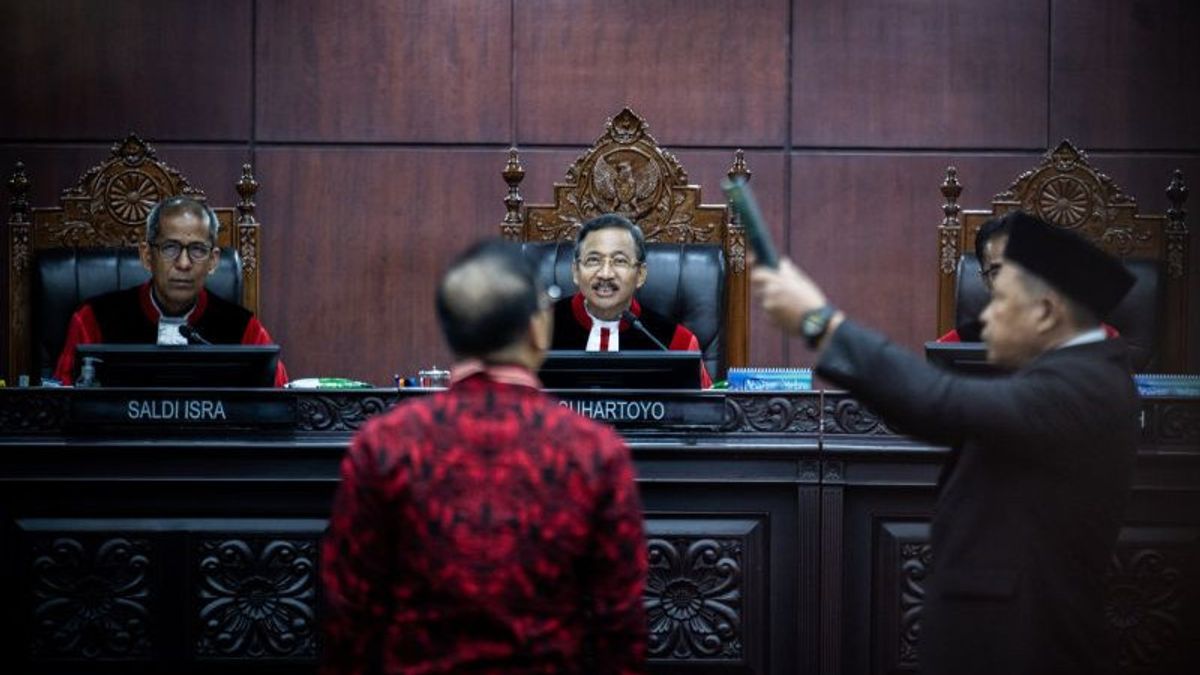


JAKARTA - The Constitutional Court (MK) has finished hearing the judicial review case of the obstruction of justice (OOJ) article in the Corruption Crime Law which was requested by the Secretary General of the PDI Perjuangan (PDIP Secretary General) Hasto Kristiyanto.
"Today is the last trial for this case. Therefore, the applicants, the DPR, and the President's attorney will also conclude that they have been given seven days from today's last trial," said Chief Justice of the Constitutional Court Suhartoyo in Jakarta, Monday, as quoted by Antara.
With the end of the series of trials, the Constitutional Court asked the parties, namely Hasto as the applicant and the DPR and the government to submit a written conclusion containing the final view of the case.
After that, the constitutional judges will hold a panel of judges to decide on Hasto's request before the verdict is pronounced in a trial that is open to the public.
As for this Monday, the Constitutional Court held a trial with the agenda of hearing expert statements presented by the government, namely Al Azhar University Indonesia Professor of Law Suparji and Borobudur University Law Teacher Ahmad Redi.
The two experts both agree that Article 21 of Law Number 31 of 1999 concerning the Eradication of Corruption which regulates the issue of OOJ does not conflict with the constitution, as Hasto argued in his petition.
"The provisions of Article 21 of the Corruption Crime Law are a norm that does not conflict with the value of the constitution, especially legal certainty," said Suparji.
SEE ALSO:
-
 | BERITA
Rusia Tuduh Ukraina Tempatkan Tentara Bayaran Asing untuk Cegah Pasukannya Mundur
27 Oktober 2025, 13:57 -
 | BERITA
Di Tengah Ancaman Larangan di AS, TikTok-Trump Teken Kesepakatan Final Kamis Pekan Ini
27 Oktober 2025, 14:39


He explained that the provisions of the article already have clear limits and orders. In the perspective of criminal law, he said, the article in question has provided guarantees of legal certainty and protection of human rights.
Suparji also said that the article does not need a new interpretation by adding elements 'against the law', as Hasto requested.
"Because it is clear what actions are actually prohibited, it is clear how the norm structure is," he said.
Meanwhile, Redi said that the article tested by Hasto had met the proportionality element.
According to him, the criminal threats regulated in this article do not need to be changed, as Hasto requested in this case.
"The threat of imprisonment for 3'12 years and a fine of Rp. 150'600 million is proportional to the seriousness of the act. Actions that thwart the legal process in corruption cases can result in enormous state losses and damage public confidence in the criminal justice system," he said.
Previously, Hasto questioned Article 21 of the Anti-Corruption Law which stipulates that anyone who deliberately prevents, obstructs, or thwarts directly or indirectly investigations, prosecutions, and examinations at court hearings against suspects and defendants or witnesses in corruption cases, shall be sentenced to imprisonment of 3'12 years and/or a fine of IDR 150 million' IDR 600 million.
According to Hasto, in practice, the article is interpreted disproportionately and creates legal uncertainty so that it is contrary to the principles of a fair state of law, as mandated by the constitution.
He wanted the norms of the article to be clarified. In the petitum, he asked the Constitutional Court to add the phrase "illegally" and through the use of physical violence, threats, intimidation, intervention, and/or promises to provide inappropriate benefits" into the article in question.
In addition, he also argued that the criminal threat in Article 21 of the Corruption Act was disproportionate. For this reason, he asked that the threat of criminal obstruction to the investigation be reduced to a maximum of 3 years.
Also asked by Hasto, the word "and" in the phrase "investigation, prosecution, and examination at trial" is interpreted as cumulative. In other words, he asked, a person can only be punished if he takes actions to prevent, obstruct, or thwart in all stages of investigation, prosecution, and examination in court.
Hasto was a defendant in the alleged obstruction case of investigation and gratification related to interim replacement (PAW) Harun Masiku.
The panel of judges at the Corruption Court at the Central Jakarta District Court stated that Hasto was not proven to have obstructed the investigation, but was proven to be involved in the bribery award so that he was sentenced to 3 years and 6 months in prison and a fine of Rp250 million, subsidiary to three months in prison.
However, Hasto did not undergo a period of punishment because he had received amnesty from President Prabowo Subianto.
The English, Chinese, Japanese, Arabic, and French versions are automatically generated by the AI. So there may still be inaccuracies in translating, please always see Indonesian as our main language. (system supported by DigitalSiber.id)


