

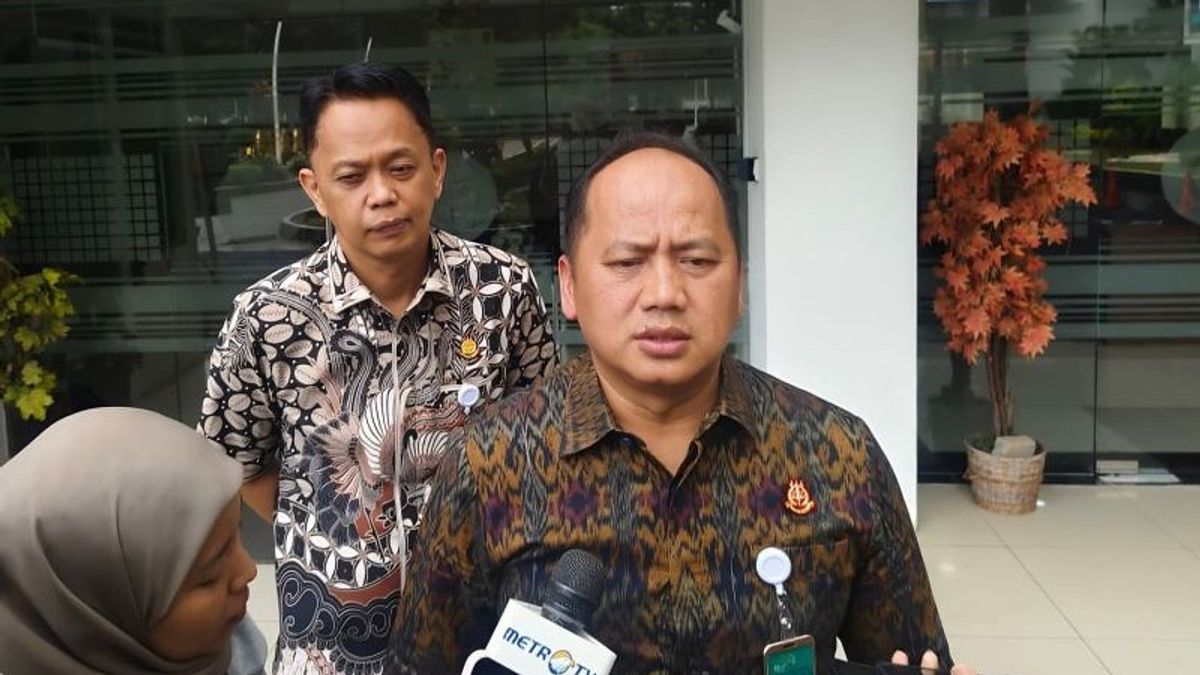


The Attorney General's Office (AGO) said that the decision of the Constitutional Court (MK) regarding the arrest of the prosecutor must be based on the permission of the Attorney General, except in a hand arrest operation (OTT) or threatened with the death penalty, support the prosecutor in order to have more integrity.
"The prosecutor is not immune to the law either. In fact, this is good for all of us to be more vigilant and with integrity, work professionally," said Head of the Legal Information Center (Kapuspenkum) at the Attorney General's Office, Anang Supriatna, as reported by ANTARA, Friday, October 17.
He said the Prosecutor's Office encouraged prosecutors to work professionally and with integrity. Therefore, the Adhyaksa Corps has no problem with this decision.
"We really encourage prosecutors to work professionally, with integrity. There is no problem," he said.
It is known, the Constitutional Court decided that the arrest of the prosecutor who was carrying out his duties and authorities must be based on the permission of the Attorney General, except in terms of hand arrest operations (OTT) or suspected of committing a crime that carries out the death penalty.
In this case, the Constitutional Court granted part of the request for judicial review of Law Number 11 of 2021 concerning the Attorney General's Office of the Republic of Indonesia which was requested by activist Agus Setiawan and advocate Sulaiman.
The Constitutional Court stated that Article 8 paragraph (5) of the Prosecutor's Law is contrary to the 1945 Constitution of the Republic of Indonesia and does not have conditionally binding legal force as long as it does not mean it contains certain exceptions.
The exception referred to by the Court, namely being caught red-handed committing a criminal act; or based on sufficient preliminary evidence suspected of committing a crime that is threatened with the death penalty, criminal acts against state security, or special crimes.
The Constitutional Court gave a new meaning to Article 8 paragraph (5) of the Prosecutor's Law which originally reads, 'In carrying out its duties and authorities, summons, examinations, searches, arrests, and detentions of prosecutors can only be carried out with the permission of the Attorney General.'
If you refer to the norms of the article before the signing of the Constitutional Court, every arrest of the prosecutor, without exception, must first obtain the permission of the Attorney General.
In the legal consideration read out by Constitutional Justice Arsul Sani, the Court considered that legal protection for law enforcers or state administrators whose duties were related to judicial power was needed.
However, the Court considered that the norms of Article 8 paragraph (5) of the Prosecutor's Law were not in line with the spirit of equality of all people before the law, especially in the perspective of legal protection for fellow law enforcers.
SEE ALSO:
-
 | BERITA
Pemimpin Kudeta Madagaskar Kolonel Randrianirina Dilantik Jadi Presiden
17 Oktober 2025, 18:01 -
 | BERITA
Zelenskyy Optimistis Pertemuan dengan Trump Bisa Bantu Akhiri Perang
17 Oktober 2025, 02:03 -
 | BERITA
Uni Afrika Cabut Sementara Keanggotaan Madagaskar Usai Kudeta Militer
17 Oktober 2025, 01:01
According to the Court, exceptions to treatment should still be required with reasonable and measurable boundaries. Because, said Arsul, the absence of exceptions could hinder the law enforcement process and weaken the principle of equality before the law.
"So there is no other choice for the Court regarding the norms of Article 8 paragraph (5) of Law 11/2021 to be declared contrary to the 1945 Constitution of the Republic of Indonesia conditionally," he said.
The English, Chinese, Japanese, Arabic, and French versions are automatically generated by the AI. So there may still be inaccuracies in translating, please always see Indonesian as our main language. (system supported by DigitalSiber.id)


