


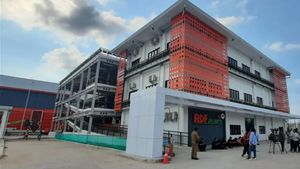
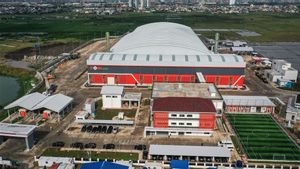
JAKARTA - Head of the DKI Jakarta Environmental Agency, Asep Kuswanto, revealed that his party has involved environmental experts in ITB to ensure that currently the Refuse Derived Fuel (RDF) waste processing facility Plant Rorotan, North Jakarta, is safe to operate.
Asep admitted that the problem of the smell of garbage that was polluted was complained by residents from the implementation of the Rorotan RDF trial which has now been corrected.
"From the start, the construction of this facility has considered environmental aspects and public health. Although there were obstacles in the first trial, we continued to improve and conduct a large-scale evaluation," Asep said in his statement, Tuesday, September 23.
Asep said, DLH also added three units of deodorizers so that now a total of four units operate. This deodorizer is equipped with a blower, an advanced oxidation system with ozone and ultraviolet light, scrubs, and active carbon filters to neutralize odor-causing gases.
"This step shows the seriousness of DLH in reducing the potential negative impact that residents are worried about," he said.
Continuing, ITB Environmental Engineering expert, Haryo S. Tomo, currently the RDF Plant is safe for the environment and public health. According to him, RDF is a high standard emission control technology that has been also implemented in large industries.
"RDF Plant Rorotan has been equipped with Air Pollution Control Devices (APCD) with a comprehensive configuration to reduce pollutants optimally," said Haryo.
Haryo explained, RDF Plant combines a number of pollution control units, ranging from cyclone, baghouse filters, wet scrubs, wet electrostatic precipitators (ESP wet), to active carbon filters.
This system is intended to set aside particulates, sulfur dioxide (SO2), nitrogen oxide (NOx), and gas appeals so that the final results still meet the emission quality standards according to the Minister of Environment and Forestry Regulation Number 70 of 2016.
SEE ALSO:
-
 | BERITA
Ingatkan Pemprov DKI Bereskan Masalah Bau RDF Rorotan, PSI: Harganya Mahal, dari Pajak Rakyat
22 September 2025, 16:20 -
 | BERITA
Ingin RDF Rorotan Diresmikan Prabowo, Pramono: Kan Nilai Investasinya Gede
12 September 2025, 17:13 -
 | BERITA
Kapolri Bentuk Tim Transformasi Reformasi Polri, Libatkan 52 Pati dan Pamen
22 September 2025, 11:36
"This technology implementation has been tested in other industrial sectors. Even in the smelting industry, Wet ESP efficiency can reach more than 98 percent," he added.
The English, Chinese, Japanese, Arabic, and French versions are automatically generated by the AI. So there may still be inaccuracies in translating, please always see Indonesian as our main language. (system supported by DigitalSiber.id)
Most Popular Tags
#Prabowo Subianto #donald trump #2026 World Cup #venezuela #konflik timur tengahPopular


