

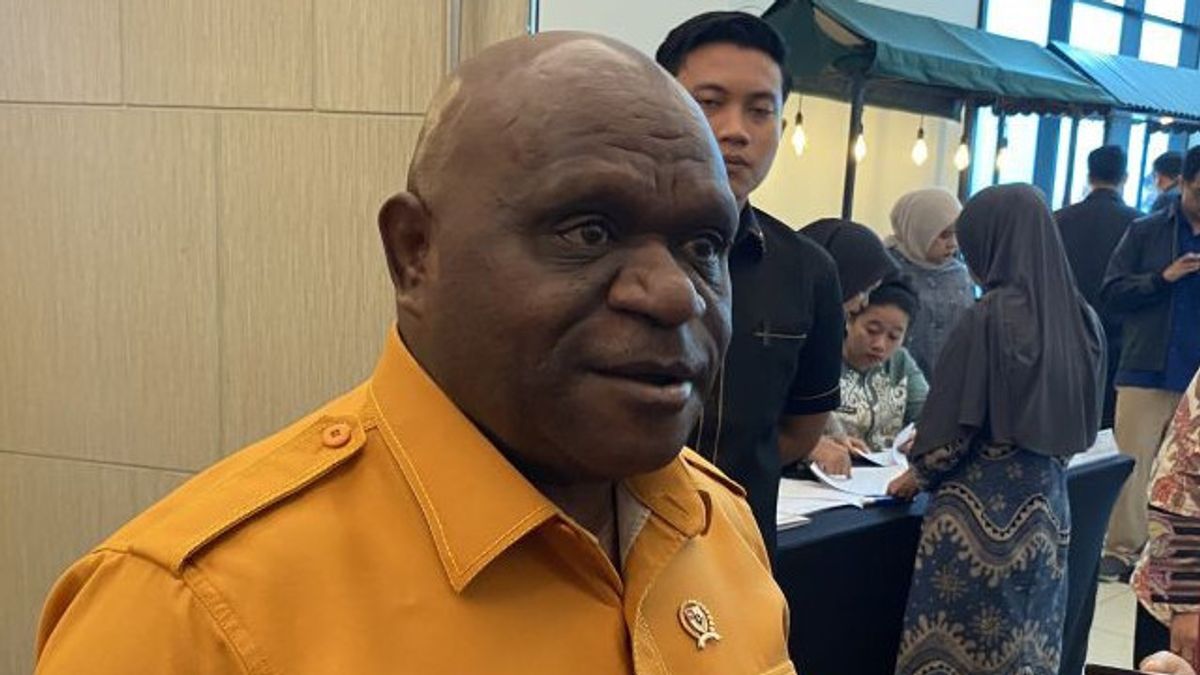


JAKARTA - Human Rights Minister Natalius Pigai explained that the idea of providing a demonstration room in the courtyard of the DPR RI building was a strategic step to strengthen substantive democratic practices.
Pigai said that he meant substantive democracy, namely when people's aspirations were channeled, public order was maintained, and a symbol of sovereignty was present at the heart of parliament.
"Providing a demonstration room in the DPR yard is a strategic choice that needs serious consideration because it will bring together the community and the institutions representing them," he said.
The Minister of Human Rights stated that the public has the right to express their opinion peacefully. The state not only respects this right, but also is obliged to ensure that the space exists, one of which is through the idea of providing the demonstration room.
According to Pigai, the proposal is in line with President Prabowo Subianto's attitude.
On August 31, 2025, when delivering a statement regarding the wave of demonstrations, President Prabowo emphasized that freedom of expression was guaranteed by the United Nations International Convention on Civil and Political Rights and the Human Rights Act.
For Pigai, the President's statement shows the government is consistent with international and national human rights commitments.
In addition, the right to express opinions is also guaranteed by Article 28E of the 1945 Constitution.
However, he said the practice of democracy in Indonesia often creates friction, especially because the locations of demonstrations are often on the main roads that cause congestion and potential clashes.
Therefore, Pigai believes that by providing a demonstration room in the courtyard of the DPR RI building, the state can answer the dilemma. That way, people's rights are guaranteed and public order is maintained.
According to Pigai, there are at least eight reasons the importance of the demonstration room is important, among others, as an authentic symbolism of democracy, proximity to aspiration targets, reducing traffic, security and order burdens, direct dialogue culture, eradicating negative stigma demonstrations, logistical efficiency, and precedents for the region.
He said the demonstration room had been practiced in several countries, including Germany providing public squares in Berlin for major action with official notices and Britain arranging demonstrations at Parliament Square with special permission.
Singapore, he said, provides a demonstration room at Speakers' Corner Hong Lim Park, while in the United States there are free speech zones in major political events.
Meanwhile, South Korea, according to Pigai, has banned actions near palaces, parliaments and courts, but facilitated major action in iconic public spaces such as Gwanghwamun Square.
"This idea of a kind of demonstration room has actually been proposed by the DPR-RI in the 2015'2019 DPR Strategic Plan by calling the construction of a 'democracy field'," he said.
The democratic Square is proposed to be built on the left side of the DPR complex, occupying the Taman Rusa area, futsal field, and parking lot. The plan is designed to accommodate approximately 10,000 people with permanent oration stage facilities, loudspeakers, evacuation routes, and safe access.
"The symbolic inauguration was carried out on May 21, 2015, but this project did not continue," he said.
In addition, continued Pigai, the DKI Jakarta Provincial Government in 2016 built an Aspiration Park at the Northwest Plaza Monas, covering an area of approximately 1,000 square meters with open park facilities, murals, and public expression rooms.
"However, this space is more symbolic and does not function as an official demonstration location that is recognized by law," he said.
He said international experience provides an important lesson, Singapore with its Speakers His Corner is often criticized because the demonstration room has turned into an instrument of restriction.
On the other hand, Germany and South Korea show that the aspiration space at the heart of the city strengthens democracy without blocking the possibility of action elsewhere.
Therefore, said Pigai, the proposed democratic space in the courtyard of the DPR needs to be seen as an additional representative, safe and symbolic official space, instead of being interpreted as an effort to limit demonstrations only there.
According to Pigai, in that way, Indonesia can avoid regulatory traps that curb freedom and actually expand the facilitation of democracy in the most substantive form.
The Minister of Human Rights continued to say that the proposal of the DPR's courtyard as a demonstration room was a second opportunity to realize a long-delayed idea.
SEE ALSO:
-
 | BERNAS
Dari Indonesia Hingga Prancis, Bendera One Piece jadi Simbol Ketidakpuasan Generasi Z di Dunia
15 September 2025, 06:00 -
 | OLAHRAGA
Banyak Pertentangan, UEFA Menunda Rencana Pertandingan Villarreal vs Barcelona di Miami
15 September 2025, 06:14 -
 | EKONOMI
Berpotensi Ganggu Stabilitas Sistem Keuangan, DPR Diingatkan Segera Seleksi Pimpinan LPS
15 September 2025, 06:06
"In the past, the DPR had written it down in a strategic plan, the DKI Provincial Government had built it at Monas. Now, with the right political momentum, we can ensure that the democratic space is really present, not just a discourse," explained Natalius Pigai.
The proposal to provide community centers to express their aspirations in the courtyard of the DPR RI building, Senayan, Jakarta, was first conveyed by Natalius Pigai on the sidelines of a review by the Regional Office of the Ministry of Human Rights in Denpasar, Bali, Friday (12/9).
The English, Chinese, Japanese, Arabic, and French versions are automatically generated by the AI. So there may still be inaccuracies in translating, please always see Indonesian as our main language. (system supported by DigitalSiber.id)


