

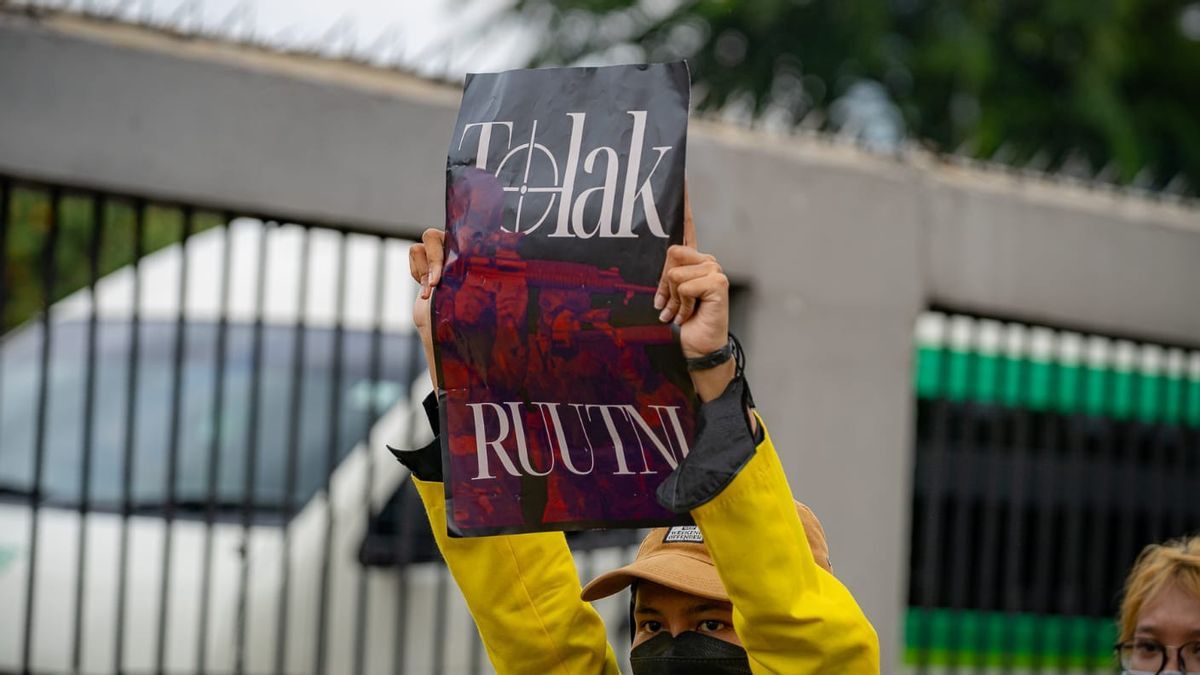


YOGYAKARTA - President Prabowo Subianto emphasized his commitment to maintaining the principle of civil supremacy in response to public concerns regarding the issue of martial law. This was conveyed by Prabowo during a meeting with the Nation Conscience Movement (GNB) at the Presidential Palace, Jakarta, Thursday, September 11.
A member of the NAM who is also a former Minister of Religion, Lukman Hakim Saifuddin, said President Prabowo had said several times that he would uphold civilian supremacy in the three-hour meeting.
"That is one of the points we convey (related to the issue of martial law), that civil supremacy must be upheld, and the President has repeatedly stated that his commitment to it is that the President is committed to upholding civilian supremacy," Lukman said after the meeting.
Regarding civilian supremacy, NAM highlighted military involvement in civilian space. GNB asked President Prabowo to be placed as a professional soldier and not burdened with tasks beyond their main functions and roles. So what is the rule of law?
Civilian supremacy is a concept of democracy that places civilians as the highest authority holders in the country. In this system, the military is only tasked with maintaining defense and security without interfering in political affairs. That way, the state's decision remains in the hands of a civilian government elected through democratic elections.
The application of civilian supremacy makes civilian officials have full authority to regulate military activities. This is important so that the country's strategic policies are not determined by the armed parties, but by the people's representatives. Developed democratic countries have proven that this practice strengthens political stability and public trust.
Indonesia as a democratic country places the people as the owner of the highest sovereignty. Through elections, the people choose civilian officials who are mandated to make strategic decisions. With this system, the TNI functions as a state tool that is subject to civilian authorities.
The military must remain professional with a focus on defense tasks. This means that soldiers should not be involved in civilian affairs such as practical politics or bureaucracy. Civil supremacy in the context of Indonesia is the foundation so that democracy runs healthy and stable.
Civilian supremacy is important to prevent military domination in the life of the state. If the military holds political control, the people lose their role as sovereignty holders. This could lead to authoritarianism that is against the spirit of democracy.
In addition, civil supremacy ensures that laws and the constitution are upheld. Civil governments are obliged to obey the laws made for the benefit of the community. That way, state policies more reflect the aspirations of the people, not the interests of armed groups.
The military and civilians have clear differences in their functions, roles, and legal status. Civilians have basic rights protected by the constitution, such as freedom of speech, movement, and work. They comply with civil laws governing inter-individual relations and society.
Meanwhile, the military is subject to more disciplined and strict military law. They have a major obligation to safeguard the country's sovereignty, defense and security. With this specific role, the military must remain focused on its duties without interfering in civilian political affairs.
Civilian supremacy does not mean weakening the military, in fact strengthening their professionalism. The military that focuses on defense duties will be better prepared to face external and internal threats. This makes the country have a strong defense as well as a healthy democracy.
SEE ALSO:
-
 | BERNAS
Dari Indonesia Hingga Prancis, Bendera One Piece jadi Simbol Ketidakpuasan Generasi Z di Dunia
15 September 2025, 06:00 -
 | OLAHRAGA
Banyak Pertentangan, UEFA Menunda Rencana Pertandingan Villarreal vs Barcelona di Miami
15 September 2025, 06:14 -
 | EKONOMI
Berpotensi Ganggu Stabilitas Sistem Keuangan, DPR Diingatkan Segera Seleksi Pimpinan LPS
15 September 2025, 06:06
When the military is free from the burden of civil duty, they can train, develop technology, and maintain preparedness. This professionalism is a form of real support for the democratic system. Thus, the civilian supremacy and professional military go hand in hand.
By keeping the civilian supremacy, the military remains focused on defense, while the people through the civilian government determine the direction of policy. This principle is not only a matter of politics, but also a matter of keeping democracy alive.
The English, Chinese, Japanese, Arabic, and French versions are automatically generated by the AI. So there may still be inaccuracies in translating, please always see Indonesian as our main language. (system supported by DigitalSiber.id)
Most Popular Tags
#Prabowo Subianto #donald trump #Febrie Adriansyah #8791 #giias 2026Popular


