

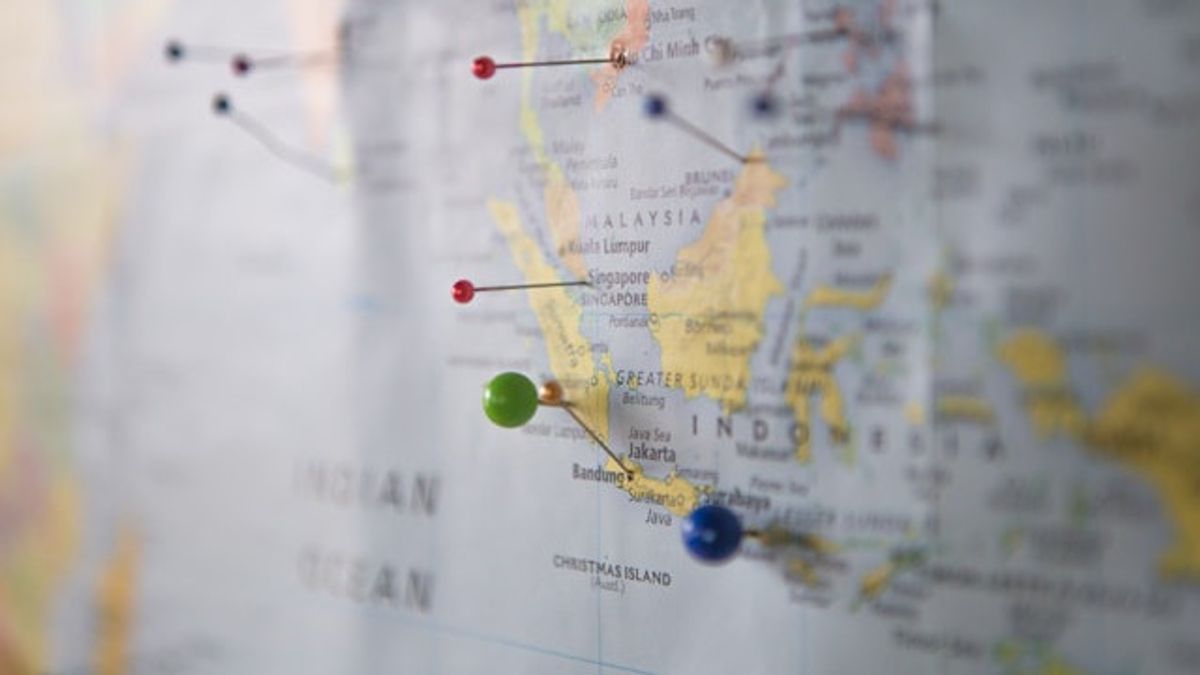


YOGYAKARTA - Indonesia's geographical impact on people's lives is enormous. The strategic position between the two continents and the two oceans has made Indonesia benefit in several ways.
Despite bringing many advantages, the location of this geography also presents challenges. Because of the various challenges that exist, it is required to form a strong nation's character in dealing with it.
Reporting from the UMY ETD (Electronic Theses and Dissertations) website, because it is on a world crossing route, Indonesia is a point of international trade traffic, both sea and air.
Because it is strategically located, merchant ships from Japan, Korea, to China bound for Europe or the Middle East often pass through Indonesian waters. Likewise, the trade route from Asia to Australia and New Zealand.
In addition, natural wealth in the form of flora, fauna, and mineral sources further strengthens Indonesia's position in the global economy.
Also read the article that discusses 10 Geographical Concepts: Location, Distance, Pattern, To Spatial Relations
With these conditions, Indonesia acts as the main liaison between industrial countries and developing countries in various parts of the world. In more detail, here are some of the advantages that Indonesia can get:
Indonesia's position makes it an important global trade route. This makes many merchant ships from East Asia to Europe, the Middle East, to Australia that cross this region.
With so many trade and shipping activities, Indonesia has benefited from foreign exchange, employment, and increasing the transportation and logistics sector.
Located in the tropics makes Indonesia rich in flora, fauna, and high-value mineral resources for world trade.
Indonesia's cross position made it a meeting place for various nations. This creates unique cultural, traditional, and culinary diversity.
Indonesia is part of the world's main shipping route connecting Asia Pacific, Europe, and America through the Malacca Strait, the Suez Canal, and the Panama Canal.
SEE ALSO:
-
 | BERITA
Tersambar Petir saat Memancing di Danau Sentani, Seorang Warga Ditemukan Meninggal
07 September 2025, 23:32 -
 | BERITA
Gempa Magnitudo 5,2 Guncang Kepulauan Tanimbar, Tidak Berpotensi Tsunami
07 September 2025, 23:12

Although Indonesia's geographical position brings many advantages, there are also challenges that must be faced. One of them is the problem of sea borders in the area of the Exclusive Economic Zone (EEZ).
You should know, Indonesia has a very large sea area, and according to the 1982 UNCLOS international regulation, each country has the right to EEZ as far as 200 nautical miles from the shoreline. In this zone, Indonesia has the right to manage natural resources, both biological and non-hayati.
However, in reality everything doesn't always run smoothly. Indonesia often deals with sea border disputes with neighboring countries such as Vietnam and the Philippines.
In fact, China's unilateral claims in the North Natuna Sea also sparked tensions. In fact, this area is very important economically because it is near the South China Sea, one of the busiest trade routes in the world.
The trade value in the North Natuna Sea reaches thousands of billions of dollars, especially through major cooperation such as TPP and RCEP involving many countries.
This challenge requires Indonesia to continue to strengthen international diplomacy while safeguarding its maritime sovereignty. Thus, Indonesia can continue to take advantage of its strategic position without losing the rights to the marine area and the resources contained in it.
In addition to discussing the impact of Indonesia's geographical location on the impact of Indonesia's geographical location, follow other interesting articles on VOI, to get updated news, don't forget to follow and monitor all of our social media accounts!
The English, Chinese, Japanese, Arabic, and French versions are automatically generated by the AI. So there may still be inaccuracies in translating, please always see Indonesian as our main language. (system supported by DigitalSiber.id)


