
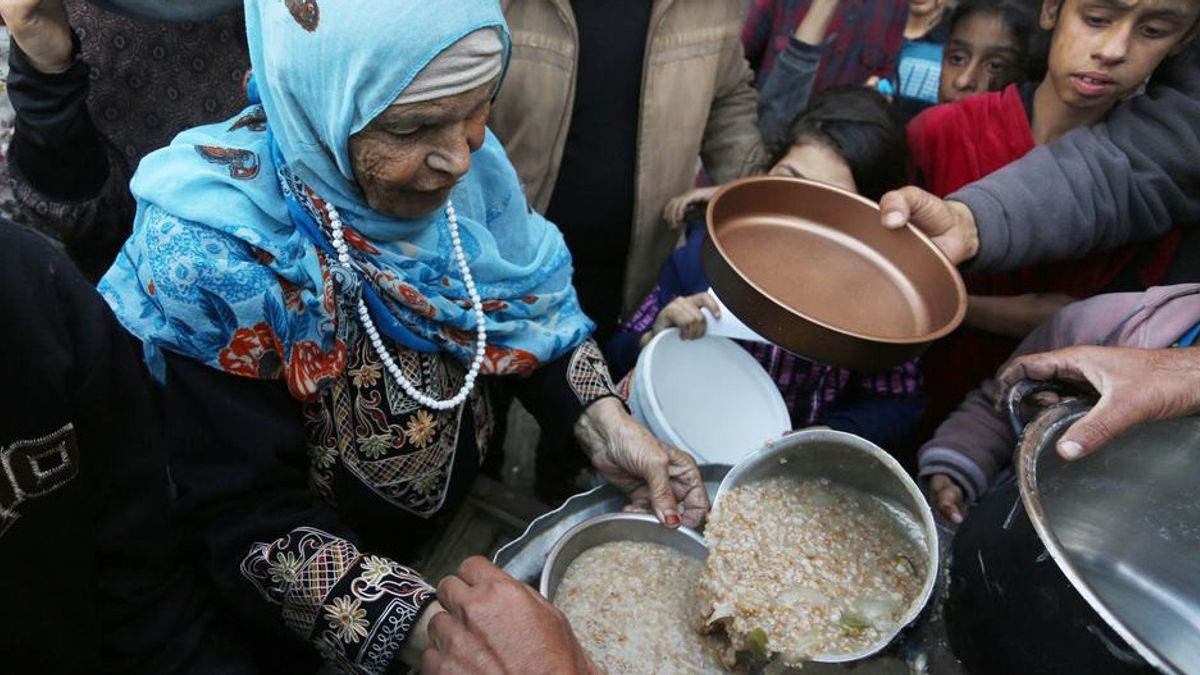


JAKARTA - Global hunger monitors have declared for the first time that famine has struck the densely populated northern Gaza Strip, some 22 months after the outbreak of war in the enclave following Hamas' deadly invasion of Israel in October 2023.
The Integrated Food Security Phase Classification System (IPC) report estimates that 514,000 people, nearly a quarter of Gaza's population, are experiencing hunger. This number is expected to rise to 641,000 by the end of September.
About 280,000 of these people are in the northern area encompassing Gaza City—the Gaza Governorate—which the IPC says is currently experiencing famine, as reported by The Times of Israel on August 22.
Famine is also occurring in Deir al-Balah and Khan Younis, central and southern areas that the IPC projects will be hit by famine by the end of next month.
The IPC said the famine has been driven by fighting and an aid blockade, and exacerbated by widespread displacement and the collapse of food production in Gaza, pushing hunger to life-threatening levels across the region after 22 months of war.
More than half a million people in Gaza, about a quarter of the population, face extremely high levels of hunger, and many are at risk of dying from malnutrition-related causes, the IPC report said.
Last month, the IPC said a "worst-case scenario of famine" was unfolding in Gaza, but has not yet issued a formal ruling.
Israel immediately denied the allegation, with the Coordinator of Government Activities in the Territories (COGAT) accusing the IPC of basing its report on "biased and self-serving sources originating from Hamas."
For a territory to be classified as a famine zone, at least 20 percent of its population must be experiencing extreme food shortages, with one in three children experiencing acute malnutrition and two out of every 10,000 people dying daily from starvation or malnutrition and disease.
COGAT, which coordinates humanitarian affairs in the Gaza Strip, issued a counter-report refuting the CTF's report.
"Instead of providing a professional, neutral, and responsible assessment, the report adopts a biased approach riddled with serious methodological flaws, thus undermining its credibility and any trust the international community could place in it," fumed COGAT Head Major General Ghassan Alian.
"We expect the international community to act responsibly and not be swayed by false narratives and baseless propaganda, but instead to thoroughly examine the data and facts on the ground," he stressed.
COGAT accused the IPC of unreliable data collection methods and of being based in part on assessments conducted by UNRWA officials in the Gaza Strip.
The COGAT report focuses primarily on aid entering the Gaza Strip since May 2025, and only briefly mentions the "temporary closure" of the crossing in March 2025, which led to a complete halt in aid deliveries for 11 weeks.
The report stated that since May, "more than 10,000 aid trucks have entered the Gaza Strip," while the US- and Israeli-backed Gaza Humanitarian Foundation (GHF) has "distributed over 2.2 million aid packages to civilians in need."
The English, Chinese, Japanese, Arabic, and French versions are automatically generated by the AI. So there may still be inaccuracies in translating, please always see Indonesian as our main language. (system supported by DigitalSiber.id)


