
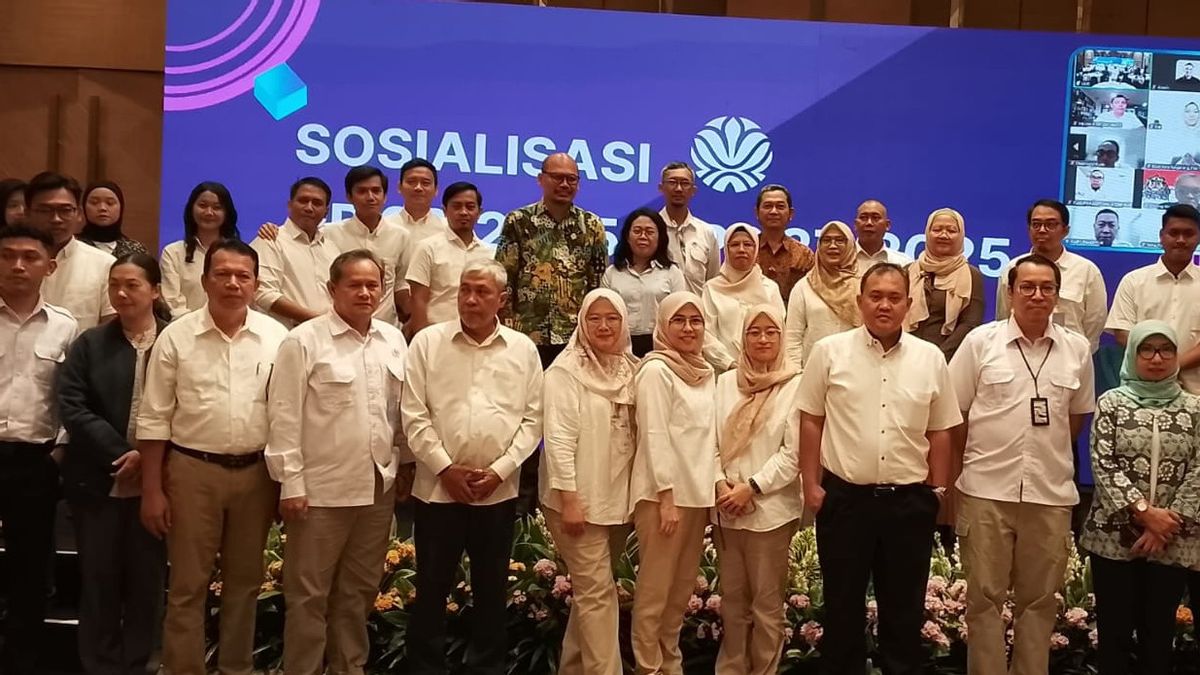


JAKARTA - The Government of the Republic of Indonesia has officially enacted Government Regulation (PP) Number 27 of 2025 concerning the Protection and Management of the Mangrove Ecosystem (PPEM).
This regulation marks an important milestone in Indonesia's efforts to maintain its coastal natural wealth, as well as affirm the country's commitment to sustainable development and handling climate change.
Prof. Dr. Denny Nugroho Sugianto, Professor of the Faculty of Fisheries and Marine Sciences, Diponegoro University and Chairman of the Undip SDGs Center, in this PP socialization, emphasized the urgency of protecting the mangrove ecosystem.
"Mangroves have very important ecological, social and economic functions. However, this ecosystem continues to face worrying pressure over land and degradation functions," he said, in a written statement, quoted Wednesday, July 23.
PP 27/2025 was born from a long process involving in-depth scientific studies, accurate spatial data, and extensive public consultations. The philosophy behind the preparation of this PP is an integrated landscape approach from upstream to downstream, as well as the principle of strong collaboration between the government, indigenous peoples/local peoples, business worlds, and research institutions.
This approach is expected to be able to overcome overlapping regulations and authorities that have often been a challenge in mangrove management in the past. The main goal of PP 27/2025 includes:
- Protect the mangrove ecosystem from damage.
- Regulate the use of mangroves fairly, environmentally friendly, and sustainable.
- Involve the community actively in managing and maintaining mangroves.
- Guarantee ecological and economic justice, especially for small fishermen, indigenous peoples, and coastal residents.
This regulation is also in line with the vision of national development
"Together with Indonesia Forward Towards Indonesia Gold 2045", especially in strengthening the harmonious alignment of life with the environment. With a mangrove area of 3.3 million hectares or 22.4% of the world's total mangroves, Indonesia has great potential in carbon absorption. Data shows that Indonesian mangrove forests are capable of absorbing an average of 52.85 tons of CO2/ha/year, much higher than global estimates. The national carbon absorption potential reaches 170.18 Mt CO2/year.
"When mangroves are damaged, the stored carbon will be transmitted back into the atmosphere. Therefore, mangrove protection is a crucial investment in climate change mitigation," added Prof. Denny.
PP 27/2025 comprehensively regulates from planning (inventory, determination of functions, preparation of plans), utilization, control of damage, maintenance, to supervision and administrative sanctions. Community participation is also an important pillar, realized through empowerment, provision of incentives, and direct involvement in every management stage.
With the enactment of this PP, it is hoped that the protection and management of mangrove ecosystems in Indonesia can be carried out more effectively, integrated, and sustainably, for the future of a better community environment and welfare.
The English, Chinese, Japanese, Arabic, and French versions are automatically generated by the AI. So there may still be inaccuracies in translating, please always see Indonesian as our main language. (system supported by DigitalSiber.id)
Most Popular Tags
#Prabowo Subianto #donald trump #Febrie Adriansyah #8791 #giias 2026Popular


