
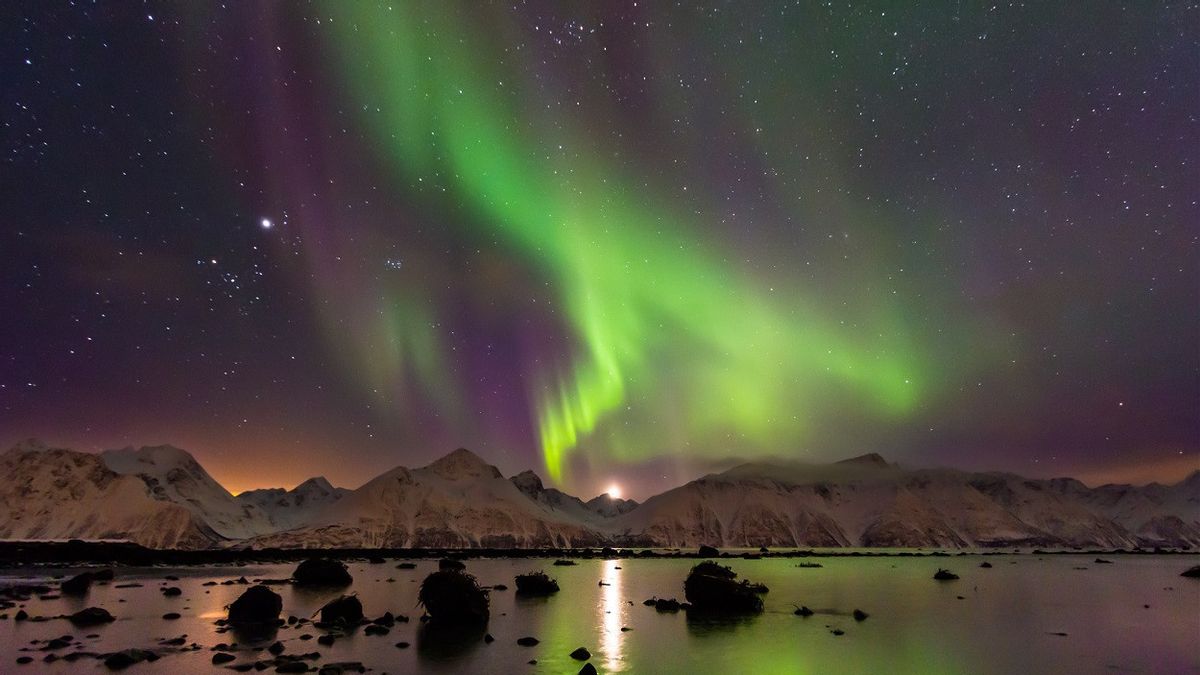


JAKARTA - Forget the trip to the Arctic to see a rare aurora phenomenon, as South Korean skies may offer rare surprises.
Aurora Borealis, also known as the northern light, is famous for its beauty, which is like any other world, usually invisible from Korea.
People have to travel to Arctic areas such as Norway, Iceland, or Alaska, the United States, to get a glimpse of this elusive celestial phenomenon.
Thanks to the increase in solar activity, aurora can be seen here this summer, giving South Korean sky observers reason to look up.
"Aurora occurs during high solar activity, and we are experiencing such activity this summer," Won Chi-bok of the Korean Amateur Astronomy Association told The Korea Times, as quoted July 5.
Aurora occurs when super-charged particles from the sun are racing towards Earth at speeds of up to 72 million kilometers per hour.
When these particles collide with the upper atmosphere, the earth's magnetic field acts like a protective shield, directing the particles to the north and south poles.
There, the interaction between solar particles and atmospheric gases creates a stunning light band shining in the night sky.
Related to this, there are three locations that are considered to be used to see this rare phenomenon in the South Korean sky.
First, Mount Gwangdook Hwacheon, Gangwon Province. Won recommends this as the main aurora observation venue in Ginseng Country.
"It's easy to access, there's an observatory at its peak, and it's located in your neck, so there's almost no light pollution," he said, adding the location of any plateau with a dark sky could be a good choice.
Next is Mount Taebaek in Taebaek, Gangwon Province which has become a popular destination for star observers. The peak, free from urban light pollution, attracts thousands of visitors throughout the year.
Finally, there is the Demilitarized Paju Zone in Paju, Gyeonggi Province, which is close to Seoul, which is also recommended to see the aurora. The unobstructed view of the Arctic also offers a clear perspective, increasing the chances of seeing the aurora if the conditions are correct.
Won himself gave some tips to enjoy the aurora successfully.
SEE ALSO:
-
 | BERITA
NATO Butuh Lebih Banyak Rudal Jarak Jauh untuk Menghalau Serangan Rusia
12 Juli 2025, 05:00 -
 | BERITA
Inggris Tolak Permohonan Penghapusan Hamas dari Daftar Organisasi Teroris
11 Juli 2025, 18:00


First, choose a night with a clear sky, but try to avoid the night with a moon that is too bright, because the light of the moon can interfere with the light of the aurora dim.
Next, focus your attention on the north sky, where auroras usually appear.
Finally, use a smartphone with wide angular or panorama mode to capture the entire display.
"The cell phone is very effective in capturing light and color," he concluded.
The English, Chinese, Japanese, Arabic, and French versions are automatically generated by the AI. So there may still be inaccuracies in translating, please always see Indonesian as our main language. (system supported by DigitalSiber.id)
Most Popular Tags
#Prabowo Subianto #donald trump #2026 World Cup #Febrie Adriansyah #8791Popular


