
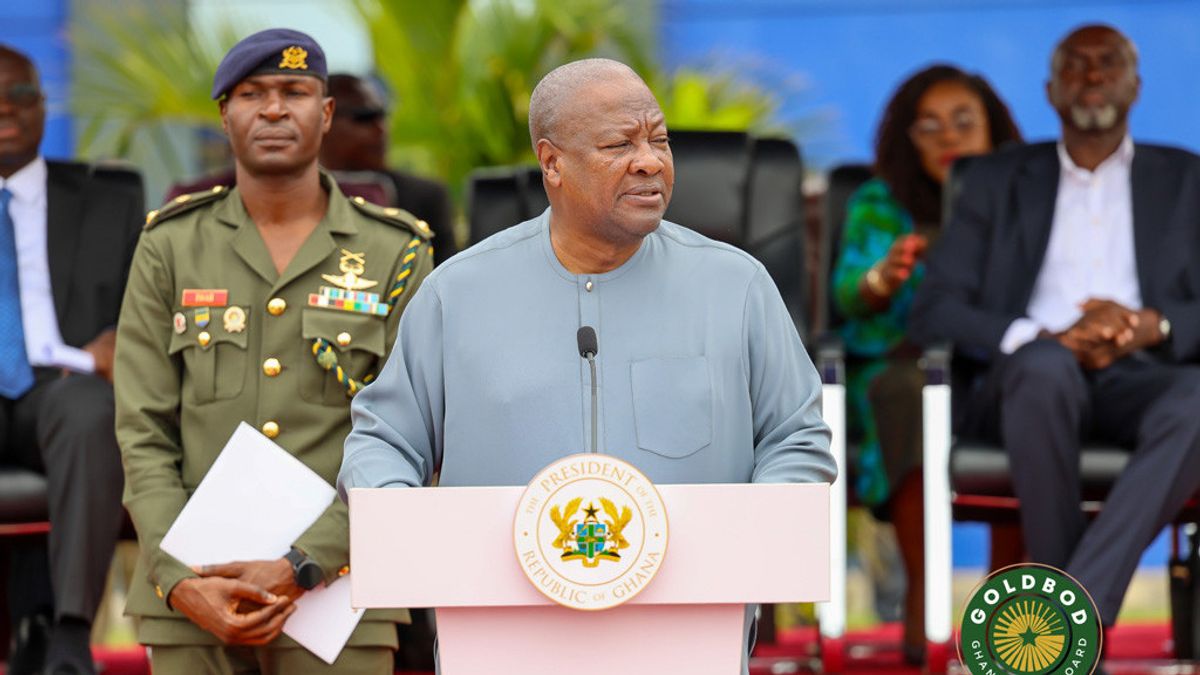


JAKARTA - Ghanaian President John Dramani Mahama on Tuesday launched a task force backed by security forces to tackle illegal gold trades, as Africa's largest gold producer efforts to recover billions of US dollars lost in smuggling.
This task force is Ghana's first national gold anti-smuggling initiative. Previously, the government had launched efforts to sanitize people's mining.
However, these efforts were unsuccessful in curbing illegal extraction and preventing revenue losses that hit most gold producers in Africa.
This year, Ghana formed a new gold council known as GoldBod to concentrate on gold trading. This has resulted in an official export record of 55.7 metric tons of gold worth US$5 billion in the first five months of 2025," President Mahama said at the inauguration of the new task force.
"This money will not return to Ghana because traders will take it and store its foreign exchange abroad," said President Mahama.
To encourage public cooperation with a new anti-smuggling task force, which will involve soldiers and police, informants will receive 10 percent of the gold value confiscated as a result of their information, President Mahama said.
"Every member of the task force will operate under strict supervision," he stressed, quoted from the Ghana Gold Board.
"All officers will wear body cameras in every operation they perform, and vehicles used by the task force will be tracked and monitored with real-time GPS," said President Mahama.
Ghana itself plans to implement a national gold tracing system and switch to processed gold exports by 2026, President Mahama added.
The country will also seek to gain more value from gold through a testing laboratory, certified by the International Organization for Standardization to ensure quality, and a dedicated manufacturing hub.
SEE ALSO:
-
 | BERITA
NATO Butuh Lebih Banyak Rudal Jarak Jauh untuk Menghalau Serangan Rusia
12 Juli 2025, 05:00 -
 | BERITA
Inggris Tolak Permohonan Penghapusan Hamas dari Daftar Organisasi Teroris
11 Juli 2025, 18:00


It is known that the government in West Africa is trying to get more revenue from soaring commodity prices. Military-led countries adopted aggressive policies, including rewriting mining codes, confiscating assets, and renegotiating contracts.
Meanwhile, democracies such as Ghana and Ivory Coast are pursuing measurable reforms through higher royalties and better profit-sharing agreements.
Gold prices have jumped 25 percent this year to date, and peaked at $3,500 per ounce in April, according to Reuters data.
The English, Chinese, Japanese, Arabic, and French versions are automatically generated by the AI. So there may still be inaccuracies in translating, please always see Indonesian as our main language. (system supported by DigitalSiber.id)


