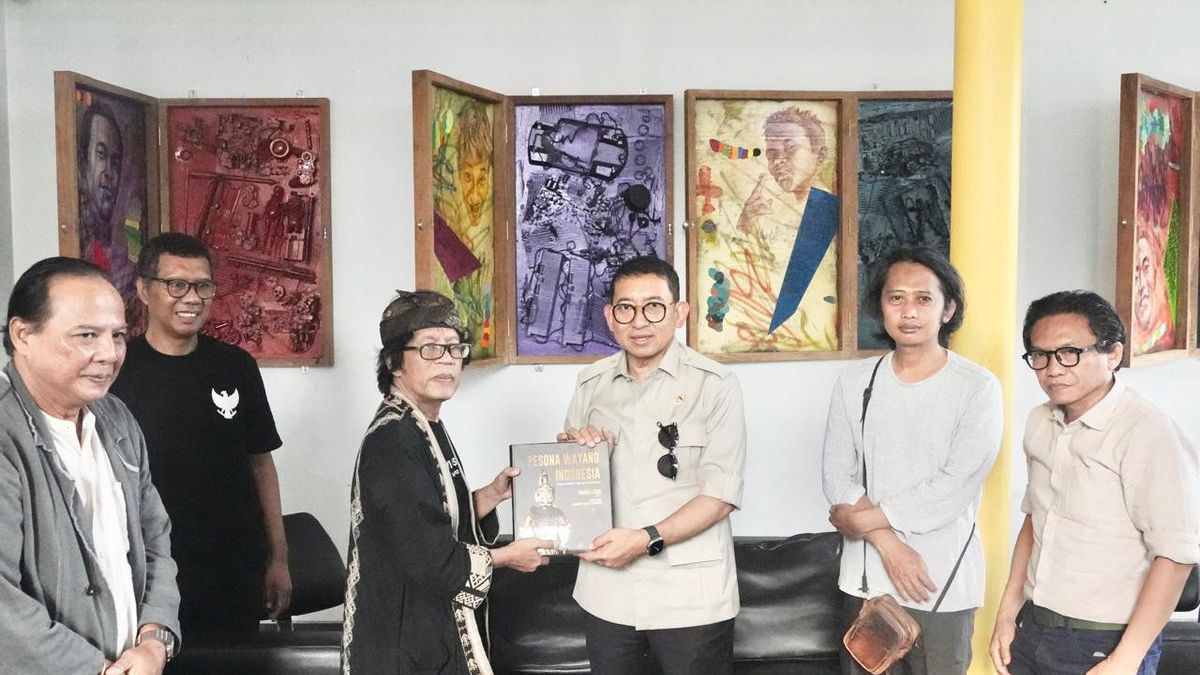


YOGYAKARTA - The Minister of Culture of the Republic of Indonesia, Fadli Zon, emphasized that the museum must be a cultural living space that is close to the public. He conveyed this message when he visited the Indonesia Idea Museum (Iniseum) in Yogyakarta, Saturday, July 5. This gallery is a gallery that specifically displays the work of the painter of the Zulkifli Galam.
The museum, which is located on Jalan Nitikan Baru No. 76 shows off nine thematic rooms titled Journey 9 of the Art Room: From Illusion Towards Light and Darkness. The Zulkifli Galam is known for its fluorescent paint painting when the gallery lights are turned off.
Menbud Fadli and Galam walked through every exhibition room with a different theme: Illusion Series, Is Blue Red, Beautiful, About Illumination Mirror, The History, At First Mosic, All Walls About Machinery, Mother Earth, To Light Spaces And Darkness.
After going around, Fadli discussed with artists about the future of fine arts. He emphasized the importance of museums being thematic and interactive. Our museum is too general. It must be directed into a space to show off thematics and places for creative interactions," he said.
Culturalist Taufik Rahzen added that many artists hope that historical museums such as Fort Vredeburg can be opened for art exhibitions with the theme of the nation's struggle, as was the case in 1978.
SEE ALSO:

Taufik said that fine research often reveals interesting stories behind visual collections and historical objects. "The process of finding works, visual documents, to authentic objects about struggle figures is often full of challenges," he said.
Fadli Zon admits that some important collections are difficult to track because they are abroad or private. "The Riset not only relies on official documents, but also on social media networks," he explained.
He gave an example of a collection of stamps, ancient money, and other authentic objects that are still sealed in their original condition. Research also reveals how historical elements penetrated public spaces through street names in various cities, including Purwokerto.
The discussions were attended by Galam Zulkifli, Taufik Rahzen, Paul Hendro, Agus Baqul Purnomo, Dipo Andy, Yayat Surya, the management of Iniseum, and a number of Yogyakarta artists.
At the end of the visit, Fadli emphasized that the preservation of history is not always in the form of a big monument. "Data debris, visual traces, and personal stories if arranged will form a map of the nation's collective memory," he concluded.
The English, Chinese, Japanese, Arabic, and French versions are automatically generated by the AI. So there may still be inaccuracies in translating, please always see Indonesian as our main language. (system supported by DigitalSiber.id)
Most Popular Tags
#Prabowo Subianto #donald trump #firearm #8791 #giias 2026Popular