


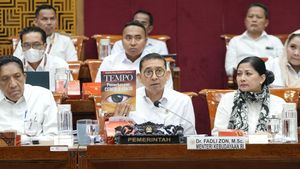
JAKARTA - The Minister of Culture of the Republic of Indonesia, Fadli Zon, emphasized the commitment of the Ministry of Culture to ensure that the process of writing national history is carried out openly, scientifically, and inclusively. This was conveyed while attending a Working Meeting with Commission X of the DPR RI at the Nusantara I Building, Parliament Complex, Jakarta.
"In the near future, of course we will conduct public trials because the writing of this history is very open for discussion," said the Minister of Culture.
The Minister of Culture emphasized that the historical writing program is not a new initiative, but a continuation of efforts to improve the national historical narrative that has not been updated for a long time. I want to emphasize that writing of this history is not a new program but a continuation. Indeed, there are several historical books that have been published, but there are still some shortcomings and have been too long unrenewable. Finally, our history was written in the Habibie era, so that 26 years of no history has been re-renewable. This is the basis for writing the history," he explained.
According to Menbud Fadli Zon, history has an important meaning as the identity of the nation and is a strategic momentum to educate the younger generation not to forget their identity in the midst of the swift currents of globalization. History is important and is the identity of this nation and writing of history is the right momentum to educate the younger generation so that they don't forget history and history as the identity of the nation in the midst of strong globalization," he said.
He added that the writing of national history would use the perspective of a central Indonesia with the aim of strengthening national interests. "This history is certainly written with the perspective of a central Indonesia for the national interest," he said. During the colonial period, for example, he explained, our national interest was an aspect of the struggle against the invaders, not a long period of colonialism.
In addition, the Minister of Culture also expressed his intention to enrich historical narratives by including the latest archaeological findings that show how long the history of the civilization of the archipelago is. Initially, the history of Indonesian civilization and the various latest archaeological findings also want us to enter into the writing of this history which started 1.8 million years ago based on the artifacts found in Indonesia. So that we can become one of the oldest civilizations in the world that is indeed recognized by the international community," he explained.
Regarding the public-crowded issue regarding the 'mass rape' diction in the context of the May 1998 riots, the Minister of Culture stated that he never denied the incident, but he doubted the use of massal' diction which was considered synonymous with structured and systematic events.
SEE ALSO:
"Massal is very synonymous with structured and systematic. In Nanjing, the victims are estimated at 100,000 to 200,000, in Bosnia 30,000 to 50,000. Well, in us, I don't deny that it happened, and I strongly condemn it," said Fadli.
"Of course I condemn and condemn the rape case that occurred at the May 1998 riots," he stressed. He admitted that he had followed the debate about this issue for more than 20 years, including discussions in various public forums. I am ready as a historian and researcher to discuss this. Menbud also emphasized that his doubts about the use of massal' diction are personal opinions and are not related to the contents of the writing of history books.
The Minister of Culture also emphasized that this process of writing history is fully guarded from the intervention of any party, including himself and the internals of the Ministry. Because indeed in the process of writing this history involves historians who already have credibility and deep experience in the field of history, so of course the writing process is carried out with full accuracy and using valid data," added Menbud Fadli.
In addition to bringing up important events in the country, the writing of history in the future is also directed to have a positive tone by highlighting Indonesia's achievements in the international arena, strengthening national pride and confidence. For this positive tone, according to the Minister of Education and Culture, it does not mean forgetting, let alone promoting tragic events in the past, including the May 1998 riots and so on.
In closing, the Minister of Culture expressed hope that the writing of national history could become an instrument to unite the nation. "We hope that the writing of this history will become a unifying of the nation and that we will not be influenced by foreign narratives that can divide the nation. Hopefully we can immediately conduct public trials as a form of our openness to the community," concluded Minister Fadli.
Present at the meeting were the Chairman of Commission X DPR RI, Hetifah Sjaifudian; Deputy Chairman of Commission X DPR RI; Director General of Cultural and Traditional Protection, Restu Gunawan; Director General of Diplomacy, Promotion, and Cultural Cooperation, Endah Tjahjani; Director General of Development, Utilization, and Culture Development, Ahmad Mahendra; Inspector General of the Ministry of Culture, Fryda Lucyana; Special Staff and Expert Staff of the Minister; and Echelon II officials of the Ministry of Culture.
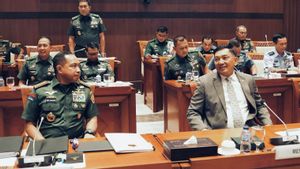
In this working meeting, Commission X of the Indonesian House of Representatives also urged the acceleration of public testing for the writing of history books. In line with this insistence, the Ministry of Culture has programmed public trials in several areas to summarize input from various parties.
The English, Chinese, Japanese, Arabic, and French versions are automatically generated by the AI. So there may still be inaccuracies in translating, please always see Indonesian as our main language. (system supported by DigitalSiber.id)


