

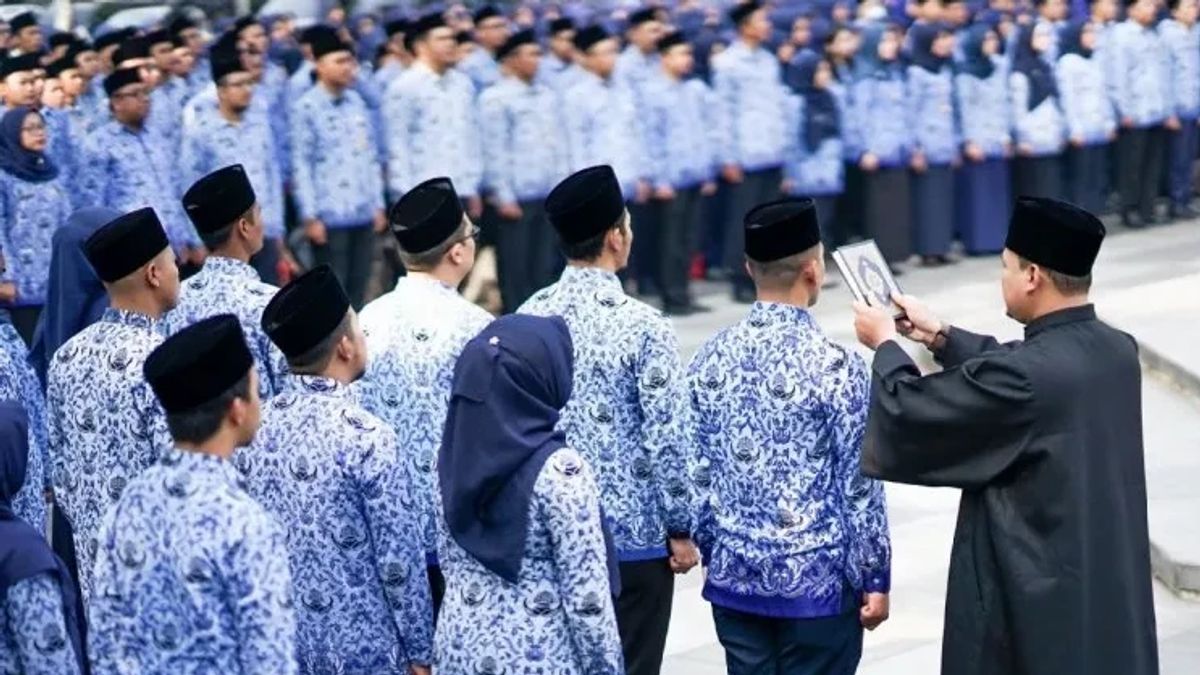


JAKARTA - Chairman of the Indonesian House of Representatives, Puan Maharani, said that the resignation of 1,967 Candidates for Civil Servants (CPNS) in 2024 as a signal that the recruitment process for the state civil apparatus (ASN) needs to be thoroughly evaluated. According to him, the ASN recruitment system needs to adapt to the times.
Puan assessed that the high number of CPNS resignations is not an ordinary phenomenon, but an indicator that shows that the existing system has not been able to answer the expectations and needs of the younger generation.
"The CPNS recruitment process should not only be administrative. There must be a thorough evaluation with careful planning and a more strategic approach, starting from the preparation of formations to the final placement. Otherwise, we will continue to face problems like this," said Puan Maharani, Friday, April 25.
It is known, the State Civil Service Agency (BKN) noted that 1,967 prospective civil servants or CPNS 2024 decided to resign for reasons of small salary to remote placement. The prospective state servants are said to have resigned because of the optimization scheme carried out by the government.
The CPNS initially did not qualify for their choice, then became accepted in other areas because there was no registrant in the formation. For example, there are CPNS lecturers who are not accepted at the Sociology of the Jember State University (Unej). However, there is a similar formation opened at Nusa Cendana University, Kupang, East Nusa Tenggara (NTT) with zero applicants.
Not only CPNS lecturers have resigned. There are several ministries/agencies (K/L) in which CPNS has resigned the most, namely the Ministry of Higher Education, Science and Technology (Kemdiktisaintek), the Ministry of Health, the Ministry of Communication and Digital Affairs (Komdigi), the General Election Supervisory Agency (Bawaslu), as well as the Ministry of Public Works and, Housing and Settlement Areas (PKP).
Puan also considered that there were factors in the weakness of planning in recruitment which caused discrepancies between participant interest and the position offered. If this is not corrected, Puan said, the state will lose quality human resources.
"The state can lose the potential of quality human resources to strengthen public services. This is a real challenge for all of us," he said.
SEE ALSO:





SEE ALSO:
The former Coordinating Minister for Human Development and Culture also encouraged the Ministry of PAN-RB and BKN to reform the ASN recruitment process by paying attention to a number of important aspects. Starting from the transparency of information from the beginning of the selection, an interest and competency-based placement system, as well as providing incentives and fair career guarantees.
In addition, Puan also emphasized the importance of a more humane approach in designing the selection process, especially for formation in the 3T region (lagging behind, leading, outermost).
"The placement of ASN, especially in 3T areas must be accompanied by appropriate incentives, fair career development opportunities, and supporting infrastructure so that they can work optimally and live a decent life," explained Puan.
Furthermore, Puan reminded that the interest of the younger generation to become civil servants can no longer rely solely on the lure of stability and retirement. According to him, the younger generation is also looking for meaning in work, opportunities to grow, and balanced quality of life.
"If the state wants to attract the best human resources, then the ASN system must also transform into an adaptive, inclusive, and responsive system to changing times," he said.
"If the ASN recruitment process still relies on old ways, don't be surprised if the younger generation chooses to resign. The ASN recruitment system must adapt to the times," added Puan.
As a government partner, Puan said, the Indonesian House of Representatives will provide constructive input in encouraging the improvement of ASN management. Puan ensured that this issue would be a serious concern in future supervision and legislation.
"We cannot allow the bureaucracy to lose regeneration. If this is not immediately addressed, then public services that should be the face of the presence of the state in the midst of the people will lose competitiveness," he concluded.
The English, Chinese, Japanese, Arabic, and French versions are automatically generated by the AI. So there may still be inaccuracies in translating, please always see Indonesian as our main language. (system supported by DigitalSiber.id)
Most Popular Tags
#Prabowo Subianto #donald trump #2026 World Cup #Febrie Adriansyah #8791Popular


