

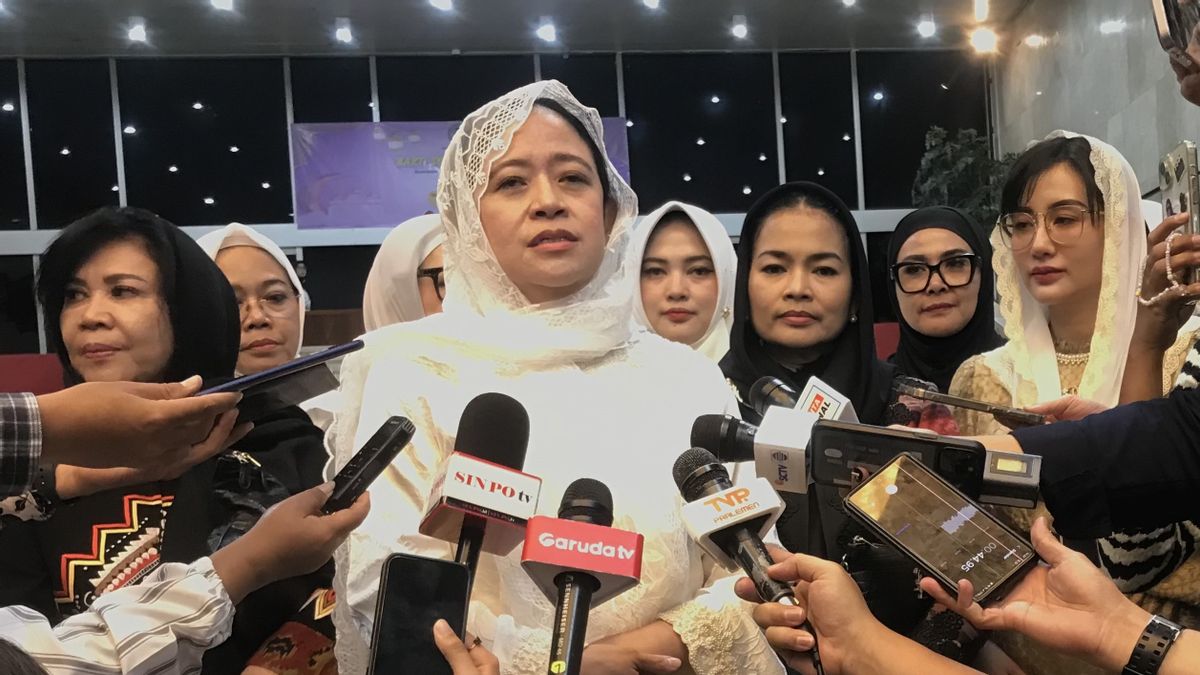


JAKARTA - The Speaker of the House of Representatives, Puan Maharani, confirmed that the revision of Law Number 34 of 2004 concerning the Indonesian State Army (TNI) would not revive ABRI's dwifunction.
This was conveyed by Puan Maharani when responding to public anxiety about ABRI's duality in the revision of the TNI Law discussed by the DPR today.
ABRI's Dwifunction is an idea implemented by the New Order Government which states that the Armed Forces of the Republic of Indonesia, especially the Indonesian Army, have two tasks, namely firstly maintaining the security and order of the state and secondly holding power and regulating the country.
"It was conveyed earlier by the Chairman of the Panja and other DPR leaders that it is not, and please see later, the results of the Panja have also been distributed," said Puan Maharani, Monday, March 17.
Puan emphasized that there are three articles in the TNI Bill that have been discussed and received input from the entire community. From the discussion, said Puan, there were no violations which meant that in the TNI Bill the DPR was working on.
"There are no things that then violate things that are suspected to then make things that in the future are injured," said Puan.
Previously, Deputy Speaker of the House of Representatives, Sufmi Dasco Ahmad, explained about the change in the sound of three articles revised in Law Number 34 of 2004 concerning the Indonesian National Army (TNI). The reason is that different drafts are circulating on social media regarding the bill.
"There are 3 articles, consisting of Article 3 regarding the position of the TNI. So this is internal in nature, namely paragraph 1, for example in the deployment and use of military power, which is domiciled under the president, there is no change," said Dasco.
"Then the second paragraph, defense policies and strategies as well as administrative support related to the TNI's strategic plan are in the coordination of the Ministry of Defense. This article is made so that all synergies and are neater in the administration," he continued.
Then article 53 concerning retirement age, which refers to other institutional laws. Dasco said, there is an increase in the retirement age limit, which varies from 55 years to 62 years.
Then article 3, namely article 47, namely active soldiers can occupy positions in ministries or institutions. Before being revised, there were 10 ministries/agencies that could be held active soldiers. Then, there are 5 additional ministries/agencies.
"Because in each agency in the law it is stated so that we enter into the revision of the TNI Law, such as the Attorney General's Office, for example because there is a military criminal attorney who in the Prosecutor's Law can be held by the TNI here, we will input it. Then for border managers it coincides with the main tasks and functions and this can be seen in the draft that we will share," said Dasco.
In Article 47 paragraph 2, in addition to occupying a position as referred to in paragraph 1, soldiers can occupy civil office after resigning or retiring from an active military service.
"In the revision of the TNI Law there are only 3 articles; article 3, article 53, and article 47, there are no other articles that are then drafted circulating on social media, I see a lot of them, and even if there are the same articles that we convey, the contents are also very different," said the Daily Chair of Gerindra.
The English, Chinese, Japanese, Arabic, and French versions are automatically generated by the AI. So there may still be inaccuracies in translating, please always see Indonesian as our main language. (system supported by DigitalSiber.id)
Most Popular Tags
#Prabowo Subianto #donald trump #2026 World Cup #venezuela #konflik timur tengahPopular


