
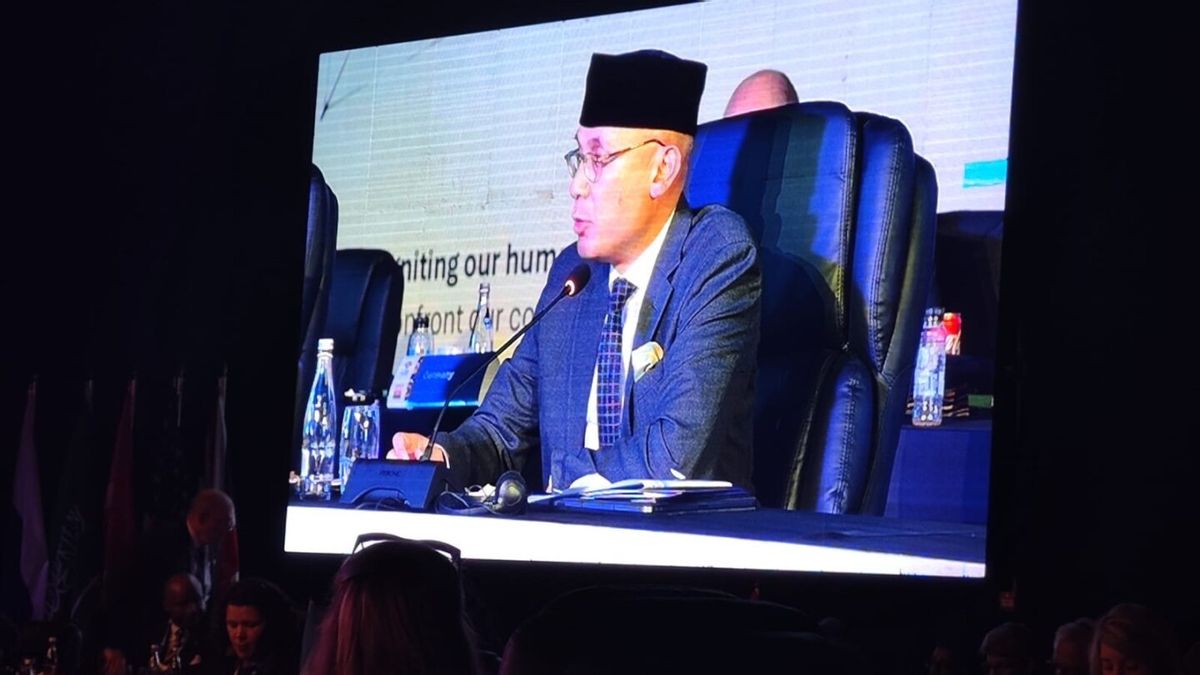


JAKARTA - Indonesia emphasized that the G20 cooperation forum must play an active role in encouraging global system reforms, when multilateralism continues to be eroded and the world's challenges are increasingly complex.
This was conveyed by the Deputy Minister of Foreign Affairs of the Republic of Indonesia, Arrmanatha Nasir, while attending a meeting of the G20 foreign minister (G20 FMM) in Johannesburg, South Africa on February 20-21 which was opened directly by President Cyril Ramaphosa.
The first day of the G20 FMM this time discussed the latest geopolitical dynamics, with member countries and invitations to raise various conflicts and global instability, ranging from the situation in Ukraine, Gaza, Sudan, the Democratic Republic of the Congo, Sahel, Myanmar to North Korea.
In general, G20 countries highlight the importance of respect for international law in maintaining world peace and stability, increasing poverty, as well as the impact of conflicts and geopolitical situations on the achievement of SDG.
Expressing Indonesia's view, the Deputy Minister of Foreign Affairs of the Republic of Indonesia emphasized the importance of reforming global governance in order to face increasingly complex world challenges.
"Multilateralism continues to be eroded, while countries that build this system are increasingly reluctant to maintain it. If this trend continues, the global system is at risk of failure," explained the Deputy Minister of Foreign Affairs of the Republic of Indonesia in a statement from the Indonesian Ministry of Foreign Affairs, Saturday, February 22.
The senior diplomat who is familiarly called Pak Tata emphasized that multilateralism should not just be rhetoric, but must be realized in real action.
He also emphasized that the principle of inclusiveness, equality, solidarity and partnership must be a guide in global governance reform.
The application of international law, continued the Deputy Minister of Foreign Affairs of the Republic of Indonesia, must also not be selective, but must be consistently enforced.
"If international law is only used when benefiting certain parties, then its credibility will be weaker," Deputy Foreign Minister Tata warned.
Indonesia emphasized that the G20 must play a more active role in encouraging global system reforms.
"Global challenges continue to develop, so global governance must also develop," said Deputy Foreign Minister Tata.
On that occasion, the Deputy Minister of Foreign Affairs of the Republic of Indonesia emphasized the lesson of the failed League of Nations caused by weak international law enforcement, inability to prevent the aggression of major countries, as well as the lack of commitment and compliance of member countries.
"If this condition is allowed to happen, we are at risk of experiencing a similar failure," said the Deputy Minister of Foreign Affairs of the Republic of Indonesia.
Therefore, the Deputy Minister of Foreign Affairs of the Republic of Indonesia emphasized the need for coordination between multilateral institutions such as the United Nations, the Bretton Woods system and the multilateral trading system to work in harmony and strengthen each other.
Indonesia also encourages the full implementation of the UN Pact for the Future as a concrete step in strengthening global governance.
In addition, the Deputy Minister of Foreign Affairs Tata emphasized the importance of the momentum of Financing for Development Conference as an opportunity to encourage more substantial reforms.
SEE ALSO:
-
 | BERITA
Hamas akan Selidiki Kemungkinan Kesalahan Identifikasi Jenazah Shiri Bibas
22 Februari 2025, 05:00 -
 | BERITA
Hamas akan Pulangkan Enam Sandera Hari Ini, Israel Bebaskan 602 Tahanan Palestina
22 Februari 2025, 03:00

Indonesia's view of global governance reforms has received appreciation from various parties, including the Secretary General of the International Telecommunication Union (ITU), which emphasizes that this momentum must be used to accelerate multilateral system reforms.
Closing his statement, Deputy Foreign Minister Tata emphasized that Indonesia is ready to cooperate with all countries to build a global order that is fairer and more resilient.
"The cost of inaction is too big. We must move forward to encourage the progress of reforming the multilateral system to create a better world for all," said the Deputy Minister of Foreign Affairs of the Republic of Indonesia.
It is known that South Africa this year holds the G20 Presidency with four main priorities, namely, strengthening disaster resilience; debt sustainability for low-income countries; funding mobilization for a just energy transition; as well as developing strategic mineral cooperation and green industry.
The English, Chinese, Japanese, Arabic, and French versions are automatically generated by the AI. So there may still be inaccuracies in translating, please always see Indonesian as our main language. (system supported by DigitalSiber.id)


