

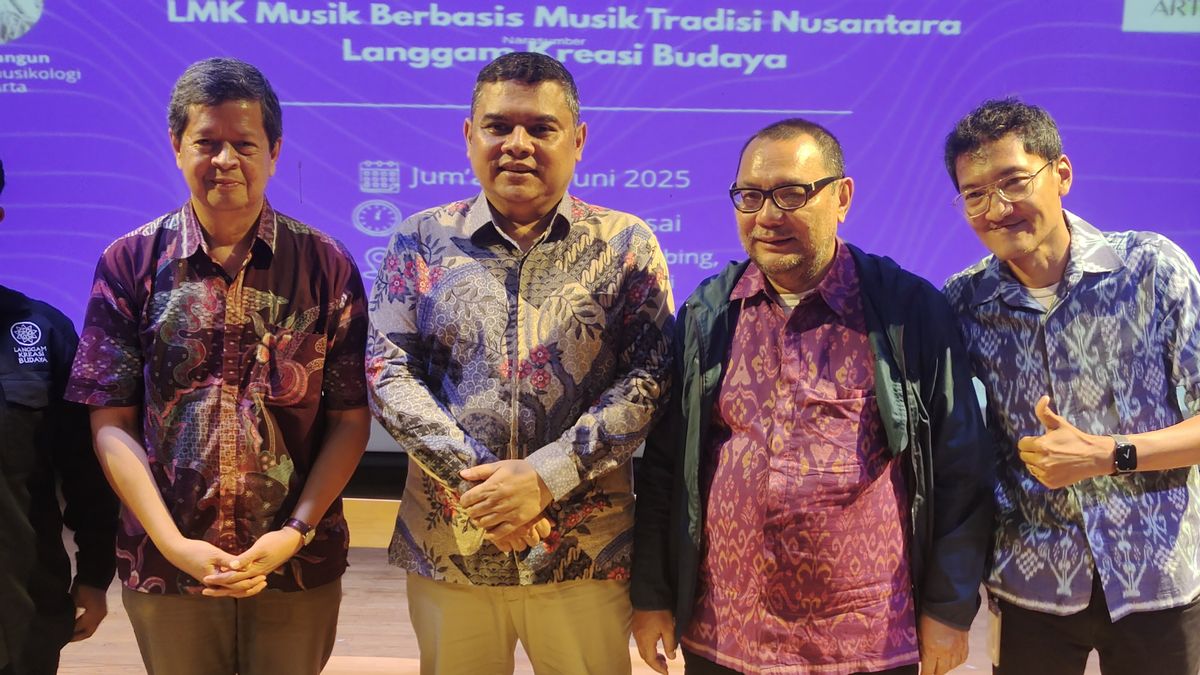


JAKARTA - Talking about the copyright of music should not be indiscriminate, especially if we want a better and fair ecosystem for everything. But in reality, the talk only focuses on names that are known to the public, without paying more attention to the perpetrators who work hard and are far from the camera.
Different from the realm of popular music, traditional music is often considered one-sided, maybe because it is less commercial or still considered ancient so that the rights that traditional music actors should get are neglected.
One thing that is fundamental to the protection of traditional musicians is the fulfillment of the economic rights of the works they produce.
This became the main topic in a public discussion held at Taman Ismail Marzuki, Central Jakarta on Friday, June 30, where the main discussion was centered on the importance of the Collective Management Institute (LMK) based on traditional Indonesian music.
So far, there are three LMKs based on traditional music, namely the Cultural Creation Langgam (LKB) as the Copyright LMK, Citra Nusa Swara (CNS) as the LMK for the Performance, as well as Pro Karindo Utama (PKU) as the LMK for the Right to the HONogram producer.
Candra Darusman, a musician who also serves as the Supervisor of the National Collective Management Institute (LMKN), welcomed the existence of LMK which focuses on traditional music.
SEE ALSO:
According to Candra, there are many cases where traditional musicians can get economic rights from their works, both traditional songs that have become public domains and new works that they create themselves.
I call it traditional music there are two poles. One pole is a song that is still protected by copyright, another pole is a song that is outside the copyright regime," said Candra. Here, uniquely from LMK Langgam Cultural Creation bridges these two poles.
For one example, Candra explained the case where traditional musicians performed songs by someone who had died 140 years ago. Then the show was recorded and uploaded on digital platforms, such as YouTube.
Since the Copyright Law regulates that economic rights are only valid for up to 70 years since the creator dies, the economic rights are no longer in effect. However, musicians who show it are still entitled to receive royalties through related rights.
"If a concert tradition orchestra at the Tourism Office, is recorded, the recording is broadcast on YouTube, then the rights arise for the musicians, the perpetrators. Even though the song no longer has copyright," said Candra.
In addition, Shatria Dharma as LKB Chair stated that the toughest challenge when dealing with traditional music and its musicians is the lack of awareness regarding copyright. In addition, many new works are only displayed, without recording.
"That's why there is an event (discussed) like this so that we can socialize it to traditional musicians," said Shatria.
Shatria believes that the huge economic potential should be the right of traditional musicians. Until now, his party is still gathering so that the musician wants to register his work and joins as a member of the LMK.
"So far, our members, although they still get a small amount of coffers, at least they have experienced royalties or economic rights from their work," concluded Shatria Dharma.
The English, Chinese, Japanese, Arabic, and French versions are automatically generated by the AI. So there may still be inaccuracies in translating, please always see Indonesian as our main language. (system supported by DigitalSiber.id)
Most Popular Tags
#Prabowo Subianto #donald trump #Febrie Adriansyah #8791 #giias 2026Popular


