

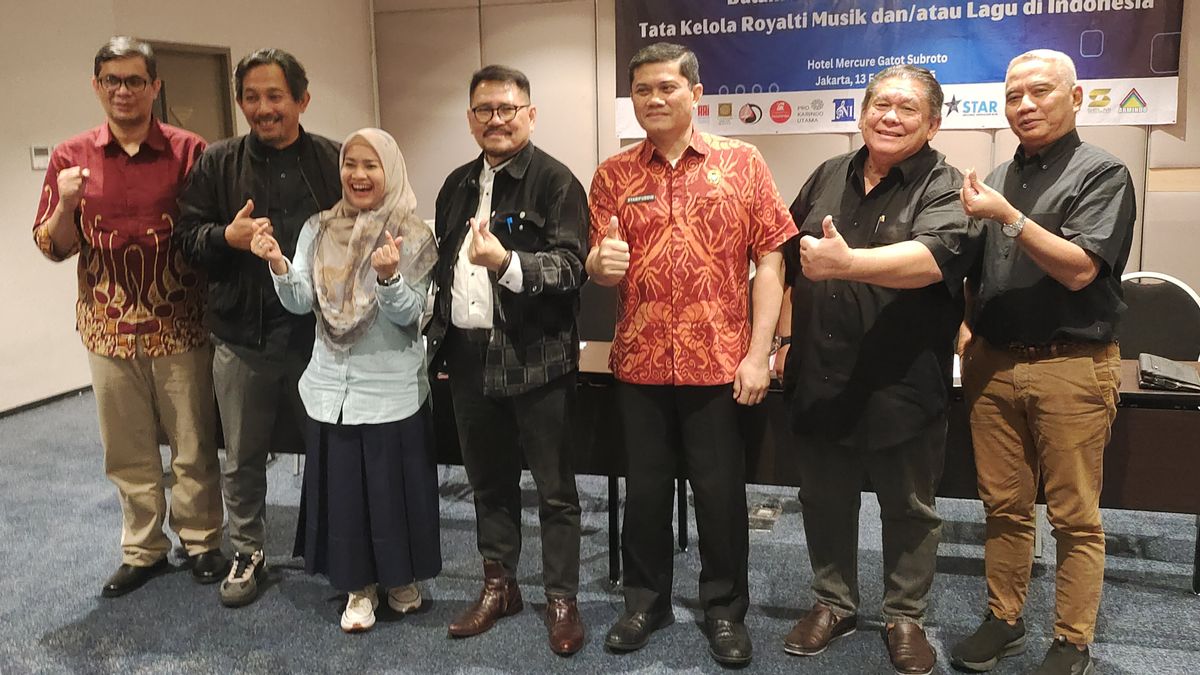


JAKARTA - The National Collective Management Institute (LMKN) as an institution to assist non-APBN governments in managing the interests of economic rights (royalti) Creators and owners of Related Rights in the field of music, issued a statement of attitude on the pros and cons of the Ari Bias and Agnez Mo cases.
As is known, the Central Jakarta Commercial Court in its decision, granted part of Ari Bias' lawsuit, and stated that Agnez Mo had committed copyright infringement and sentenced him to pay a loss fine of Rp. 1.5 billion.
Dharma Oratmangun as Chair of the LMKN during a press conference after holding a public discussion at Gatot Subroto, South Jakarta on Thursday, February 13, read out the six points that became LMKN's statement.
"That LMKN is very concerned about the impact that is developing in society, especially music ecosystem stakeholders, on the decision of the Ari Bias Commercial Court against Agnes Monica as seen in the polemic on social media. The songwriters and performers (singers) argued with each other in the disagreement over the decision of the Commercial Court," said Dharma, reading out the first point.
In the second point, said Dharma, LMKN respects everyone's right to take legal action, when they feel that their rights have been harmed. This is in line with LMKN which also respects every court decision until the decision has permanent legal force.
Then in the third point, Dharma said, his party is always guided by the applicable laws and regulations, in carrying out their duties and authorities.
The regulation in question includes Law No. 28 of 2014 concerning Copyright (UUHC), Government Regulation No. 56 of 2021 concerning the Management of Song and/or Music Copyright Royalties (PP No.56 of 2021), and Regulation of the Minister of Law and Human Rights No. 9 of 2022 concerning the Implementation of Government Regulation No. 56 of 2021 (Permenkumham No. 9 of 2022).
"LMKN bases the management and protection of rights on the common thread that is inseparable from the three articles in the UUHC, namely Article 9 which protects the right of song creators... Article 23 paragraph (5) that protects Performers... Article 87 paragraph (5) that protects users," said Dharma.
"These three articles are not contradictory but complement each other and protect creators, performers, and song and/or music users," he continued.
At the fourth point, Dharma urges Users to apply for licenses and pay royalties for performing rights, such as what is the provisions of legislation and habits that apply around the world.
The obligation to pay royalties for performing rights is placed on Commercial Users. On that basis, LMKN performs royalties withdrawal tasks aimed at Users. For this reason, LMKN urges song users and/or music in public areas for commercial purposes, obey the law by obtaining licenses and paying royalties. If Users comply with the law, then cases like Ari Bias and Agnes Mo will not happen," he said.
Furthermore, in the fifth point, said Dharma, LMKN appealed to this case not to develop into a precedent where songwriters are suing or suing singers, but jointly proactively remind and require Users to pay royalties.
SEE ALSO:
-
 | MUSIK
LMKN Tegaskan Tidak Boleh Ada Intervensi dalam Proses Hukum Ari Bias dan Agnez Mo
13 Februari 2025, 22:45


"The obligation to pay royalties by this user should be included as a clause in the agreement between the Performers of the Show and the Users. LMKN proposes that it be agreed on a standard clause that must be included in the agreement," added the Head of the LMKN.
At the last point, Dharma admitted that his party had not yet maximally withdrawn royalties according to existing potentials. He said several obstacles had to be faced, such as weak law enforcement as well as withdrawing systems technology and royalty distribution that had not yet supported.
"For this reason, LMKN has started a collaboration with several IT vendors who will help upgrade LMKN royalties management. Regarding regulations, LMKN urges the government to attend," said Dharma.
"In music performance activities, LMKN again urges the Ministry of Law and the Indonesian National Police to make a Joint Decision that requires Users to obtain licenses and pay royalties, so that before there is an LMKN recommendation, the licensing process cannot be carried out. It is hoped that with this decision, users will carry out their legal obligations," he said.
The English, Chinese, Japanese, Arabic, and French versions are automatically generated by the AI. So there may still be inaccuracies in translating, please always see Indonesian as our main language. (system supported by DigitalSiber.id)
Most Popular Tags
#Prabowo Subianto #donald trump #2026 World Cup #Febrie Adriansyah #8791Popular


