

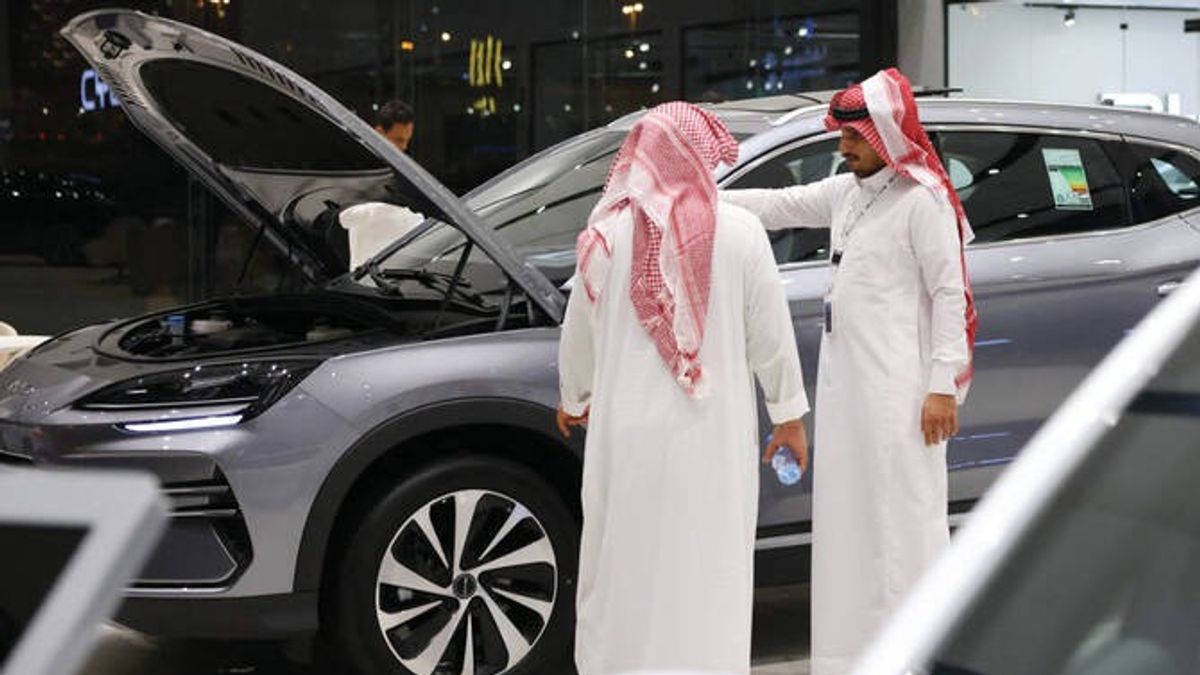


JAKARTA - Saudi Arabia is starting to become an important player in electric cars in the Middle East. In the midst of the region's efforts to reduce dependence on oil, sales of electric vehicles or EVs in the Middle East will rise 40 percent by 2025.
According to a report by Arab News citing the International Energy Agency or IEA, quoted on Saturday, May 30, EV sales in the Middle East reached around 75,000 units in 2025. Saudi Arabia and Qatar account for about 45 percent of regional demand.
EV is an abbreviation for electric vehicle, which is a vehicle that uses electric power from batteries.
The United Arab Emirates is still the largest market for electric cars in the Middle East, with almost 50 percent of sales. But its share has fallen from more than 60 percent in 2023 as Saudi Arabia and Qatar start to move faster.
In Saudi Arabia, the push for electric cars is part of the Vision 2030 strategy. The kingdom is targeting net zero carbon emissions by 2060. Riyadh is also targeting 30 percent of electric vehicles by 2030, as part of efforts to reduce the capital's emissions by 50 percent.
Joseph Salem of Arthur D. Little Middle East said this change was driven by local manufacturing investment, including Lucid and Ceer facilities in King Abdullah Economic City.
Lucid Motors is expanding the AMP-2 facility with a target capacity of 150,000 full-assembled vehicles per year. Meanwhile, Ceer, a local EV brand from a collaboration between the Public Investment Fund and Foxconn, is building a 1 million square meter factory with a production target of up to 240,000 vehicles per year. Its launch is targeted for the end of 2026.
Cararak CEO Hashim Al-Fatayerji told Arab News that the growth of Saudi Arabia's EVs reflects a major shift in the GCC region, the Gulf Cooperation Council. The drivers include Vision 2030, infrastructure investment, EV manufacturing projects, and the electrification of vehicle fleets.
"The young population of this region is also more willing to adopt and try new technologies," said Al-Fatayerji.
Safak Yucel from Georgetown McDonough assessed that the UAE's EV market is still dominated by premium vehicles. On the other hand, Saudi Arabia and Qatar are beginning to move towards the mass market. This could expand EV adoption in the region.
The market map is also changing due to the entry of new players. The IEA noted that when electric car sales began to rise in the Middle East in 2020, the US-made Tesla accounted for about half of sales. Now Tesla's share has dropped to about 15 percent.
In contrast, BYD, which entered the regional market in 2022, grew rapidly and now controls about 60 percent of regional EV sales.
According to Salem, the appeal of EVs in Saudi Arabia is also supported by the decline in global battery prices and the entry of more competitive Chinese electric cars. However, the general market still faces obstacles, especially the availability of charging stations, vehicle performance in extreme heat, and resale value.
Charging networks are the next key. ADNOC Distribution in the UAE is expanding its fast and superfast charging network to 400 points by early 2026. In Saudi Arabia, the Eviq joint venture is targeting the installation of 5,000 fast chargers by 2030 to support intercity travel.
"The main lesson is that EV adoption depends on the development of a complete ecosystem, not just selling vehicles," said Al-Fatayerji.
Globally, the IEA estimates that electric car sales will reach 23 million units by 2026, or almost 30 percent of all global car sales. By 2025, global EV sales have already exceeded 20 million units.
China remains the largest center of EV production. Chinese manufacturers supply 60 percent of the world's electric cars sold and produce almost three-quarters of the approximately 22 million global electric cars last year.
EV growth in the Middle East is now not only supported by vehicle sales. IEA data and analyst views show that plant expansion, charging networks, more affordable prices, and consumer confidence are important factors for accelerating the adoption of electric cars in the region.
The English, Chinese, Japanese, Arabic, and French versions are automatically generated by the AI. So there may still be inaccuracies in translating, please always see Indonesian as our main language. (system supported by DigitalSiber.id)
Most Popular Tags
#Prabowo Subianto #donald trump #firearm #8791 #giias 2026Popular


