

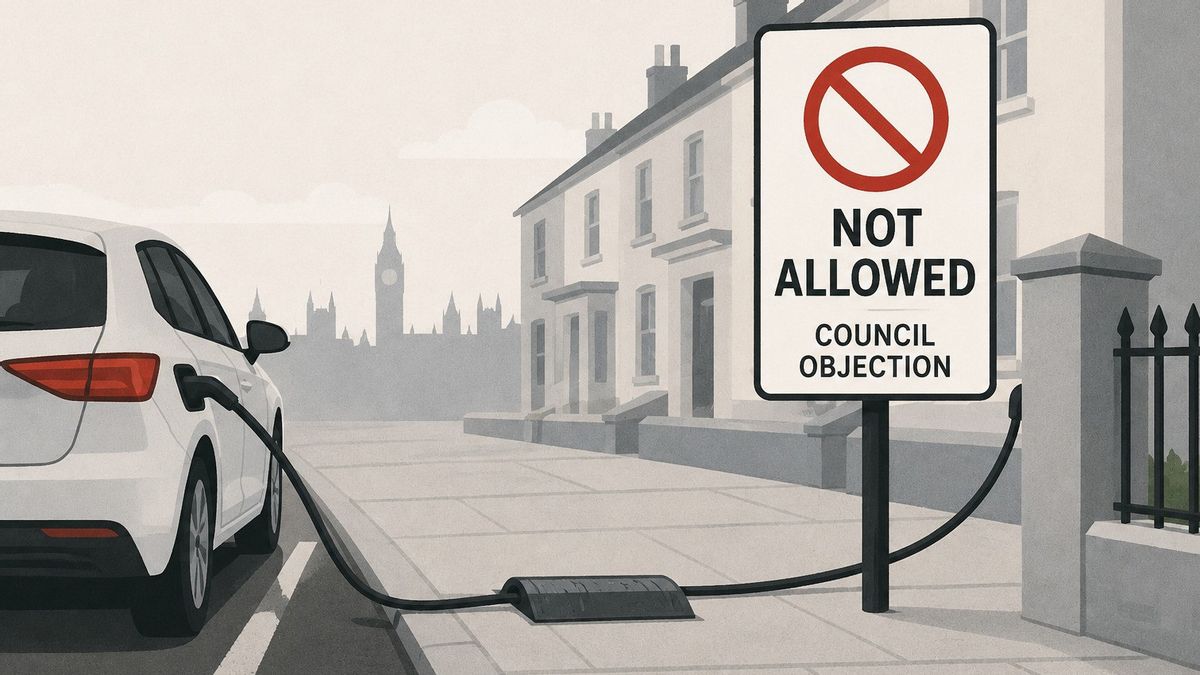


JAKARTA - The UK's plan to accelerate the use of electric cars is still stuck on a seemingly simple problem: cables crossing the sidewalk. In many areas, residents who want to charge electric cars from home still have to deal with local council rules.
According to a report by The Guardian, quoted on Saturday, May 30, more than 20 local authorities in the UK still refuse to install gully chargers, that is, small channels in the sidewalk to place charging cables so that they do not scatter and do not make people stumble.
British Energy Minister Ed Miliband previously said the technology could help cut costs for electric vehicle owners.
The cost of charging from home electricity is much cheaper than public chargers. In the UK, home electricity for electric vehicles is subject to a 5 percent VAT, while public chargers are subject to a 20 percent VAT.
However, according to consultants Field Dynamics, around 9.3 million households in the UK do not have access to private parking. This means that many electric car owners find it difficult to enjoy cheaper home electricity.
EV is an abbreviation for electric vehicle or electric vehicle. In this context, EV refers to an electric car that requires battery charging.
The rejections came from Kent, Leicester, Worcestershire, as well as a number of London boroughs such as Westminster and Hackney. A borough is an administrative area at the district level in large cities such as London.
The Guardian reported that London has the highest number of electric cars in the UK, as well as the largest number of households without private parking.
Manufacturers of gully chargers such as Kerbo Charge, Gul-e, Pavecross, and ACO say their technology is safe. The cable is inserted into a small path so that the pavement surface remains neat.
However, many local councils are still opposed. Local authorities or local councils are local governments that regulate public services, roads, parking, and licensing in their respective areas.
"Installation still requires local government approval," said one of the founders of Kerbo Charge, Michael Goulden.
His company is working with 48 local authorities that have already allowed or are testing the technology. But the rules are different in each region.
Some of the board are concerned about who will take care of the cable line. There are also those who question legal responsibility if someone stumbles and is injured.
Leicester City Council considers that many terraced houses in its area cannot always get a parking space right in front of the house. Kent is concerned that damaged cables can pose a risk of electric shock.
Worcestershire has refused to demolish or damage roads to install EV charging connections, although it still allows for cable protectors in the form of ramps on the pavement.
In west London, Ealing Council is concerned about the safety of the elderly, disabled, wheelchair users and residents with vision impairment. They chose to increase public chargers on lamp posts.
Westminster judged the gully charger to be unsuitable for densely populated urban areas. Hackney wants to reduce the objects that fill the streets and prioritize pedestrians and mobility tool users over private vehicles.
The UK government has removed the obligation for planning permission to speed up installation. However, installers still need a road works permit from the local council.
"Each has a different process," said Gul-e's director, Adam Dolphin. "It doesn't mean they are deliberately hindering. They are still going through the process."
This obstacle shows that the transition to electric cars does not only depend on batteries and charging stations. In the UK, rules on sidewalks and local government permits also determine who can charge cheaper than at home.
The English, Chinese, Japanese, Arabic, and French versions are automatically generated by the AI. So there may still be inaccuracies in translating, please always see Indonesian as our main language. (system supported by DigitalSiber.id)


