

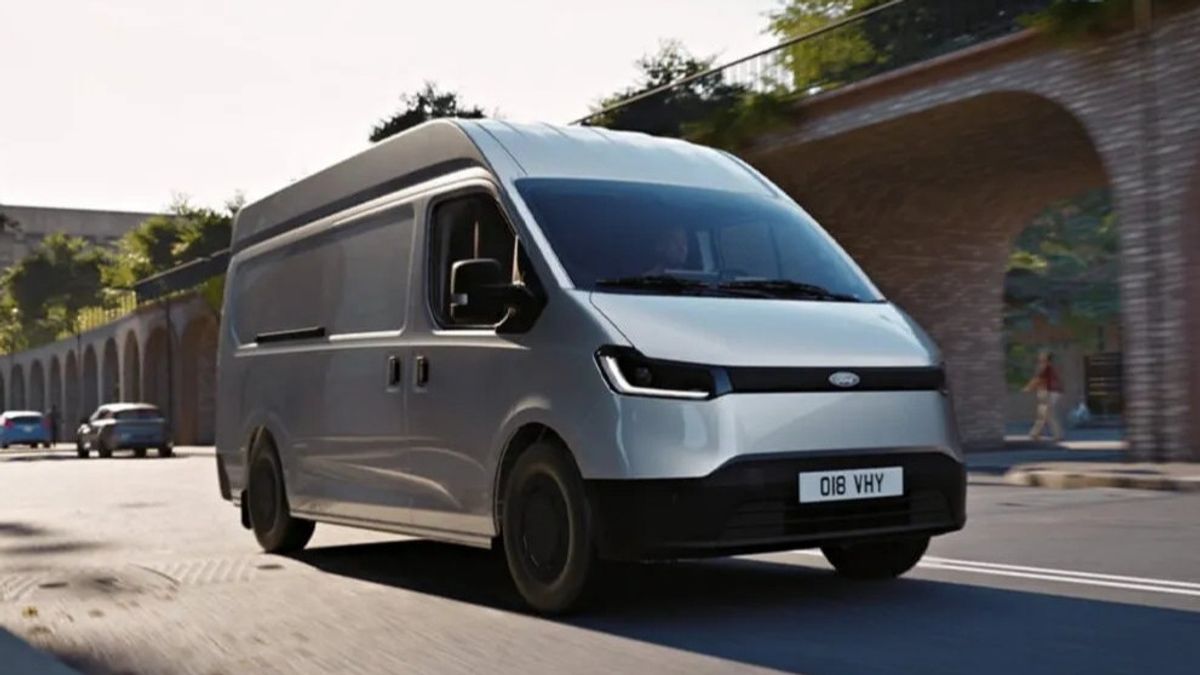


JAKARTA - Ford Pro continues to expand its commercial vehicle line with the introduction of a new model called Transit City. Although it already has a line of electric vans such as the E-Transit Custom and E-Transit, this manufacturer continues to add new options that target cost efficiency and daily operational needs.
Transit City is built on an electric vehicle platform developed by Jiangling Motors Corporation (JMC) and assembled in China, with a target market of mainland Europe and the UK. To reduce production costs, Ford applied a very simple approach.
Transit City is only available in one variant without additional options, so there is almost no room for personalization. This philosophy is also reflected in the exterior design which is made straightforward, carrying modern LED lights connected to a closed grille, a clean body without many ornaments, black rims, and plastic bumpers without paint which emphasize the orientation of efficiency.
In terms of configuration, this model is offered in three body options, namely a standard panel van, a high roof version with a long wheelbase, and a cabin chassis variant prepared as a conversion base by aftermarket industry players.
Its carrying capacity is quite competitive, ranging from 1,085 kg to 1,530 kg depending on the specifications. Meanwhile, the largest variant can accommodate up to 8.5 cubic meters of cargo with a load space length of 3,070 mm.
Although it carries the economic concept, the features embedded are still complete. The interior is equipped with a 12.3-inch touchscreen with the Ford SYNC 4 infotainment system, a digital instrument panel, and various storage compartments.
Reported by Carscoops, Friday, March 27, safety and comfort features are not overlooked. Starting from adaptive cruise control, lane-keeping assist, front-rear parking sensors, reverse camera, to heated driver's seat.
Unlike other Ford Pro lines, the Transit City comes as a pure electric vehicle without internal combustion engine or hybrid options. Ford claims that using this system can reduce maintenance costs by up to 40 percent compared to diesel-powered vans.
Technically, this vehicle uses a ladder frame chassis developed by JMC, combined with a 148 hp front electric motor. The energy source comes from a 56 kWh Lithium Iron Phosphate (LFP) battery that allows a range of up to 254 km based on the WLTP standard.
Although it is considered moderate, Ford said that most users in this segment average less than 110 km per day. For charging, the Transit City supports DC fast charging up to 87 kW, which is able to add 50 km of mileage in 10 minutes, or charge the battery from 10 to 80 percent in about 33 minutes.
Meanwhile, charging using an AC 11 kW takes about five hours to full. Regarding price, Ford has not officially announced, but the position of the Transit City is confirmed to be between the E-Transit Custom and the E-Transit, which are currently priced starting at 43,630 euros and 49,545 euros.
The English, Chinese, Japanese, Arabic, and French versions are automatically generated by the AI. So there may still be inaccuracies in translating, please always see Indonesian as our main language. (system supported by DigitalSiber.id)


