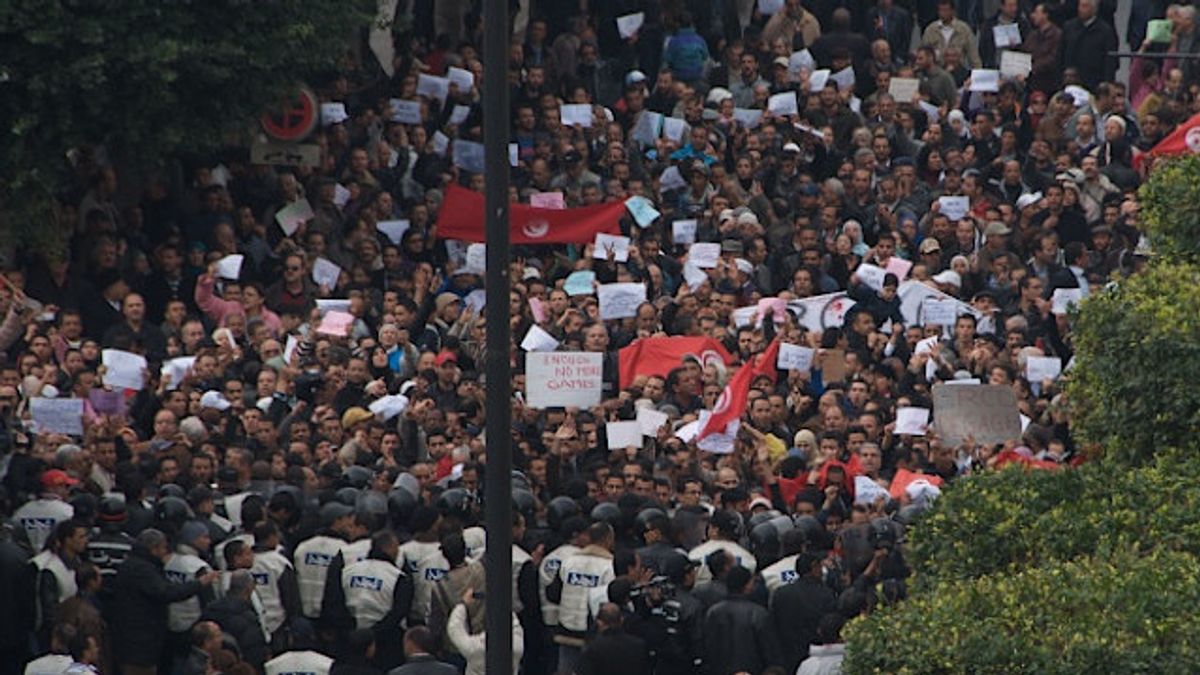


JAKARTA - The strength of young people cannot be underestimated. They are often martyred by struggle. Once injustice arises, young people move against it. Take for example when the Arab Spring Middle East Revolution.
Turbulent young Tunisians against corrupt and authoritarian governments inspire other Middle Eastern youth. The art of using social media to mobilize aid and support is the estuary. An solidarity that is able to overthrow many dictators in the Middle East.
Young people who are familiar with social media are often underestimated. They are often labeled lazy by the old generation. Sometimes it is also considered an example of the state's failure to build the next generation of the nation. However, everything changes when injustice arises.
Take for example Tunisian youth. Tunisian youth are no longer able to be under the government of Zine El Abidine Ben Ali. Ben Ali's power has been going on since 1987. He likes to turn his country into an authoritarian, corrupt country too. The life of the Tunisian people fell to its lowest level.
Young people find it difficult to find work. His old generation is far from welfare. Instead of Ben Ali caring, the power owner actually thinks about how to continue to be in power. In fact, with his nephew Ben Ali was nicknamed Ben a Vie which means a lifetime president.
Young people who refuse their power to be brushed off. However, the government's reckless actions that raided Mohamed Bouazizi's fruit cart in Sidi Bouzid City changed everything. Boauzizi had time to go to the city hall to ask for his cart back. However, it was ignored.
As a result, the fruit trader set himself on fire in front of the local Governor's Office on December 17, 2010. The self-immolation took the whole of Tunisia. As a result, young Tunisians began to take advantage of their social media from Facebook, Twitter, to Youtube to seek support.
They want to overthrow Ben Ali's power. Each platform tries to be utilized optimally. In fact, there is its own function. Facebook to spread news of the action took to the streets. Twitter for coordination. The rest YouTube to notify the world. The result was garnered and Ben Ali stepped down on January 14, 2011.
Social media has a huge impact on delivering news to the outside world, while bloggers and Twitter users can spread short news that has never previously reached mainstream media. This information has played an important role in attracting the attention of world citizens who express solidarity with these oppressed individuals.
They may even pressure their own government to react. Another use of social media is to send information about medical needs, important phone numbers, and the frequency of Al Jazeera's persistent satellites, "said Peter Beaumont in his writing on The Guardian page entitled The Truth about Twitter, Facebook and the Uprisings in the Arab world (2011).
The struggle of young Tunisians to overthrow the dictator's regime brought a stir everywhere. In fact, the struggle spread to other middle eastern countries. This condition is because the government is not much different: it smells authoritarian and corrupt.
The country that then tried to follow Tunisia's success was Egypt. Hosni Mubarak's leadership is considered a failure. Many undergraduate graduates in Egypt are unemployed. Not to mention that the ruling regime is anti-criticism.
Gelora protested that young Egypt began to be crowded on various social media. The move follows the movement of young people in Tunisia. This solidarity makes young people look for support and logistics. The world community also supports the struggle of the Egyptian people.
The action took place everywhere for 18 days. The government had turned off the internet. Hosni's regime considers the move as part of breaking the chain of resistance. However, the guess is wrong. Protests continue to grow.
Like it or not Hosni stepped down from his pocket which he sat on for three decades on February 11, 2011. Like the domino effect of youth actions with his social media movement inflamed other mass actions in Libya, Bahrain, and Syria.
SEE ALSO:
-
 | MEMORI
Polemik Peretasan Bjorka: Omong Kosong Klaim Peretas Sudah Diketahui BIN dan Polri
04 Oktober 2025, 06:45 -
 | MEMORI
Aktivisme Leonardo DiCaprio: Aksi Aktor Hollywood Kritik Kerusakan Hutan di Indonesia
02 Oktober 2025, 08:45

A series of actions prove that the strength of young people cannot be underestimated. Young people in the middle east do not believe in television because they think television is the ball of the rulers. Something that makes them more confident in the wave of information via social media.
As a result, many people call Arabia Spring a Facebook Revolution. There are also those who call it a Twitter Insulation.
While the revolution in Tunisia, Egypt, Libya and Yemen is a form of disappointment with repressive power and frustration with economic hegemony. Ironically, these authoritarian regimes are actually familiar with countries that drive democratic principles.
"Zein al-Abidin bin Ali, Hosni Mubarak, Ali Abdullah Saleh, and even Muammar Gaddafi in the final period of his government had intimate relations with the governments of the United States and European countries. Public narratives cannot digest the logic. The solution: power must be contributed. Because, democratic mechanisms, such as general elections, are not capable of being used as a tool of resistance, "said Muhammad Ja far in his writing in Tempo magazine entitled Arab Revolution: The Beginning of a Story (2011).
The English, Chinese, Japanese, Arabic, and French versions are automatically generated by the AI. So there may still be inaccuracies in translating, please always see Indonesian as our main language. (system supported by DigitalSiber.id)
Most Popular Tags
#Prabowo Subianto #donald trump #firearm #8791 #giias 2026Popular