


JAKARTA - The concept of a healthy school is not only related to environmental cleanliness. There are many factors that include it such as good eating habits, physical activity, mental health, to concern for environmental sustainability.
Various schools in Indonesia have also begun to develop innovative programs to build healthy living habits that can be applied sustainably by students and all school residents.
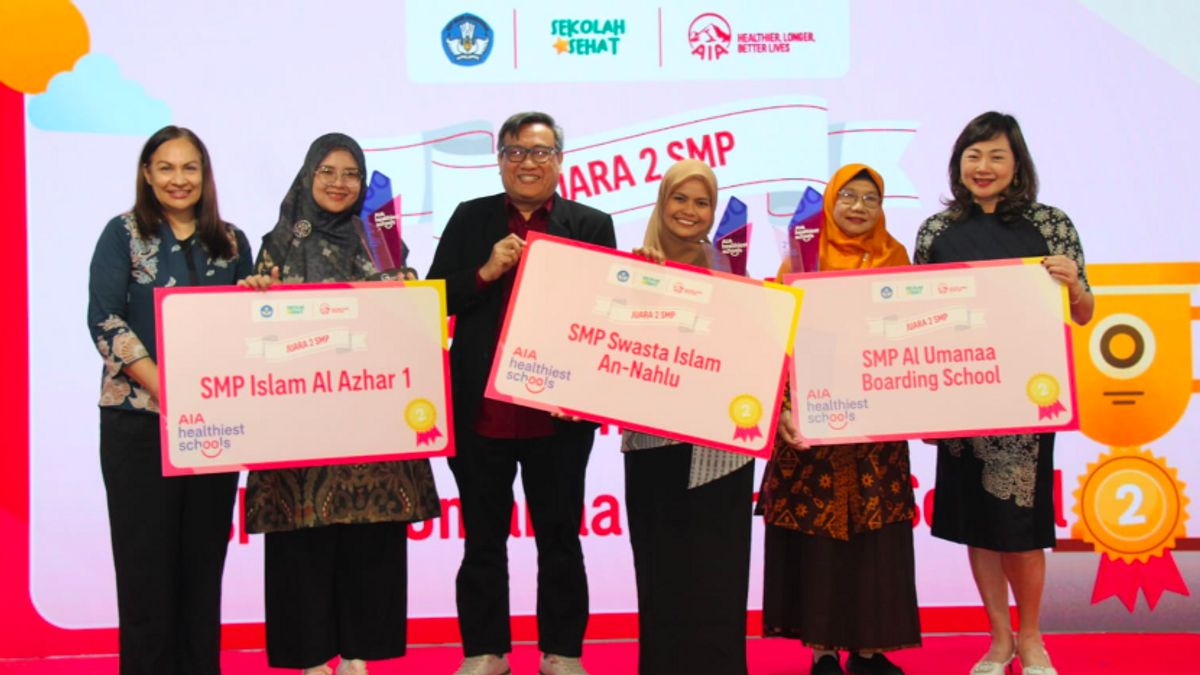
In line with these efforts, various parties have also encouraged the birth of innovations and healthy school programs. Including for PT AIA Financial which gave appreciation to two schools that won the best national title in the AIA Healthiest Schools 2026 healthy school project competition.
The two schools are SDN Cipedak 01 as the winner of the Elementary School (SD) category and SMP IL Kapten Fatubaa as the winner of the Middle School (SMP) category.
The two schools will then represent Indonesia in the regional level competition which will take place in Bangkok in July 2026 with participants from various countries in the Asia Pacific region.
"We want to contribute to the quality of the nation's generation and make a healthy lifestyle part of every child's learning journey. That is the reason why AIA Healthiest Schools presents a learning module that is specifically designed for students in Asia Pacific including Indonesia which can be accessed for free, flexible, and fun, then followed by the Healthy School Project Competition," explained Harsya Prasetyo, President Director of AIA.
AIA Healthiest Schools focuses on developing a healthier school environment through the provision of online learning modules for teachers as well as school project competitions that address the themes of healthy eating, active lifestyles, mental health, and a healthy and sustainable environment.
In this year's implementation, Indonesia recorded the highest number of participants compared to other participating countries. A total of 2,896 participants registered and produced 359 healthy school projects submitted in the competition.
AIA Chief Marketing Officer Kathryn Parapak assessed that positive changes in the school environment can begin with simple steps that are tailored to the needs of each school.
"The healthy school project does not have to start from something big, the most important thing is to understand the real challenges in each school environment, present relevant solutions, and ensure that the impact can be felt and measured sustainably. When teachers, students, parents, and communities move together, positive changes will be created stronger and last longer," said Kathryn.
For the Elementary School category, SDN Cipedak 01 Jakarta was selected as the winner through the GEMARIPAH SEGAR or Aah Segar Drinking Water Movement program. The program was born from findings regarding the high risk of dehydration in students due to the lack of habit of drinking water regularly.
Through a number of activities such as drinking schedules, water consumption monitoring cards, educational poster competitions, to the formation of Little Hydration Ambassadors, schools have managed to encourage changes in students' habits in meeting daily fluid needs.
Based on the results of the school evaluation, within seven days after the program began, the number of students who met the recommendation of consuming two liters of water per day increased from 12 percent to 98 percent. Meanwhile, the risk of dehydration, which previously reached 60 percent, was reported to have decreased to zero percent.
Meanwhile, the first secondary school category was won by SMP IL Kapten Fatubaa which is located in Belu Regency, East Nusa Tenggara, the border region of Indonesia and Timor-Leste.
The school won the award through the Huka Upcycling Project (HUP), a program that processes banana peel waste into useful products such as ice cream, compost fertilizer, and organic liquid fertilizer.
The program not only involves students in the school environment, but also invites students from Timor-Leste through collaborative seminars and product trials. The activity also benefits the surrounding community and local farmers who use the results of waste processing.
The evaluation of the competition is carried out based on a number of indicators, ranging from the relevance of the issues raised, the suitability of the solutions offered, the quality of program implementation, the impact generated, to the sustainability of the program in the long term.
Various projects born from this competition show that efforts to build healthy schools can be carried out through a simple approach but relevant to the needs of each school environment. The innovations developed by the participants are expected to serve as a reference for other schools in creating a healthier, inclusive, and sustainable learning environment.
The English, Chinese, Japanese, Arabic, and French versions are automatically generated by the AI. So there may still be inaccuracies in translating, please always see Indonesian as our main language. (system supported by DigitalSiber.id)
Most Popular Tags
#Prabowo Subianto #donald trump #Febrie Adriansyah #8791 #giias 2026Popular


