
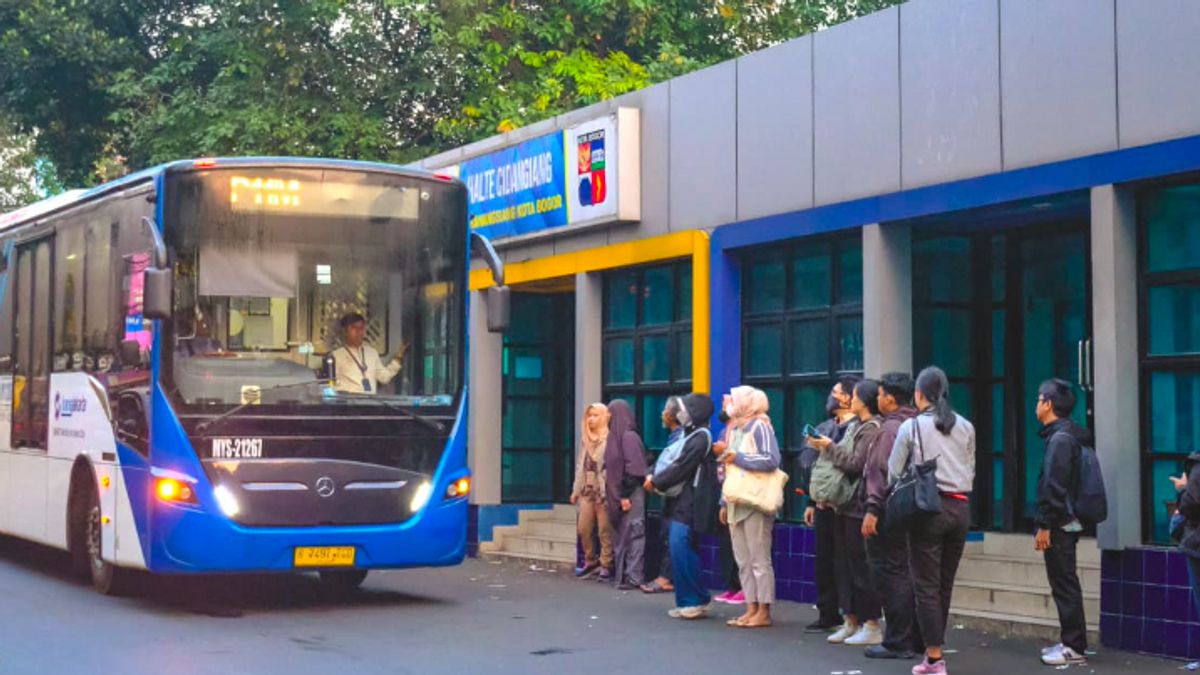


JAKARTA - The need for convenient, integrated, and easily accessible public transportation is now a major concern for urban communities, especially in the Jabodetabek area which has high mobility every day.
Not a few residents living in the buffer city have to travel long distances to Jakarta to work, school, and other activities.
However, cross-regional transportation systems that are not fully connected are still a challenge that public transportation users often feel.
Data shows that the Jabodetabek area records more than 4.4 million commuter movements every day. Of this number, about 1.5 million trips come from the Bodetabek area to Jakarta.
The magnitude of this community mobility is considered to require a transportation system that is not only adequate, but also integrated institutionally and inter-regionally.
In response to this condition, the Institute for Transportation and Development Policy (ITDP) Indonesia together with the Zero Net Emissions Vision Indonesia Foundation (ViriyaENB) held a Focus Group Discussion (FGD) entitled "Towards an Integrated Transportation Institution in Jabodetabek" in Jakarta on May 13, 2026.
The forum, which is part of the Comprehensive Low-Emission Action for Resilient Transport in Jabodetabek (CLEAR Jabodetabek) project, was attended by more than 60 participants from ministries, local governments, transportation operators, academics, to civil society organizations.
Director of Partnership and Integration of Infrastructure Development of the Ministry of PPN/Bappenas, Taufiq Hidayat Putra, assessed that the integration of transportation systems in the Jakarta agglomeration area has become an urgent need.
"More than 1.5 million commuter trips are made from Bodetabek to Jakarta every day, so there is a real need for integration of services, governance, and the Jakarta agglomeration area transportation system. The presence of the Jakarta Agglomeration Development Master Plan (RIPKA) is expected to answer that: synchronizing cross-regional and cross-sector planning, so that more connected and quality transportation services can really be realized in the field," he said.
Currently, cross-regional transportation services such as Transjabodetabek have begun to develop by serving 18 routes to the Bodetabek area. However, its management is still facing various obstacles, ranging from financing, sharing authority, to cross-regional asset management.
Most of the service operations are still supported by the DKI Jakarta Regional Budget, while the buffer area that also enjoys the service does not have a clear contribution mechanism.
The DKI Jakarta Provincial Government also assessed that cross-regional transportation integration could no longer be delayed.
"Public transportation integration needs to continue to be strengthened. One important aspect that must be implemented is the institutional integration of transportation, which is not only a coordination forum, but is actually able to accelerate the resolution of cross-regional transportation issues, reduce the burden of emissions, and improve the quality of public transportation services for the people of Jabodetabek," said Assistant for Economy and Finance of the DKI Jakarta Provincial Secretary, Suharini Eliawati, who was represented by Ujang Harmawan as Acting Head of the DKI Jakarta Transportation Service.
Meanwhile, the Director of Southeast Asia ITDP, Gonggomtua Sitanggang, said the forum was a first step to build a more integrated regional transportation system.
"As part of these efforts, ITDP together with ViriyaENB is committed to presenting a scale agglomeration transportation model for Jabodetabek as a contribution to Jakarta ahead of the 500th anniversary of this city next year. This data-based modeling is expected to become a foundation in planning and making sustainable transportation policies in Jabodetabek in the future," he explained.
In the discussion, a number of major issues that hinder transportation integration were also discussed, ranging from overlapping authorities between institutions, unclear division of subsidy burden, to the management of cross-provincial transportation assets that are still separate.
Forum participants also assessed that a more equitable and data-based financing system was needed so that public transportation services could run more optimally.
One of the proposals that has emerged is the development of an account-based ticketing system or Account-Based Ticketing to help calculate subsidies and contributions between regions in a more transparent manner.
In addition, there is also a recommendation for the establishment of an integrated transportation institution in Jabodetabek which can become a forum for cross-regional coordination without having to replace existing operators.
Through this effort, the public transportation system in Jabodetabek is expected not only to be able to accommodate the increasing mobility of urban communities, but also to provide more comfortable, efficient, and environmentally friendly services in the future.
The English, Chinese, Japanese, Arabic, and French versions are automatically generated by the AI. So there may still be inaccuracies in translating, please always see Indonesian as our main language. (system supported by DigitalSiber.id)


