

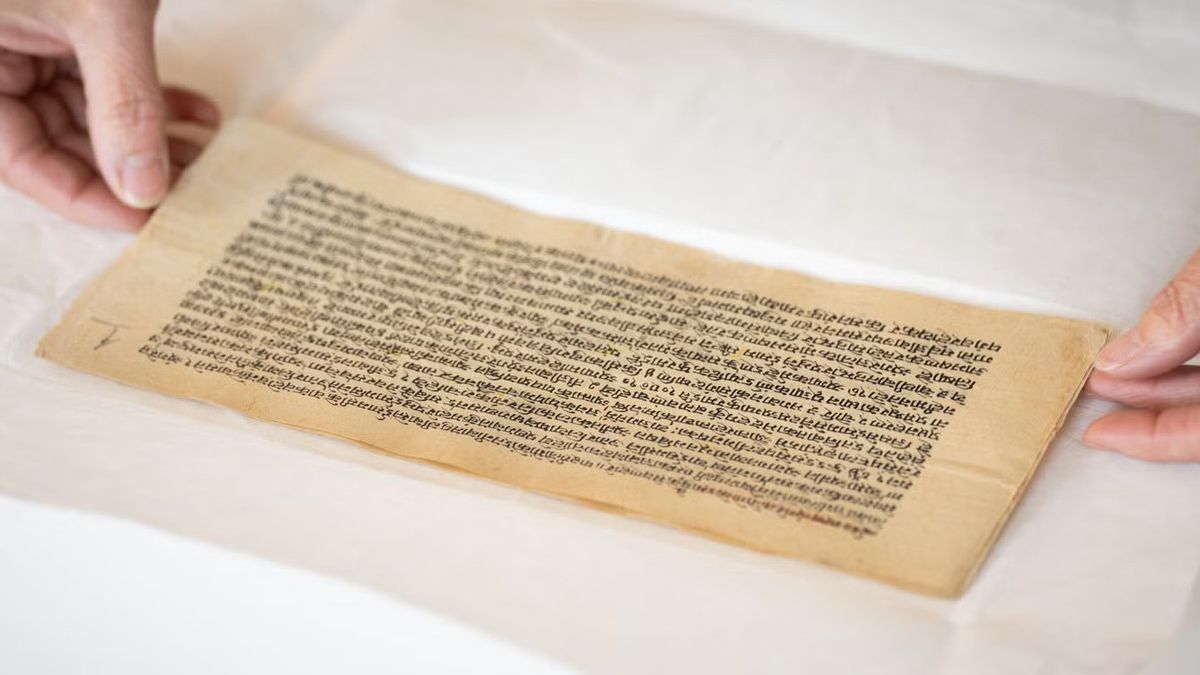


JAKARTA - More than 2,000 historical Jain manuscripts will leave the Wellcome Collection in London. However, this rare collection is not sent to India or Pakistan, but to the Dharmanath Network in Jain Studies at the University of Birmingham.
The Independent reported Tuesday, May 19, that Wellcome Collection decided to return the manuscript to the Jain community after concluding that most of the collection was obtained "at a low price and against the best interests of the original owner".
The collection is the largest collection of Jain manuscripts outside South Asia. The manuscripts were obtained in 1919 by Sir Henry Wellcome's agent, a pharmaceutical entrepreneur and collector.
More than half of the collection is said to come from a Jain temple in Punjab, an area that is now part of Pakistan. The temple no longer exists. Acquisition records show that the Wellcome agent paid 5 rupees for each manuscript. Its value is around 0.8 pence based on the current exchange rate.
A Wellcome Collection spokesperson told The Independent the manuscript was then insured for shipment to the UK for 22,000 rupees or 170 pounds sterling. The archive also shows Wellcome agents knew the manuscript was obtained below its true value, while the seller did not understand the real price.
The return agreement was signed by the Wellcome Trust, the Institute of Jainology, and the University of Birmingham in the House of Commons on May 14. This process was carried out after several years of discussion.
The manuscript covers a span of five centuries. It includes religion, literature, and medicine in Prakrit, Sanskrit, Gujarati, Rajasthani, as well as early Hindi scripts.
One of the important manuscripts is a 16th-century illustrated copy of the Kalpasutra. This text contains the stories of Jain spiritual teachers, including Mahavira. There is also a damaged manuscript from 1688 that is suspected of containing the oldest copy of Vaidyamanotsav, a medical treatise written in 1592.
The collection also includes anti-colonial texts that are said to be early examples of criticism of the ethical basis of British rule in India.
Although it is called the return or restitution of cultural objects, the manuscript remains in the UK. The collection will be transferred to the Dharmanath Network in Jain Studies at the University of Birmingham. According to the Wellcome Collection, it is considered the most appropriate place to care for the manuscript while providing access for researchers and the Jain community.
Wellcome Collection called this deal the first such return for the institution. The transfer will be carried out gradually for five years, while completing an audit of the collection.
Dharmanath Network was established in 2023 and is supported by the Jain community in the United Kingdom, United States, and India. The institution plans to open access for researchers and communities who are able to read, interpret, and translate the manuscript.
The decision not to send the collection to India or Pakistan is related to the region's complicated history. Many manuscripts come from the region that is now Pakistan. After the separation of India and Pakistan, many Jain communities were expelled and their temples were abandoned.
India now has around 4.45 million Jain adherents according to the 2011 census. In the UK, the Jain community is estimated to number around 60,000 people.
Managing trustee of the Institute of Jainology, Mehool Sanghrajka, told The Independent that some of the manuscripts may not have survived the turmoil in India after independence.
Daniel Martin of the Wellcome Collection said the deal acknowledged the harm caused by the unethically acquired and stored cultural heritage.
The case comes as British museums and institutions continue to come under pressure to return artifacts from former colonies. In March, the Ashmolean Museum returned a 16th-century bronze statue of Saint Tamil Tirumankai Alvar to India. The British Museum is also still facing pressure from Greece to return the Parthenon statue.
The English, Chinese, Japanese, Arabic, and French versions are automatically generated by the AI. So there may still be inaccuracies in translating, please always see Indonesian as our main language. (system supported by DigitalSiber.id)


