
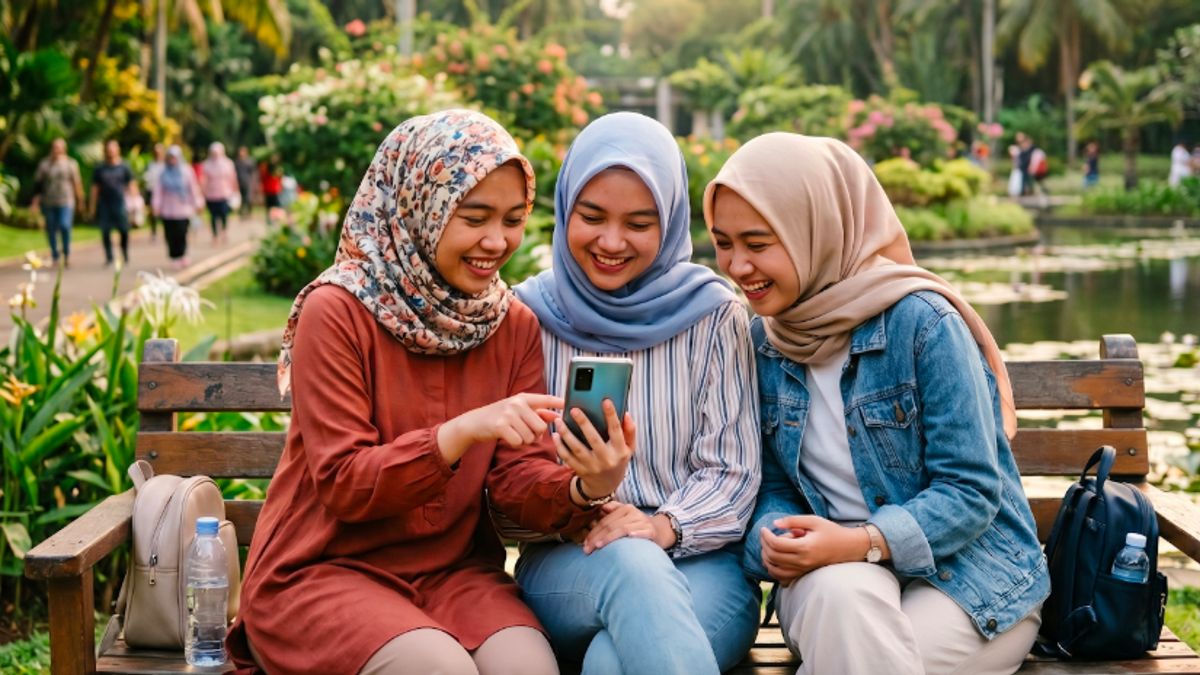


JAKARTA - As the needs of value and identity-based communities increase, a number of platforms are beginning to present a more specific approach, including for the global global community.
One of them is Salam.life, a Muslim-specific social network that is scheduled to launch internationally by the end of 2025. This platform tries to offer a different experience by presenting a cross-country digital interaction space designed to bring together Muslim users from various parts of the world without being hindered by language or geographical boundaries.
So far, social media user interactions tend to be limited within the scope of a particular country or language because the algorithms of large platforms such as Instagram and Facebook prioritize geographical proximity and local relevance. As a result, conversations between global Muslim communities are relatively rare organically in digital spaces.
Seeing this condition, Salam.life has a Universal Feed feature or a common home page that displays popular uploads from various countries in one global timeline.
The platform is also equipped with AI-based translation technology that can translate posts and comment columns into more than 30 languages in real time, including supporting right-to-left writing systems such as Arabic, Farsi, and Urdu.
Unlike translation features that are only complementary in conventional social media, translation technology in Salam.life is said to be the main foundation of the platform's architecture.
"At a time when an Indonesian citizen writes an opinion, then is answered by a Muslim from Bosnia using his own language, and the two can understand each other with their respective mother tongues,"
"The conversation that took place was no longer just a mere conversation, but a deep discussion about the tradition of takjil, news of the Islamic world, to the dynamics of the life of the people. For the majority of users, this is the first moment in their lives to be able to directly dialogue with their brothers in faith from other continents,"
This was stated by Yusuf Karim, Head of the Salam.life Partnership, in his statement to VOI, Tuesday, May 19.
Not only relying on translation technology, this platform also carries the concept of digital interaction based on adab. This platform implements a different approach than mainstream social media which has always focused more on moderation after a violation occurs.
In the platform, users are greeted using the term "Brother" and "Sister". In addition, the interaction space for men and women is separated in their respective timelines. Automatic systems are also applied to filter pornography, gambling, alcohol promotion, and abusive and provocative speech.
This approach is said to be inspired by the ethics of communication in Islam, including the spirit of maintaining healthy social interaction in the digital space.
SEE ALSO:


In addition to being a communication space, this Muslim digital platform is also starting to build an ecosystem for the global halal industry. Since the beginning of 2026, this platform has presented a Business Account feature aimed at media, halal brands, social organizations, and missionary institutions.
Through this system, content published by business accounts will be directly connected to the global timeline and can be accessed in various languages automatically. This is considered to open up new opportunities for Muslim content creators and industry players to reach an international audience.
Halal product manufacturers, Islamic media, and philanthropic institutions are said to be able to use this platform to expand their reach without being constrained by language or content distribution areas.
The presence of the platform is also considered relevant to the size of the world's Muslim population, which now reaches around 2 billion people based on Pew Research Center data 2025. However, sociologically, the majority of Muslims do not use Arabic as a daily language so that global communication barriers are still quite large.
Indonesia itself is considered to have a strategic position in the development of the global Muslim digital ecosystem. With a Muslim population of around 242 million and a high level of social media usage, Indonesia is one of the largest digital markets in the Muslim world.
The phenomenon of the development of digital dakwah content and the popularity of preachers on social media also shows the high consumption of Islamic content in Indonesia.
However, building a social media specifically for Muslims is not an easy matter. In the last decade, a number of similar projects have failed to develop due to weak business models to user data security issues.
The case of same platform, which was dragged into the issue of selling user location data to the acquisition of the others application by the parent company of Tinder, is an example that raises concerns about privacy among Muslim users.
Therefore, Salam.life emphasizes that their focus is not to build a platform based on data exploitation, but to provide a safe and comfortable digital communication space for the global Muslim community.
The English, Chinese, Japanese, Arabic, and French versions are automatically generated by the AI. So there may still be inaccuracies in translating, please always see Indonesian as our main language. (system supported by DigitalSiber.id)


