

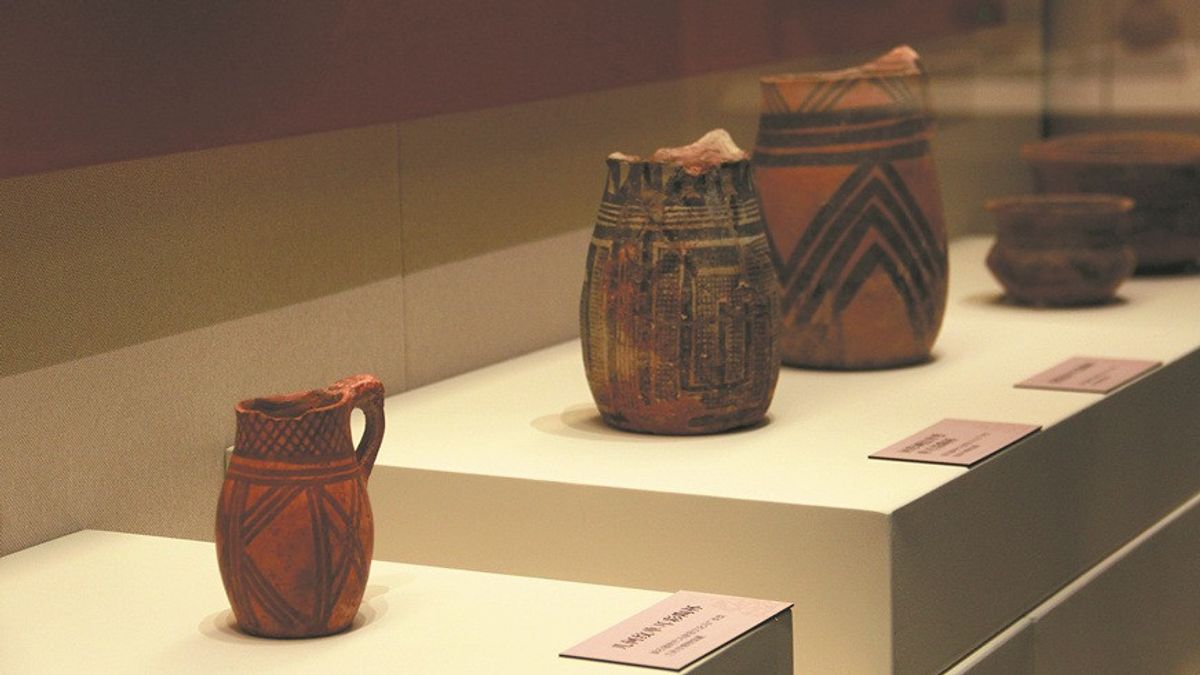


JAKARTA - The traces of patterned pottery from the Yellow River to the Tianshan Mountains are now on display at the Xinjiang Museum. This exhibition traces the journey of prehistoric ceramics that spread thousands of kilometers and became one of the early routes of cultural exchange before the Silk Road was widely known.
Citing a report by China Daily, Wednesday, May 13, the exhibition titled From the Yellow River Basin to Tianshan Mountains: Tracing the Westward Journey of Prehistoric Painted Pottery opened on April 10 and runs until July 10.
A total of 175 sets of pottery were exhibited. The collection comes from the Gansu Provincial Museum, the Xinjiang Museum, as well as 13 other cultural preservation institutions in Gansu and Xinjiang.
Thousands of years ago, the patterned pottery culture from the central and upper reaches of the Yellow River spread west through the Hexi Corridor in Gansu. From there, its influence moved to the north and south slopes of the Tianshan Mountains in Xinjiang, then blended with local traditions.
The motifs displayed show the skills of prehistoric artisans. There are geometric patterns, spirals, fish, flower petals, to abstract shapes resembling gods. Some containers are also decorated with eagle and goat head ornaments.
The curator of the exhibition, Wang Nannan, said Gansu and Xinjiang are connected by strong geographical and cultural roots. According to him, the spread of patterned pottery shows how the aesthetic taste and way of life of the early people move along with the objects.
The pottery distribution line intersects with the ancient Silk Road. Researchers call it the Painted Pottery Road or Painted Pottery Road. This term refers to an academic path to explain the spread of pottery culture from east to west, not the name of an official trade route such as the Silk Road.
Professor Han Jianye of Renmin University of China said that patterned pottery from Shaanxi and Gansu regions spread to the west from the fourth to the first millennium before Christ.
"The Patterned Pottery Route was the main channel of early cultural exchange between China and the West, and can be considered a predecessor of the Silk Road," Han wrote, quoted by China Daily.
One of the oldest findings comes from the Dadiwan site in Qin'an, eastern Gansu. There, archaeologists found pottery dating back about 8,000 years. The object is one of the earliest decorated pottery found in China.
The exhibition also showcases the cultural traces of Yangshao which developed around 7,000 to 5,000 years ago, as well as the Majiayao culture which flourished around 5,300 to 4,000 years ago. During the Majiayao period, the art of patterned pottery reached one of its peaks.
Wang said the layout of the exhibition was made based on geographical points so that visitors could follow the relationship between ancient communities in Xinjiang and the Central Plains of China more easily.
The English, Chinese, Japanese, Arabic, and French versions are automatically generated by the AI. So there may still be inaccuracies in translating, please always see Indonesian as our main language. (system supported by DigitalSiber.id)


