
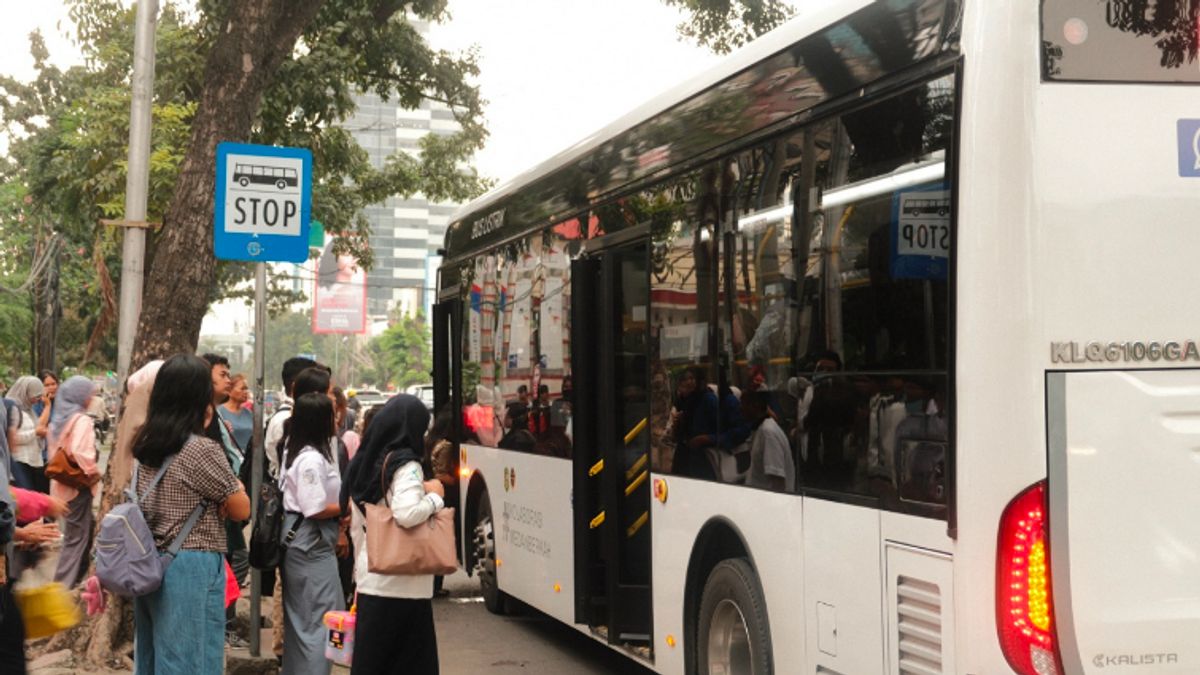


JAKARTA - The need for reliable public transportation is increasingly felt amid the increasing mobility of urban communities. For many people, access to public transportation is not just a choice, but an important part of daily activities.
But unfortunately in various cities in Indonesia, this service has not yet been fully present evenly and consistently.
Perhaps this is also what makes public transportation not the main choice of residents living in urban areas.
Departing from this problem, the Institute for Transportation and Development Policy held a Focus Group Discussion (FGD) on Monday, April 27, 2026, to encourage the strengthening of public transportation policies in Indonesia.
One of the things that stands out is the fact that until now, public transportation has not been fully considered as a basic service that must be provided by the local government.
This situation makes the development of public transportation in each city not uniform, because it depends very much on the priorities and capabilities of each local government. As a result, efforts to build a consistent, sustainable, and reliable transportation system still face various obstacles.
The FGD entitled Towards a Fair Transportation Energy Transition in Indonesia involves more than 40 stakeholders, ranging from the Ministry of Transportation, the Ministry of ATR/BPN, Bappenas, to Transjakarta, PT KCI, and PT MRT Jakarta. Discussions are divided into seven thematic groups that discuss various issues, ranging from service mandates, metropolitan area governance, to regional financing.
"This forum is designed not only as a discussion room, but as a first step to jointly identify issues that are truly urgent and need to be prioritized in Indonesia's future sustainable transportation agenda," said Deliani Siregar in a statement to VOI, Monday, May 4.
One of the important findings in the discussion was that there was no strong legal mandate for local governments to provide public transportation.
Unlike the education and health sectors, which have been included in the Minimum Service Standards (SPM), public transportation services such as city buses do not have similar obligations. As a result, the allocation of the budget for transportation is often less prioritized than other sectors, even in joint discussions with the DPRD.
This condition was once seen in Bali, when public transportation programs were halted because no local government continued. The impact is quite real as a number of students have to transfer schools because of increased transportation costs.
"Strengthening this mandate is important so that public transportation can be planned and funded more consistently, not only depending on short-term priorities, but as part of the services that the community needs," said Deliani.
"Without a clear mandate, public transportation will always be in a less priority position, even though its role is very important in supporting community mobility and city productivity."
In addition, inter-regional coordination is also a major challenge, especially in metropolitan areas such as Jabodetabek. Expansion of services such as Transjakarta to buffer areas is often hampered by differences in authority, financing, and the unclearness of the party leading cross-regional coordination.
On the other hand, cities such as Surabaya show enthusiasm in developing public transportation, but are still hampered by limited access to international funding that must go through the approval of the central government.
The issue of developing a transport-based area or Transit-Oriented Development (TOD) is also in the spotlight. Although this concept has been included in various planning documents such as RTRW and RDTR, its implementation in the field is still not consistent. In fact, without inclusive planning, TOD has the potential to trigger gentrification and push low-income people out of strategic areas.
Participants in the discussion assessed that without the support of housing subsidies and the involvement of residents from the beginning, the benefits of TOD would only be felt by certain groups.
In terms of financing, many areas outside Jakarta face structural challenges, ranging from limited APBD to a lack of technical capacity to access innovative funding schemes such as Land Value Capture (LVC) or green financing. In addition, the lack of a carbon certification mechanism in the transportation sector also closes the funding opportunities that other countries have actually used.
"In the future, public transportation needs to be positioned as the main foundation of urban mobility. With a stronger policy framework and cross-sector collaboration, we can ensure a more reliable, inclusive, and sustainable transportation system for the community," concluded Deliani.
The results of this discussion will later become input in the agenda of policies and dialogues of ITDP Indonesia with the government throughout 2026, including in efforts to encourage a revision of regulations so that public transportation has a stronger mandate at the regional level.
The English, Chinese, Japanese, Arabic, and French versions are automatically generated by the AI. So there may still be inaccuracies in translating, please always see Indonesian as our main language. (system supported by DigitalSiber.id)
Most Popular Tags
#Prabowo Subianto #donald trump #firearm #8791 #giias 2026Popular


