
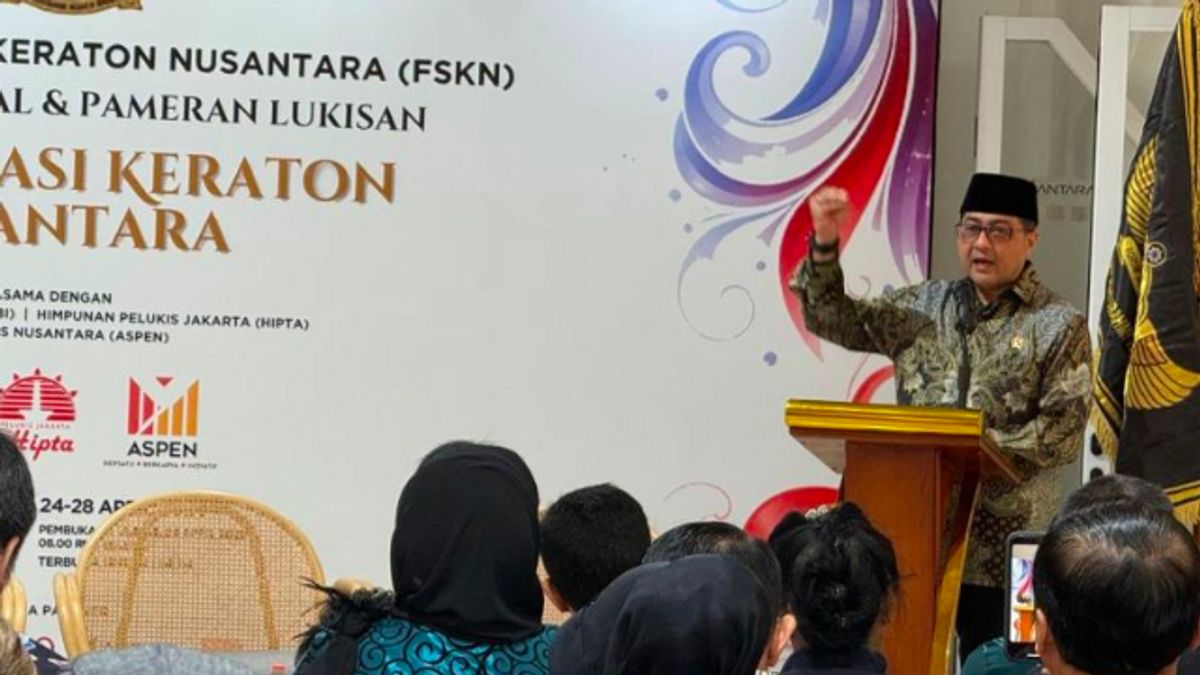


JAKARTA - Cultural heritage is not merely a relic of the past, but a foundation of identity that continues to live and needs to be maintained for its sustainability.
Moreover, in the midst of globalization and digitalization, values such as history, folklore, and local wisdom are actually important assets that can be developed not only as cultural symbols, but also as economic sources that are relevant to the times.
The Minister of Creative Economy, Teuku Riefky Harsya, assessed that the strength of the Nusantara culture can be processed into a sustainable economic potential if combined with innovation and technology.
"We will pass down the strong cultural roots, we will pass it on with a touch of innovation, technology, and creativity, and with the basis of this digital age, we can generate sustainable economic values, some of which are also to revive our journeys or histories," said Riefky in his speech. quoted by ANTARA.
He added, many countries with strong cultural foundations have managed to develop advanced creative industries by utilizing history as the main material. This transformation is visible in various sectors such as film, fashion, culinary, to games which ultimately open up new economic opportunities.
According to him, the richness of stories in Indonesia is an unlimited resource. With more than 500 regencies, each region has a unique narrative that can be developed into high-value creative products.
"The 514 districts will not run out of stories, in fact. From the story, the story is written, from there it can be a comic, it can be a film, it can be a souvenir, it can be an animated film, it can be a game, and so on," he said.
The role of various parties, ranging from the palace environment to the wider community, is considered important in maintaining and reviving these stories so that they remain relevant, both nationally and globally.
The government through the Ministry of Creative Economy also emphasized its commitment in encouraging the revitalization of the palace as part of the strategy to maintain the nation's identity while also driving the regional economy.
A collaborative or hexahelix approach involving communities, academics, governments, media, and financial institutions is seen as key to realizing these efforts on an ongoing basis.
"Because in fact, helping to revitalize the archipelago's palaces is not only providing funds, but this will actually turn around the regional economy, and also create jobs, increase regional income, so there are many multiplier effects," said Riefky.
In the future, the government will also open opportunities for cooperation with the Silaturahmi Keraton Nusantara Forum (FSKN) through various initiatives, including art exhibitions. This step is expected to be able to encourage the transformation of cultural heritage into economic power that is not only of historical value, but also has a direct impact on the social and economic life of the community.
The English, Chinese, Japanese, Arabic, and French versions are automatically generated by the AI. So there may still be inaccuracies in translating, please always see Indonesian as our main language. (system supported by DigitalSiber.id)


