
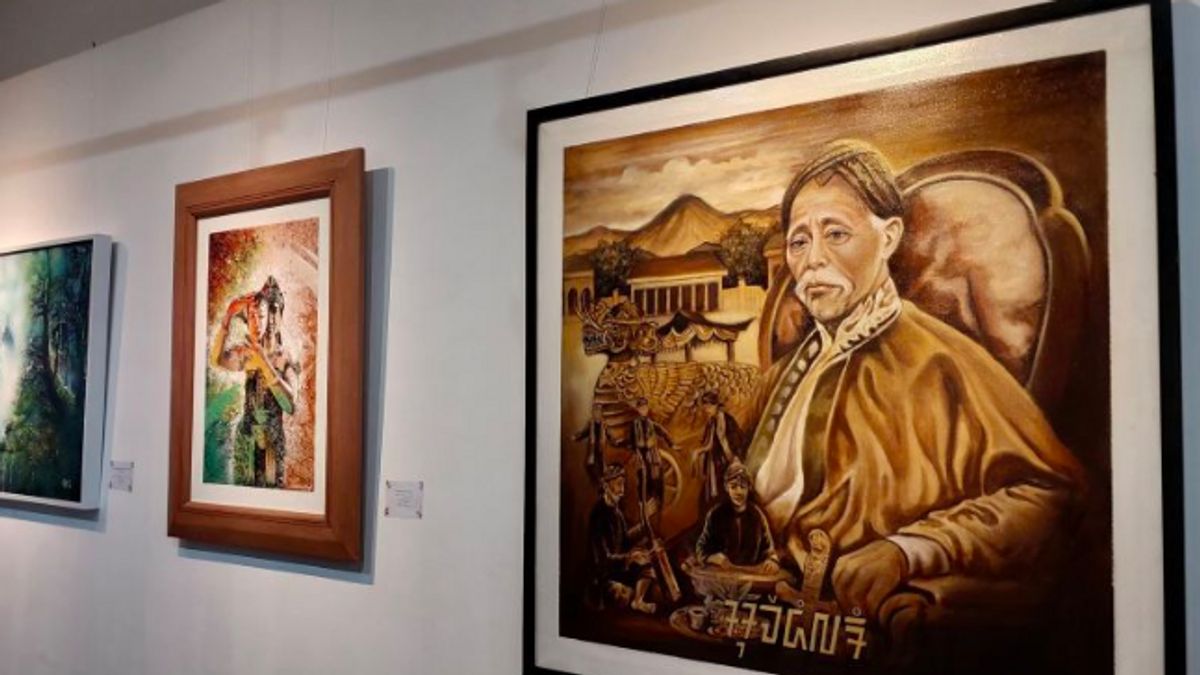


JAKARTA - The exhibition entitled Revitalization of the Keraton Nusantara is a reminder that cultural heritage is not only to be remembered, but also revived in the context of the present. Held at the Antara Heritage Center, this exhibition is a meeting space between visual art and efforts to care for the identity of the nation's culture.
This exhibition is the result of collaboration between the Keraton Nusantara Community Forum (FSKN) with artists from the Islamic Cultural Art Association (HSBI), the Jakarta Painters Association (Hipta), and the Nusantara Painters Association (Aspen). Through the medium of painting, the artists try to bring back the meaning of the palace as a symbol of civilization that once became the center of culture in the archipelago.
The Chairman of the National Seminar and Painting Exhibition Organizing Committee of FSKN, Dedi Yusmen, said that this exhibition was born from a collective awareness to preserve the roots of culture.
"We forget that the archipelago was once a kind of center of civilization and culture, because of the change of time, we forget what our basis is. Local wisdom has proven to be a contextual and high-precision system that eventually became the Republic of Indonesia," said Dedi at the opening of the exhibition.
The exhibition, which runs from April 24-28, features works from 44 Nusantara painters. Not only presenting a variety of visual styles, but also bringing together perspectives on the importance of reviving the values of the palace in the contemporary era.
The theme of revitalization is the common thread that connects each work. The palace is not only positioned as a historical object, but as a living entity that is relevant to be re-read by today's generation.
The General Chair of FSKN, AA Mapparessa, emphasized that the organization he leads is committed to continuing to synergize with the government in preserving cultural heritage in the midst of globalization.
"We choose to be strategic partners rather than the government, we have to maintain this neutrality because the sultan kings in their respective regions are cooling radiators, if there are conflicts, there is something that needs to be resolved," said Mapparessa.
Furthermore, he emphasized that this exhibition does not stop at the artistic aspect alone, but also becomes part of an effort to connect historical values with the development of time.
"What we are doing is not restoring the glory of the past kingdoms or kingdoms, but this is how the assets that exist in each kingdom, the sultanate are optimized so that they can become a source of foreign exchange that can help the community," he said.
The English, Chinese, Japanese, Arabic, and French versions are automatically generated by the AI. So there may still be inaccuracies in translating, please always see Indonesian as our main language. (system supported by DigitalSiber.id)


