

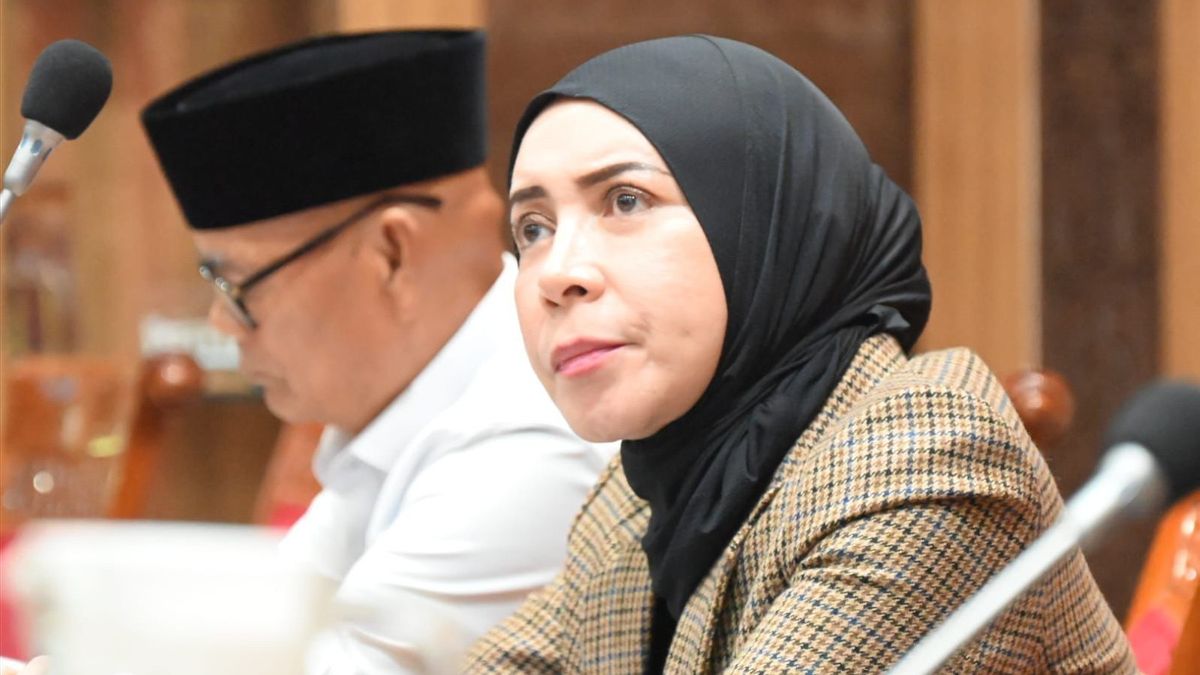


Member of Commission X of the Indonesian House of Representatives, Melly Goeslaw, encourages the National Education System Bill (RUU Sisdiknas) to provide a flexible legal basis for schools related to the curriculum. He assessed that the structure of subjects must be able to be added, reduced, or adjusted to the development of time, technology, and industry needs.
The proposal highlights the importance of providing space for the creative economy sector, digital entrepreneurship, content development, to technology-based businesses. Melly assessed that these materials should have been introduced to students from SMP to SMA/SMK.
According to Melly, the current national education system should no longer be rigid and only focus on the transfer of conventional knowledge. Education must be able to capture opportunities in new fields that will become the focus of the future of the younger generation as well as the engine of the country's economic growth.
"Schools must be a space that makes children dare to try, dare to fail, and dare to learn from mistakes. A healthy risk taker character is born from creative education," said Melly in his statement, quoted by VOI, Thursday, April 9.
The politician and well-known public figure in the country explained that the creative economy material can later be implemented as a special subject, optional content, or integrated into intra-curricular and extra-curricular activities according to the characteristics of each school.
In addition to honing future competencies, education that emphasizes creativity is considered to have a positive impact on stimulating students' brain development. Students will be more courageous to make decisions and be able to solve problems (problem solving) innovatively.
Melly added that the creativity space in the school environment is a crucial instrument for shaping children's more resilient, confident, and hopeful mental outlook for the future.
"Instead of children feeling depressed without a space for expression, creative education can actually be a way to find solutions, build confidence, and see failure as a learning process," he said.
Furthermore, learning creative economy from an early age will instill a foundation so that students are not only able to produce works or businesses. They are also encouraged to understand the morality, ethics of working, social responsibility, and their contribution to the national economy.
This approach, said Melly, is in line with the practices in various developed countries that have previously made entrepreneurship, design, innovation, and the creative industry as strategies to create the next generation at the secondary school level.
Through this proposal, the RUU Sisdiknas is expected not only to be a regulation that regulates the academic process, but also to be an ecosystem for the formation of productive generations.
"It is hoped that this ecosystem will be able to produce a generation that is creative, resilient, and truly a problem solver for the nation," he concluded.
The English, Chinese, Japanese, Arabic, and French versions are automatically generated by the AI. So there may still be inaccuracies in translating, please always see Indonesian as our main language. (system supported by DigitalSiber.id)
Popular


