
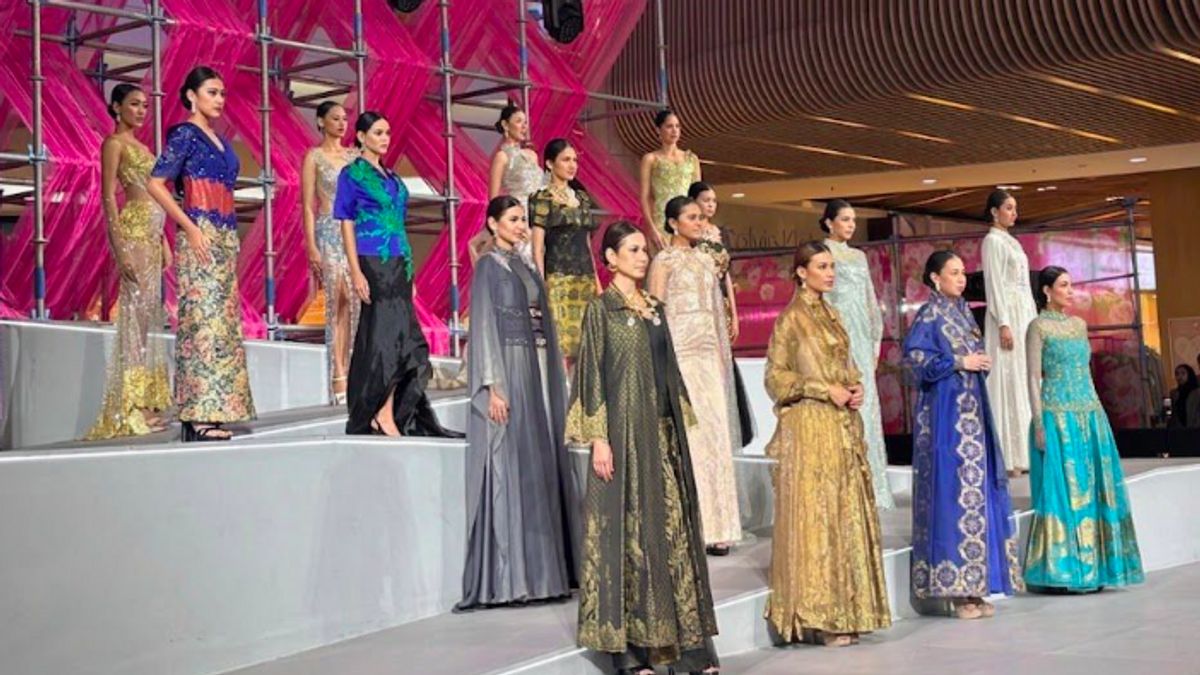


JAKARTA - The concept of halal cloth in Indonesia has begun to receive attention as people's awareness of products that are not only fashionable, but also in accordance with religious and ethical values.
In general, halal fabrics refer to textiles that are free from non-halal materials and processed in a clean and responsible manner. Not only that, this concept is also often associated with the principle of thayyib, which is good and safe, including the use of environmentally friendly materials such as cotton or other natural fibers.
Chairman of the Indonesian Fashion Designer Association (APPMI), Poppy Dharsono, revealed that the concept of halal fabrics has been introduced to the international stage in recent years. In fact, this concept-based work has been shown in world fashion cities such as London, Milan, and Paris.
"Two years ago we brought the concept of halal fabric to London, Milan, and Paris. With the large population of Indonesia and the majority of Muslims, this is a big potential if we can develop it," Poppy said at the closing ceremony of the Ramadan Runway 2026 in Kota Kasablanka, Jakarta, recently.
Halal fabrics generally refer to textiles that do not use non-halal materials, such as prohibited animal derivatives or materials with unclear sources.
All of the production processes are clean and ethical, starting from the use of dyes, finishing processes, to adhesive materials that are guaranteed to be free from haram elements.
Furthermore, the concept of halal fabrics is also often associated with sustainability aspects, for example through the use of natural materials such as cotton, linen, or bamboo fiber, as well as efforts to recycle textile waste to be more environmentally friendly.
According to Poppy, with a very large Muslim population, Indonesia has a potential market for halal value-based fashion products. This halal fabric can also be very relevant in the textile or fashion market.
"Halal fabrics can also mean eco-friendly fabrics. For example, from cotton that is usually discarded, then processed back into yarn," he explained.
Efforts to introduce this concept to the global market have also shown a fairly positive response. Poppy said that the presentation of halal fabrics in London alone was able to reach millions of pairs of eyes, showing that the international market is beginning to open up to value-based innovations like this.
The existence of halal labels also gives Muslim consumers a sense of security, especially for religious needs such as Hajj and Umrah. This is considered an added value that many global fashion products do not have.
Furthermore, Poppy emphasized that Muslim fashion is not just about trends, but has great potential as an economic driver. According to him, the large domestic market should be maximized by local industry players.
"Muslim fashion is not just a matter of trends, but also the economy. We must be able to host our own market," he said.
Amid the prevalence of fast fashion dominance that is difficult to match, he encourages local fashion designers to seek a different approach, one of which is by strengthening the cultural identity and halal values in every work.
Through various initiatives such as Ramadan Runway, APPMI strives to strengthen collaboration and solidarity among Muslim fashion industry players. With a network that now includes 21 branches and around 400 designers, this ecosystem is expected to have a broad impact on the development of the national fashion industry.
"This is our own market. We must be able to create designs that are rooted in culture and have halal values for the community," he added.
In the future, Poppy is optimistic that the Indonesian modest fashion industry will continue to grow, especially with the support of collaboration between industry players and creative spaces such as shopping centers that are a meeting place for designers and consumers.
The English, Chinese, Japanese, Arabic, and French versions are automatically generated by the AI. So there may still be inaccuracies in translating, please always see Indonesian as our main language. (system supported by DigitalSiber.id)


