
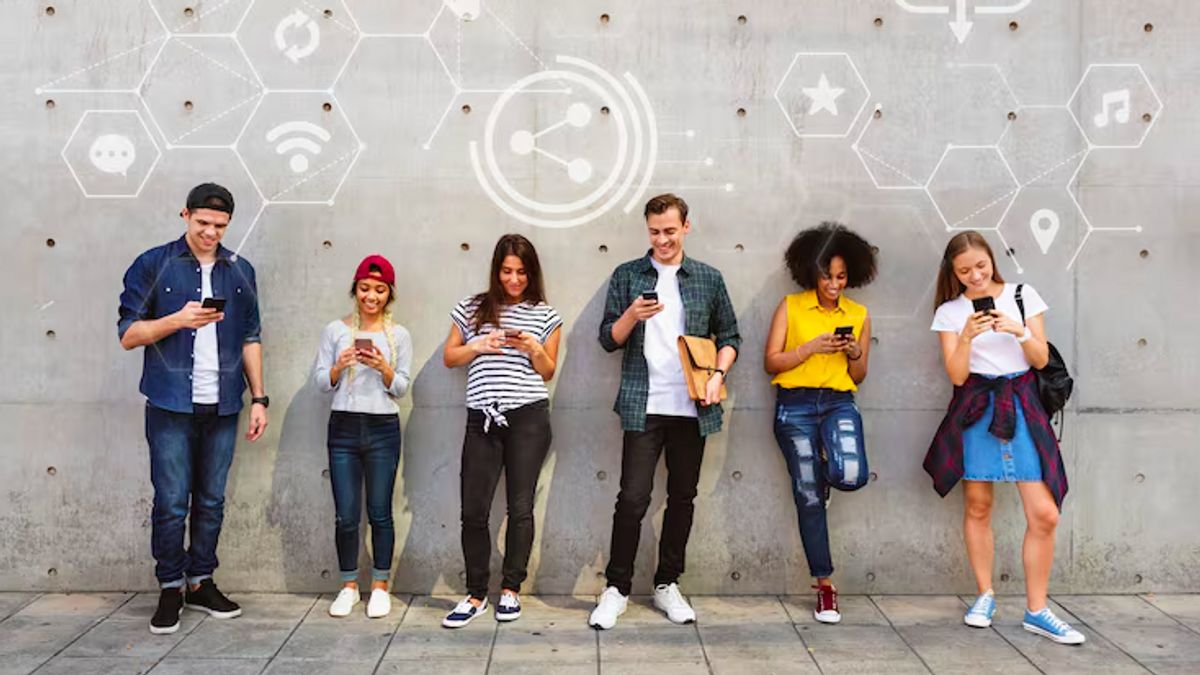


JAKARTA - Mobile phones, applications, and various digital services are now part of daily routines. Many people start the day by checking emails, uploading photos to social media, to organizing work and finances through various digital applications.
Technology that was once only used in the office has now merged with modern lifestyles. However, the increasing number of activities that move to the digital space also means that more and more personal data is stored in it.
Behind this ease, the public needs to be aware that currently there is a new challenge of cyber security threats which also develop along with technological advances, including artificial intelligence (AI).
AI technology, which has been known to help increase work efficiency, has also been used by cyber criminals to develop more sophisticated attack methods.
According to Clara Hsu, Indonesia Country Manager at Synology Inc., the development of AI has significantly changed the way cyber attacks are carried out today.
"Previously, cyber attacks were heavily dependent on manual efforts. Now AI allows attackers to automate attacks and run them on a large scale, so that the threat becomes more sophisticated and more difficult to detect by organizations," he explained.
This change is seen from several types of attacks that are increasingly evolving, such as phishing, credential data theft, and ransomware.
Phishing is actually not a new method in the world of cyber security. For years, fake emails have been used to trick users into providing important information such as passwords or personal data.
In the past, these kinds of messages were relatively easy to recognize because they often contained spelling errors or sentences that felt awkward. However, now, AI technology makes these fraudulent messages much more convincing.
With the help of AI and machine learning, attackers can create emails that look authentic and feel more personal. They can even use public information from social media, company websites, or professional profiles to target someone more specifically.
Instead of general messages, victims can receive emails that mention their positions, projects they are working on, even the names of colleagues.
"AI removes many warning signs that people used to use to recognize phishing. Messages sent can sound natural, professional, and contextual," said Clara.
This level of personalization makes phishing attacks increasingly difficult for users to recognize. Meanwhile, another threat that is also developing is the theft of digital account credentials.
With the help of AI, attackers can analyze common password patterns and try out various possibilities automatically in a short time. In some cases, they even try to imitate the user's behavior patterns so that their activities are not detected as suspicious.
If access is successfully obtained, the impact can spread quickly. Hacked accounts can be used to access sensitive data, explore internal systems, and become an entry point for other attacks such as ransomware.
Ransomware attacks themselves are also growing. If previously malware directly locked files after successfully entering the system, now some modern variants actually choose to hide first.
During this period, the attacker studied the network environment and identified the most valuable data before launching the attack.
"Attacks like this are becoming more planned. Cybercriminals are not only focused on getting into the system, but also maximizing the impact after they have gained access," explained Clara.
To respond to this cybercrime threat, the public needs to be aware of the security of personal data. It is also becoming increasingly important. Not a few people now store various important information on their digital devices and accounts, ranging from work documents to financial data.
Therefore, simple habits such as being more careful when receiving emails or messages that ask for personal information, not carelessly clicking on links, and using strong passwords can help reduce the risk of data misuse.
If Digital Data is Attacked, What Can Be Done?
As cyberattacks become more sophisticated, traditional security approaches alone are no longer enough. Even organizations with strong security systems are still potentially vulnerable to security breaches.
Therefore, many cybersecurity experts now emphasize the importance of cyber resilience, not just prevention. This concept focuses on the ability of organizations to continue to operate and recover quickly after an attack.
One of the most frequently recommended ways is to ensure that important data has a backup stored in a different place. For example, the 3-2-1-1-0 backup strategy, which is to store multiple copies of data in different storage environments, including backups that are immutable or isolated.
(3-2-1-1-0 Backup Strategy, doc. Synology Inc.)
This way, we don't have to panic because if the main data is lost, locked, or damaged due to an attack, there is still a copy that can be restored.
"Backup is often the last line of defense when a cyber incident occurs. If an organization can quickly recover clean data, the impact of ransomware can be significantly reduced," he said.
Then activating additional security layers such as two-step verification is also a step that is increasingly relevant in the midst of increasing cyber threats.
Currently, technological developments will continue to bring convenience to daily life. However, at the same time, vigilance against digital security is also an important part of modern lifestyles.
"AI is changing the world of cybersecurity. The question is no longer whether attacks will become more sophisticated, but whether organizations are ready to respond to them," concluded Clara.
The English, Chinese, Japanese, Arabic, and French versions are automatically generated by the AI. So there may still be inaccuracies in translating, please always see Indonesian as our main language. (system supported by DigitalSiber.id)


