
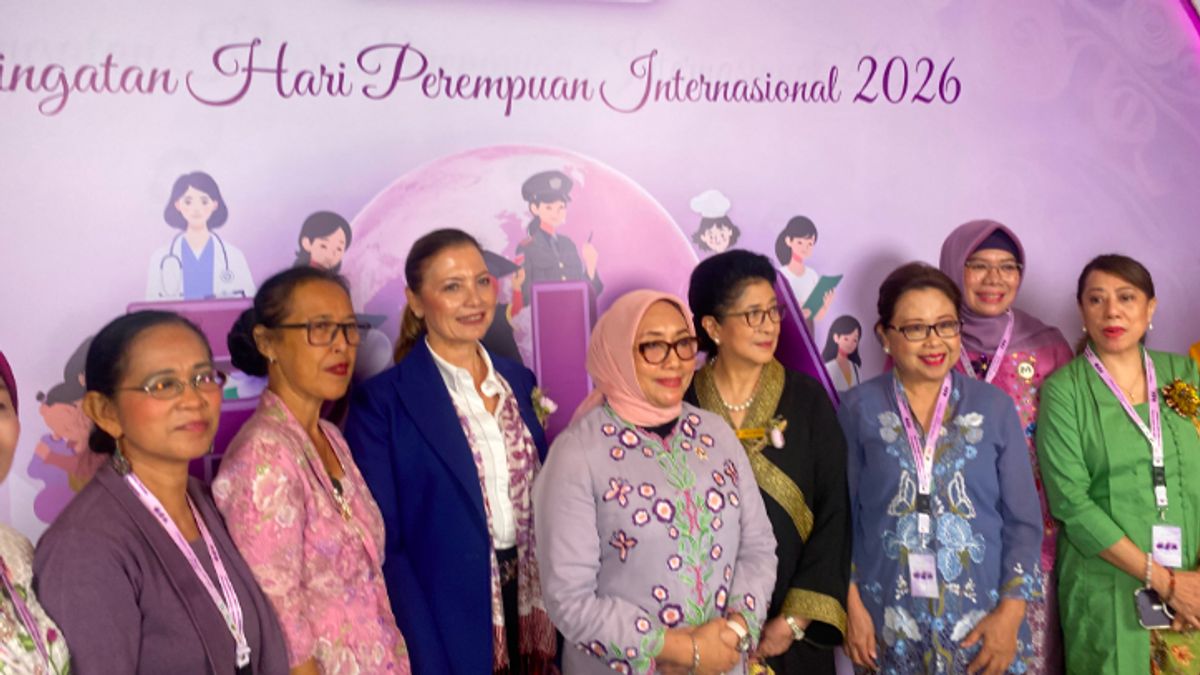


JAKARTA - The commemoration of International Women's Day 2026 is an opportunity to reaffirm the role of women in development, especially in the fields of education, health, and leadership.
This was conveyed in a Women's Forum entitled "Rights. Justice. Action. From Rights to Action for All Women and Girls".
The forum, which was held by the Farid Nila Moeloek Society together with Takeda Innovative Medicines, was a space for dialogue to discuss strategies to strengthen the role of women in human development through increased access to education and health literacy.
The founder and chairman of the FNM Society, Nila Moeloek, emphasized that women's empowerment is closely related to improving the quality of public health.
"When women have access to health information, resources, safe environments, and opportunities to participate in decision-making, women are able to make better decisions regarding their health, their families, and their communities," said Nila at the Raffles Jakarta Hotel, Tuesday, March 10, 2026.
He added that women's leadership plays a role in bridging the gap between policy and implementation of health programs.
"Empowering women in the health sector not only provides benefits for individuals, but also strengthens the health of families and the community at large," he said.
Minister of Empowerment of Women and Child Protection, Arifatul Choiri Fauzi, said that the pressure for women's progress must begin by providing basic rights, including education.
"The advancement of women must begin by providing basic rights, followed by justice, and realized through concrete actions in sustainable development policies and programs," said Arifatul.
According to him, gender equality is the main principle of inclusive development.
"Gender equality means that women and men have equal rights, opportunities, access, participation and control over resources and benefits of development," he explained.
He also emphasized that the impact of equality on education would be felt more widely by families and communities.
"When women have equal opportunities to participate in various sectors of life, the impact is not only felt by the women themselves, but also by families, communities, and the country," he said.
Although Indonesia's gender development index continues to increase, challenges still exist. The rate of women's participation in the workforce is still around 56 percent, while cases of violence against women and children are still a serious problem.
"Data that shows violence against women and children is still a serious problem and requires joint attention," said Arifatul.
The Chairperson of Commission IV of the Indonesian House of Representatives, Siti Hediati Soeharto or Titiek Soeharto, assessed that investing in women is a sustainable development strategy.
"When women are given equal space, opportunity, access, and support, then what grows is not only individuals, but families, communities, and civilizations," he added.
He also emphasized that recognition of rights alone is not enough.
"Rights without justice are only texts, justice without action is only rhetoric, and action without impartiality will lose its direction," he said.
According to him, education is the key to opening opportunities for women.
"We need consistent affirmative policies, equal access to education and literacy, balanced economic opportunities, and firm and effective legal protection," he concluded.
Titiek Soeharto also reminded that Indonesia's future depends on the quality of women and children today.
"If we talk about Indonesia Emas 2045, then what we are talking about is actually the quality of women and children today," he said.
He added that there are still many girls who have to leave education because of poverty and early marriage.
"This is not merely a social issue. This is a public policy responsibility and a mirror of our partisanship as a nation," he said.
This forum also highlights the importance of increasing women's participation in leadership. 2024 Election data shows that women's representation in the DPR reached around 21.9 percent or 127 members out of a total of 580 parliamentarians, the highest achievement since the reform, although it is still below the 30 percent target.
"When women are involved in decision-making, public policies tend to be more responsive to basic community needs such as health, education, nutrition, and social protection," he said.
The Women's Forum emphasized that women's empowerment requires collaboration from various parties, ranging from the government, parliament, business world, academics to civil society.
"Empowering women means strengthening the family, and strengthening the family means building the nation," said Titiek Soeharto.
This year's International Women's Day momentum is a reminder that women's struggle does not stop at the recognition of rights, but must be realized through justice and concrete action for a more equal future for Indonesian women and girls.
The English, Chinese, Japanese, Arabic, and French versions are automatically generated by the AI. So there may still be inaccuracies in translating, please always see Indonesian as our main language. (system supported by DigitalSiber.id)
Popular


