


JAKARTA - In the modern world of work, which is fast-paced and competitive, women are often at the crossroads of various demands. They can be decision makers in the meeting room, as well as the main support for families at home.
There are also those who have to prove themselves harder in an environment that is still dominated by hierarchical culture or gender stereotypes. These challenges do not stand alone, but intersect to form a different professional experience for each individual.
This is where the concept of intersectionality becomes relevant. Intersectionality helps us understand that women's experiences in the workplace cannot be generalized.
The term intersectionality itself has recently been talked about, especially when discussing equality and leadership. This is a way of understanding that everyone has diverse identities such as gender, age, social background, education, to economic conditions that intersect and shape their life experiences.
In the context of today, this approach is relevant because the professional world is no longer homogeneous. The challenges that a person faces at work are often not stand-alone, but rather the result of the various layers of identity that are attached to him.
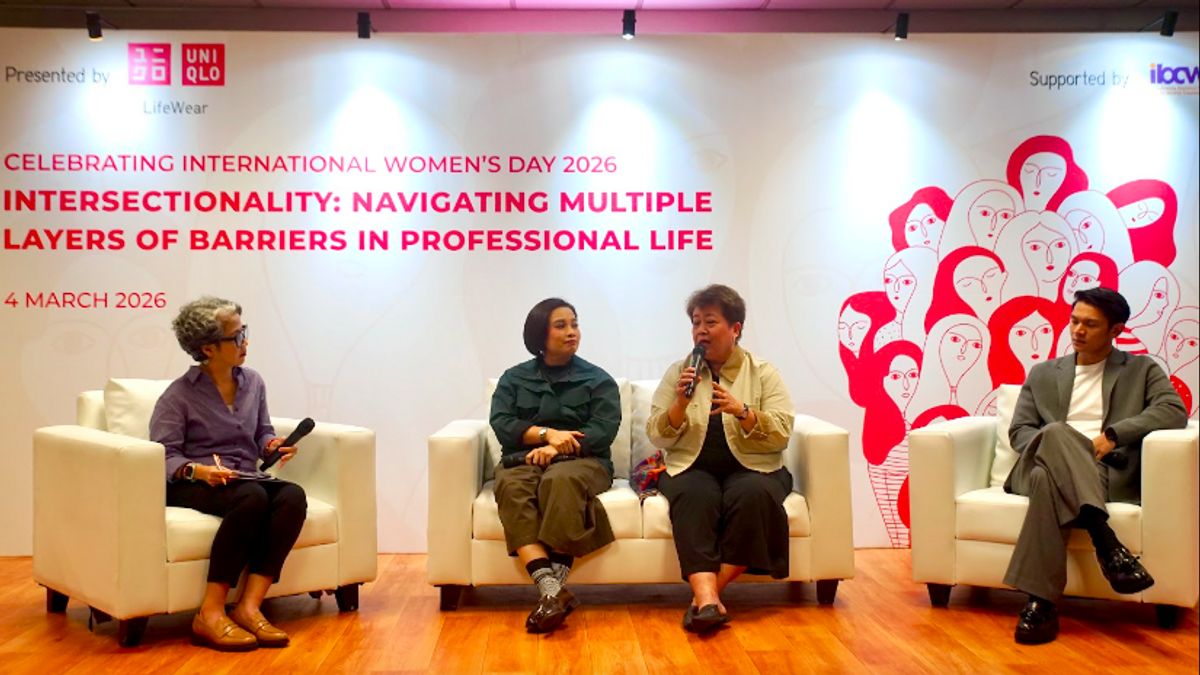
Departing from this understanding, the Japanese global retail company, UNIQLO, is collaborating again with the Indonesia Business Coalition for Women Empowerment (IBCWE) in the context of the 2026 International Women's Day.
This collaboration was realized through a discussion entitled "Intersexuality: Navigating the Various Layers of Barriers in Professional Life", which invited the public to see inclusive leadership from a broader and contextual perspective.
One example is in the increasingly dynamic world of work, where issues of targets and performance are often the main focus. However, there is an important aspect that is often missed by each individual bringing more than one identity to the professional space.
A woman can hold a strategic role in the office while being a caregiver at home. A young professional may face different challenges due to unequal social backgrounds or educational access. An intersectional perspective helps companies understand that employee experiences cannot be generalized.
This discussion presents a number of cross-sector speakers, namely Irma Yunita (Director of Corporate Affairs UNIQLO Indonesia), Fetty Kwartati (Director of PT Tara Naya Karsa), Rhaka Ghanisatria (Co-Founder of Becoming Human), and Wita Krisanti (Executive Director of IBCWE). They discuss how the complexity of identity, especially for women, affects career journeys and leadership opportunities.
Although many companies have implemented Diversity, Equity & Inclusion (DEI) policies, an intersectional approach encourages a deeper approach. Companies cannot simply ensure representation, but also need to understand how factors such as gender, age, and socio-economic background affect a person's work experience.
This approach requires the sensitivity of leaders in reading the context and making fair decisions.
Various global studies show that organizations with diverse and inclusive leadership tend to be more innovative and have better performance. This means that inclusion is not just a social discourse, but part of a long-term business strategy. In Indonesia, conversations about inclusive leadership are indeed continuing to grow, even though they are still faced with the challenge of hierarchical culture and unconscious bias.
During the discussion session, the speakers were asked to share the meaning of inclusiveness from their respective perspectives. Irma Yunita emphasized that inclusion does not stop at the number of representations.
"Diversity is not just about representation. It's about whether everyone really has the space to develop and contribute authentically. In a fast-moving retail industry, maintaining a balance between performance and inclusive leadership is challenging. But it's where leadership qualities are tested," he said.
As part of a global company, UNIQLO Indonesia implements a competency-based employee evaluation and development system as well as performance. Access to leadership training is also open to various levels, including women and young talent.
In addition, the company encourages open dialogue between management and employees to create a mutually respectful work environment, while still referring to global standards that uphold the principle of equality.
The discussion also highlighted the importance of organizational allyship - the active role of individuals, particularly leaders, to be allies for colleagues with different backgrounds.
Being an ally does not mean always having a solution, but rather showing a willingness to listen, learn, and correct biases that may not be realized. The practice can be seen from the division of speaking opportunities in meetings, flexible work policies, to the courage to challenge non-inclusive assumptions.
Through the momentum of International Women's Day, UNIQLO Indonesia invites professionals to see inclusive leadership as a long-term investment, not just an annual agenda. When a person does not have to hide his identity to be accepted, that is where the best potential can grow for individuals, teams, and organizations as a whole.
The English, Chinese, Japanese, Arabic, and French versions are automatically generated by the AI. So there may still be inaccuracies in translating, please always see Indonesian as our main language. (system supported by DigitalSiber.id)


