
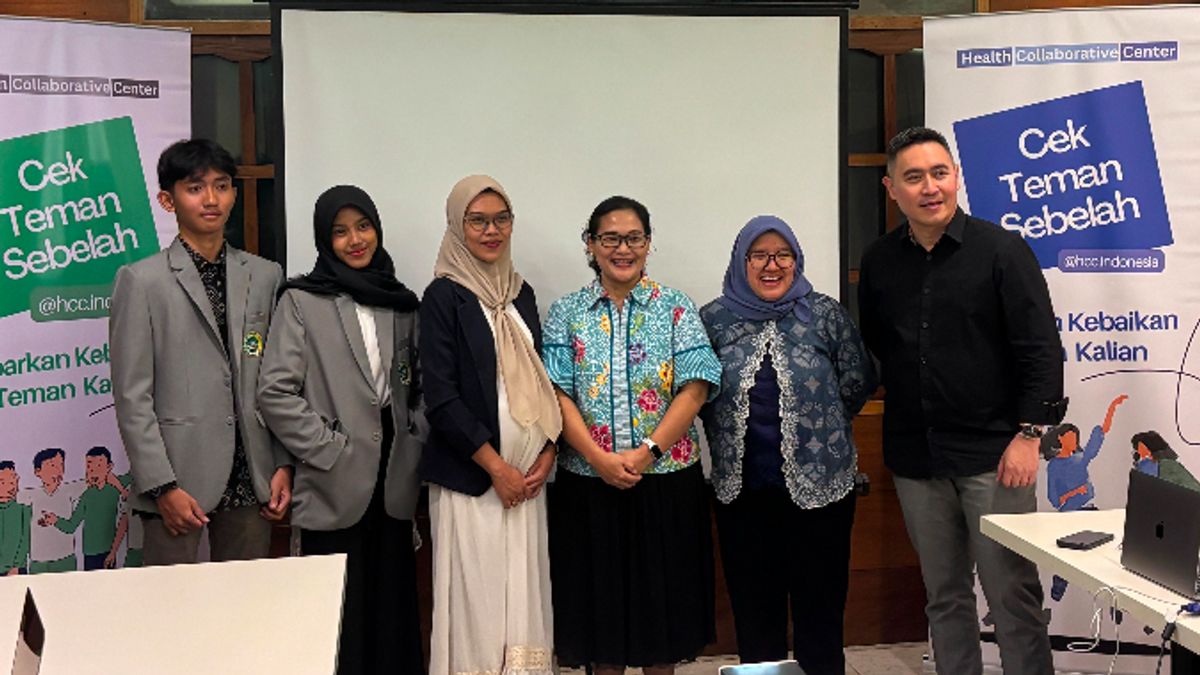


JAKARTA - Cultivating empathy among adolescents is not merely a moral discourse, but a real need in the midst of increasingly complex social life.
Young people are accustomed to seeing and recognizing the goodness around them, they learn that the world is not only filled with competition, but also a space to strengthen each other. Especially in the school environment, simple habits such as giving appreciation, caring, solidarity, and social ties can create a healthier environment.
At a time when public narratives often label Indonesian teenagers as a fragile generation and prone to mental problems, a school-based social experiment actually shows a different side. The results show that Indonesian students have strong prosocial and empathic potential and this potential can be strengthened through simple and structured interventions.
The CekTemanSebelah 2.0 program entitled "Report the Goodness of Friends" initiated by the Health Collaborative Center (HCC) is one of the proofs.
This experiment was led by the Team Leader and HCC Chairman, Ray Wagiu Basrowi, together with the HCC Executive Director, Bunga Pelangi. Through the "tootling" method or the habit of reporting positive peer actions for 10 days, this program was able to significantly increase students' empathy and prosocial behavior.
A total of 699 high school students in Jakarta were involved in this intervention, with 541 students completing the program in full. Evaluation results showed that students who actively reported their friends' kindness had empathy levels up to five times higher, prosocial behavior five times stronger, and almost four times better in the ability to understand others' points of view (perspective-taking).
According to Ray, this approach is inspired by the practice of character education in a number of developed countries that have included the tootling method in the basic curriculum. In just 10 days, 4,710 reports of goodness were collected showing a significant doubling effect of a simple intervention.
"In fact, 8 out of 10 students feel positive changes after participating in the program. Those who actively report the good have 11 times more opportunities to feel positive changes", said Ray in Jakarta, recently.
Another interesting data shows that 77 percent of students report kindness as a form of thanks, 71 percent as appreciation, 50 percent as a return, 41 percent to inspire other friends, and 34 percent so that the kindness is known more widely.
Another finding showed that female students have a much greater tendency to report kindness to their fellow women, illustrating a social dynamic that could be considered in the development of follow-up programs.
In terms of mental health, this program measures six aspects of adolescents' emotions, including emotional symptoms, behavioral problems, hyperactivity, peer relationships, difficulty scores, and prosocial, as well as aspects of empathy using the Interpersonal Reactivity Index.
The Clinical Psychologist of the Ciracas Health Center, Sulastry Pardede, explained that the habituation of prosocial behavior through this method is able to increase empathy and solidarity, reduce self-inconvenience, form a more positive social response, and strengthen peer relationships.
"Not only does it increase empathy and solidarity, when teenagers can focus on the good of their friends, then that behavior makes them do good as well. The term is that the value of goodness is transmitted, so that the risk of crime or the risk of bad deeds can be reduced," explained Sulastri.
Strategically, the CekTemanSebelah 2.0 social experiment shows that by getting students to report their friends' kindness for 10 days, empathy can increase up to five times, prosocial behavior strengthens five times, and the ability to understand others' perspectives increases four times.
Amid growing concerns about adolescent mental health, a strengths-based approach like this proves that solutions don't always have to be complicated or expensive. Schools can be an effective space to promote mental health through a culture of appreciation.
Support also came from the guidance counselor of MAN 2 East Jakarta, Naeni Rohmawati, S.Pd. He admitted that he saw a real change in the classroom during the program. Students who were previously passive began to dare to appreciate their friends, the classroom atmosphere felt warmer, and the interaction became more emotionally supportive.
A similar experience was shared by Donita Putri Shanum, a student in class X-D. At first he thought this activity was just a normal writing assignment, but after doing it, he realized that there were many small benefits that were often missed.
For him, appreciating friends not only makes others feel valued, but also cultivates a positive feeling in oneself.
Muhammad Khoirul Anam, a student in grade XI-G, also felt the impact. He assessed that this program made students more sensitive to good things that were previously considered trivial. When the goodness is recorded and appreciated, the friendship relationship feels stronger and more appreciative.
This experiment confirms one important thing: empathy can be trained, and kindness can become a culture. With the right space and consistent habits, Indonesian teenagers are not only able to grow into a strong generation, but also a generation that takes care of and strengthens each other.
The English, Chinese, Japanese, Arabic, and French versions are automatically generated by the AI. So there may still be inaccuracies in translating, please always see Indonesian as our main language. (system supported by DigitalSiber.id)


